
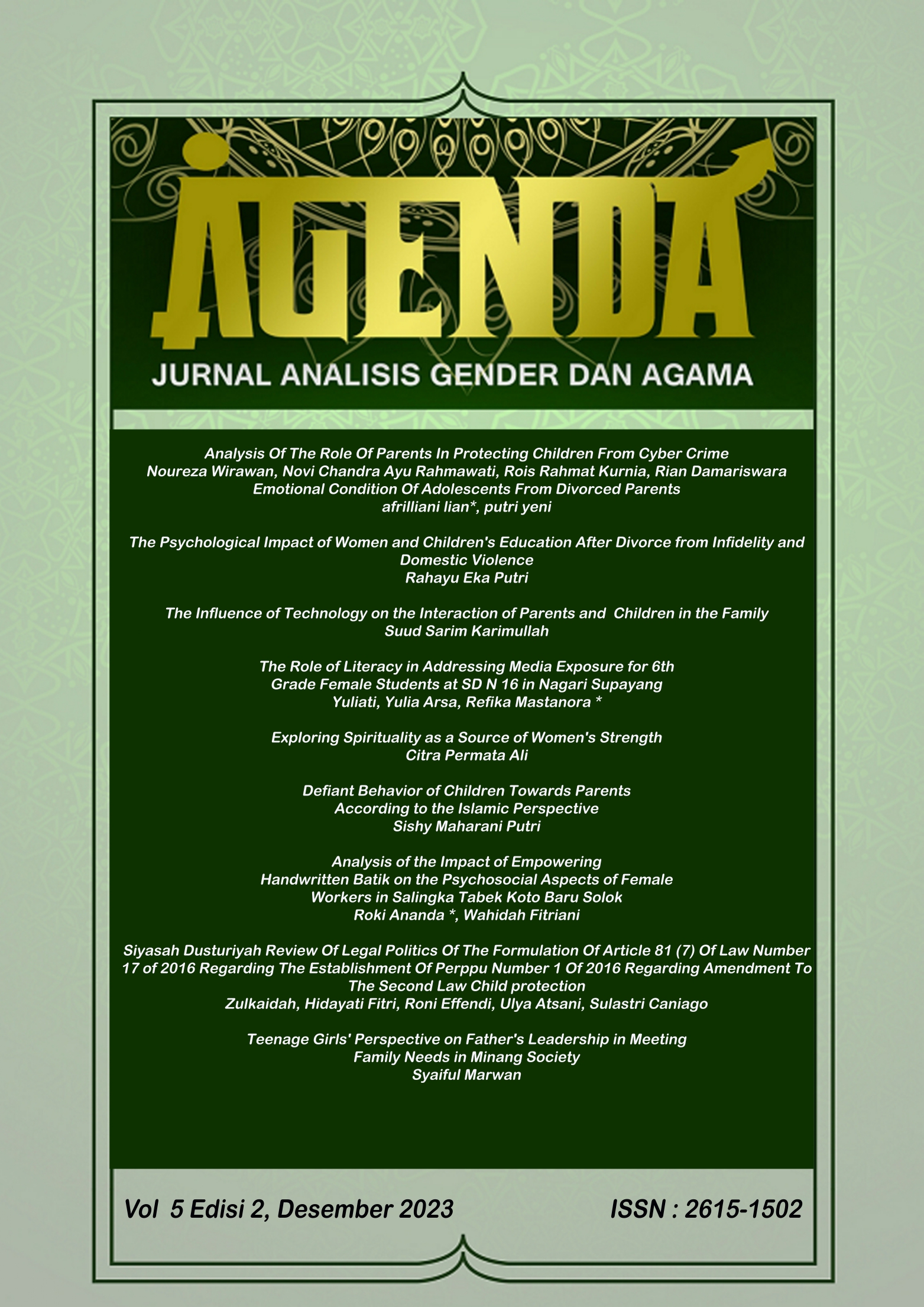
Teenage Girls' Perspective on Father's Leadership in Meeting Family Needs in Minang Society
DOI:
https://doi.org/10.31958/agenda.v5i2.10919Keywords:
Perempuan, Ayah, Kebutuhan, Keluarga.Abstract
Leading the family is the responsibility of a father as the head of the household. Thus, the head of the family carries significant responsibilities in meeting the needs of the family. The purpose of this research is to obtain a descriptive narrative from teenage girls regarding the duties and responsibilities of fathers in providing for the family in the Minangkabau community. The method used is qualitative descriptive, with the population and sample being students. The results obtained describe how fathers fulfill the family's needs in terms of clothing, food, and shelter. Additionally, data was collected on how fathers meet the social needs of a child in their environment. The conclusion drawn is that fathers in Minang, according to teenage girls, are capable of meeting the family's needs, but there is also considerable support from mothers in fulfilling these needsReferences
Al-Makassary, R. (2020). Dioalog Antar Agama Untuk Perdamaian: Bagi Para Pimpinan Agama Akar Rumput. Lembaga Perdamaian Indonesia (LPI).
Argomaniz, J., & Lynch, O. (2018). Introduction to the Special Issue: The Complexity of Terrorism—Victims, Perpetrators and Radicalization. Studies in Conflict & Terrorism, 41(7), 491–506. https://doi.org/10.1080/1057610X.2017.1311101
Arto, M. (2005). Praktek Perkara Perdata Pada Pengadilan Agama. Pustaka Pelajar.
Az-Zuhaili, W. (2011). Fiqih Islam Wa Adillatuhu. Gema Insani.
Badan Pusat Statistik Kota Surabaya. (2015). Geografi Provinsi Jawa Timur. Surabayakota.Bps.Go.Id.
Badan Pusat Statistik Kota Surabaya. (2016). Tempat Ibadah di Surabaya. Surabayakota.Bps.Go.Id.
Badan Pusat Statistik Kota Surabaya. (2019a). Banyaknya Pemeluk Agama Menurut Jenisnya (Jiwa). Surabayakota.Bps.Go.Id.
Badan Pusat Statistik Kota Surabaya. (2019b). Luas Daerah dan Jumlah Pulau Menurut Kecamatan. Surabayakota.Bps.Go.Id.
Badan Pusat Statistik Kota Surabaya. (2021). Hasil Sensus Penduduk 2020 Kota Surabaya. Surabayakota.Bps.Go.Id.
Badan Pusat Statistik Provinsi Bali. (2018). Penduduk Provinsi Bali Menurut Agama yang Dianut Hasil Sensus Penduduk 2010. Bali.Bps.Go.Id.
Badan Pusat Statistik Provinsi Bali. (2021). Penduduk Bali Hasil Sensus Penduduk, 1961-2020. Bali.Bps.Go.Id.
Badan Pusat Statistik Provinsi Bali. (2022a). Banyaknya Pemuka Agama Menurut Agama dan Kabupaten/Kota di Provinsi Bali, 2021. Bali.Bps.Go.Id.
Badan Pusat Statistik Provinsi Bali. (2022b). Banyaknya Tempat Peribadatan Menurut Kabupaten/Kota di Provinsi Bali, 2021. Bali.Bps.Go.Id.
Badan Pusat Statistik Provinsi Bali. (2022c). Luas Wilayah, Nama Ibukota Kabupaten/Kota, dan Jumlah Pulau Menurut Kabupaten/Kota di Bali, 2021. Bali.Bps.Go.Id.
Bela, D. R. S., Nurmandi, A., Muallidin, I., & Kurniawan, D. (2021). Meta-Analysis the Root of Terrorism from the Perspektif Islamic Movement in Indonesia. AL-IHKAM: Jurnal Hukum & Pranata Sosial, 16(2), 393–420. https://doi.org/10.19105/al-lhkam.v16i2.4817
Creswell, J. W., & Creswell, J. D. (2018). Research design: qualitative, quantitative, and mixed methods approaches (Fifth edit). SAGE.
Faisol, M. (2019). Hukum Islam dan Perubahan Sosial. JURIS (Jurnal Ilmiah Syariah), 18(1), 33–44. https://doi.org/10.31958/juris.v18i1.1397
Fatwa, F. (2022). Interview with Lecturers at Widya Mandala Catholic University Surabaya and Priests in Surabaya.
Fikri, F. (2018). Transformasi Nilai Al-Islah Terhadap Keberagaman Konflik: Epistemologi Hukum Islam dalam Al-qur’an. Al-Risalah: Forum Kajian Hukum Dan Sosial Kemasyarakatan, 16(02), 201–216. https://doi.org/10.30631/alrisalah.v16i02.308
García Magariño, S., & Jiménez-Ramos, M. (2022). An Attempt at a Theoretical Explanation of Violent Islamist Radicalization in Spain. Religions, 13(3), 209. https://doi.org/10.3390/rel13030209
Ghazali, A. M. (2007). Prakarsa Perdamaian, dalam Inisiatif Perdamaian Meredam Konflik Agama dan Budaya. Lakpesdam.
Hamzah, A. (2019). Penelitian Berbasis Proyek Metode Kuantitatif, Kualitatif dan R&D Kajian Teoritik & Contoh-contoh Penerapannya. Literasi Nusantara.
Harahap, N. (2020). Penelitian Kualitatif. Wal ashri Publishing.
Herimanto, & Winarno. (2008). Ilmu Sosial & Budaya Dasar. Bumi Aksara.
Intan, B. F., & Bangun, C. (2022). Principled Pluralism and the Prevention of Religious Terrorism in Indonesia. Religions, 13(5), 429. https://doi.org/10.3390/rel13050429
Ismail. (2022). Interview with Head of Tuban Village Staff.
Jayli, H. (2022). Interview with the Director of TV9 Nusantara Surabaya City.
Junaidi, & Ardiya. (2021). Radicalism in the Reality Construction of Indonesian Media. Webology, 18(1), 360–370. https://doi.org/10.14704/WEB/V18I1/WEB18094
Kachan, K. (2018). Evolution of Islamic Radicalism during the 19th to 21st Centuries. Journal for the Study of Religion and Ideologies, 17(49), 105–119. http://jsri.ro/ojs/index.php/jsri/article/view/922
Kementerian Agama Republik Indonesia. (2014). Radikalisme Agama & Tantangan Kebangsaan. Direktorat Jenderal Bimbingan Masyarakat Islam Kementerian Agama RI.
Khoiri, N. (2019). Radikalisme Agama dalam Pandangan Elit Muhammadiyah dan Nahdlatul Ulama. Southeast Asian Publishing.
Kusharyadi, S., & Dawan, A. (2021). Transformasi Budaya NTT: Refleksi Aktor Sebagai Upaya Mengatasi Kemiskinan dan Menaikkan IPM (Indeks Pembangunan Manusia). Jurnal INADA: Kajian Perempuan Indonesia Di Daerah Tertinggal, Terdepan Dan Terluar, 4(1), 1–27. https://doi.org/https://doi.org/10.33541/ji.v4i1.3777
Laila, N. Q., & Irwan Abdullah. (2022). Questioning Fiqh Muamalah of Toleration: Religious Spatial Segregation in the Urban Area of Yogyakarta. AL-IHKAM: Jurnal Hukum & Pranata Sosial, 17(1), 28–59. https://doi.org/10.19105/al-lhkam.v17i1.5419
Leavy, P. (2017). Research Design: Quantitative, Qualitative, Mixed Methods, Arts-Based, and Community-Based Participatory Research Approaches. Guilford Press.
Ludigdo, U., & Mashuri, A. (2021). Negative Evaluations of National Ethics and Its Impact on Islamic Radicalism. SAGE Open, 11(3), 1–20. https://doi.org/10.1177/21582440211041099
Malla, H. A. B., Misnah, & Markarma, A. (2021). Implementation of Multicultural Values in Islamic Religious Education Based Media Animation Pictures as Prevention of Religious Radicalism in Poso, Central Sulawesi, Indonesia. International Journal of Criminology and Sociology, 10, 51–57. https://doi.org/10.6000/1929-4409.2021.10.08
Marsudi, I., Bashri, A., Haryudo, S. I., Aji, R. N. B., Mukhzamilah, Ashadi, K., Syahidul, M., & Wiriawan, O. (2019). Menangkal Radikalisme di Kampus. Wineka Media.
Marzuki, M., Miftahuddin, M., & Murdiono, M. (2020). Mylticultural Education in Salaf Pesantren and Prevention of Religious Radicalism in Indonesia. Jurnal Cakrawala Pendidikan, 39(1), 12–25. https://doi.org/10.21831/cp.v39i1.22900
Mendra, I. W. (2022). Interview with Bandesa Traditional Tuban.
Milla, M. N., Putra, I. E., & Umam, A. N. (2019). Stories from jihadists: Significance, identity, and radicalization through the call for jihad. Peace and Conflict: Journal of Peace Psychology, 25(2), 111–121. https://doi.org/10.1037/pac0000371
Muhammadong, Weda, S., Ihsan, A., Wahyudin, & Saharullah. (2020). Religious Radicalism Prevention Efforts Based on Campus Mosque At Higher Education in Makassar Indonesia. Palarch’s Journal of Archaeology of Egypt/Egyptology, 17(4), 39–57. https://archives.palarch.nl/index.php/jae/article/view/246
Mustofa, I., Enizar, E., Hadi, M., & Irwansyah, D. (2019). Reading Types of Islamic Fundamentalism in Lampung Province (A Study on Doctrine and Movement of Islamism at Lampung University). QIJIS (Qudus International Journal of Islamic Studies), 7(2), 267. https://doi.org/10.21043/qijis.v7i2.5719
Nafi’, M. Z. (2018). Menjadi Islam, Menjadi Indonesia. Elex Media Komputindo.
Nasrulloh. (2021). Islah dan Tahkim Sebagai Penyelesaian Sengketa Perbankan Syari‘ah. Al-Munqidz: Jurnal Kajian Keislaman, 9(1), 98–112. https://jurnal.unugha.ac.id/index.php/amk/article/view/38
Nasution, I. F. A., Miswari, Daulay, M., Wildan, T., Syafieh, & Mufid, A. (2021). The Spread of Radicalism Movements in Indonesia: the State’S Accomodative Political Gradation Post-Reform. Journal of Legal, Ethical and Regulatory Issues, 24(1), 1–16. https://www.abacademies.org/articles/the-spread-of-radicalism-movements-in-indonesia-the-states-accomodative-political-gradation-postreform-11284.html
Olsson, S. (2021). The Radical Need of a Critical Language: On Radical Islam. Religions, 12(4), 225. https://doi.org/10.3390/rel12040225
Pedrason, R. (2022). Analisis Gerakan Jamaah Ansharusy Syariah sebagai Organisasi Islam Radikal dan Dampaknya terhadap Kedaulatan Negara Kesatuan Republik Indonesia. Syntax Literate: Jurnal Ilmiah Indonesia, 7(3), 2428–2436. https://doi.org/https://doi.org/10.36418/syntax-literate.v7i3.6523
Pramartha, I. N. B. (2022). Representasi Nilai Kearifan Lokal Pada Peninggalan Sejarah di Bali Serta Potensinya Sebagai sumber Pembelajaran Sejarah. HISTORIA: Jurnal Program Studi Pendidikan Sejarah, 10(2), 223–236. https://doi.org/http://dx.doi.org/10.24127/hj.v10i2.5587
Prasojo, Z. H., Elmansyah, E., & Haji Masri, M. S. (2019). Moderate Islam and the Social Construction of Multi-Ethnic Communities. Indonesian Journal of Islam and Muslim Societies, 9(2), 217–239. https://doi.org/10.18326/ijims.v9i2.217-239
Pribadi, Y. H. (2022). Interview with the East Java Gusdurian Presidium.
Priyanto, S., Dermawan, M. K., & Runturambi, A. J. S. (2020). Islah as The Key Success of Terrorist Disengagement Processin Indonesia. Journal of Al-Tamaddun, 15(1), 157–168. https://doi.org/10.22452/JAT.vol15no1.11
Purnawan, A. (2022). Interview with Indonesian Christian Church Pastor.
Purwanto, M. R., Supriadi, Abdi, S., Nurozi, A., & Mukharrom, T. (2020). Tolerance and Freedom of Religion in Indonesia and Tunisia. Hamdard Islamicus, 43(2), 2126–2135. https://hamdardislamicus.com.pk/index.php/hi/article/view/250
Rahayu, P. P., & Mayasari, I. (2021). Makna Peruntungan Kewirausahaan Bagi Etnis Jawa Tionghoa, dan Madura di Kota Semarang. Jurnal Arimbi:, 1(2), 37–43. https://doi.org/10.53416/arimbi.v1i2.41
Rahman, A., Fitriyah, F., Efendi, H., & Kusno, A. (2021). Pendekatan Sulh dan Mediasi Sebagai Alternatif Terbaik Penyelesaian Sengketa Ekonomi Syariah. Jurnal Ilmiah Ekonomi Islam, 7(2), 961–969. https://doi.org/10.29040/jiei.v7i2.2488
Rahmatiah, H. L., Arbani, T. S., & Damopolii, M. (2022). The Approach of Local Wisdom and Islamic Law to the Establishment of Regional Regulations on Alcoholic Drinks. Samarah, 6(2), 798–822. https://doi.org/10.22373/sjhk.v6i2.15045
Rajafi, A., Yetta, Y., & Lasido, N. A. (2022). Deradicalism in the Family at Tahuna, Sangihe Islands, North Sulawesi. Samarah, 6(1), 369–390. https://doi.org/10.22373/sjhk.v6I1.12445
Rozak, A., Dalimunthe, R. P., & Supianudin, A. (2017). Preventing radicalism and managing cultural diversity in transmigration areas in Indonesia. International Journal of Civil Engineering and Technology, 8(8), 1068–1080.
Sabardila, A., Vinansih, S. T., Purnomo, E., N., S. E. W. A., Asih, M. I., Syaadah, H., Anggraini, D., Ainin, R. N., Prihantari, L., Susilowati, Hida, M. K., Ash’ari, M. D., Prasetyawati, A. E., Indriyani, V., & Kustanti, E. W. (2022). Mengorek Masa Lalu Menggali Jati Diri. Muhammadiyah University Press.
Salma, S., Najuddin, R., & Yunita, M. (2020). Berdamai dengan Para Pencuri (As-Sulhu sebagai Cara Penyelesaian Pencurian di Batang Kumu). Pandecta, 15(2), 283–294. https://doi.org/10.15294/pandecta.v15i2.24299
Sarbini, A., Effendi, D. I., Lukman, D., & Herman. (2019). Model Penanggulangan Radikalisme: Analisa Kongseling Rasional-Emotif. Yayasan Lidzikri.
Sefriyono. (2018). Kearifan Lokal: Bagi Pencegahan Radikalisme Agama di Luhak dan Rantau Minangkabau. Sakata Cendikia.
Setiawan, D., & Lubis, M. A. (2022). Ilmu pengetahuan sosial dalam perspektif etnopedagogi. Kencana.
Suacana, I. W. G. (2022). Interview with Udayana University Professors.
Sudarman. (2021). Contribution of education, employment, and ethnicity level to the integration of Islam and Christian religions in Central Lampung regency. IJIMS: Indonesian Journal of Islam and Muslim Societies, 11(2), 243–270. https://doi.org/10.18326/ijims.v11i2. 243-270
Sugianto, & Rofi’i, A. (2018). Prevention of radicalism and terrorism in Indonesia through law enforcement in terrorism law. Central European Journal of International and Security Studies, 12(4), 16–34. https://cejiss.org/prevention-of-radicalism-and-terrorism-in-indonesia-through-law-enforcement-in-terrorism-law
Sugihartati, R., Suyanto, B., & Hidayat, M. A. (2020). Channelization Strategies of Radicalism Among Muslim University Students in Indonesia. Journal of Indonesian Islam, 14(2), 309–334. https://doi.org/10.15642/JIIS.2020.14.2.309-334
Suryawan, N. (2017). Kearifan Lokal sebagai Modal Sosial dalam Integrasi Antara Etnik Bali dan Etnik Bugis di Desa Petang, Badung, Bali. Jurnal Kajian Bali (Journal of Bali Studies), 7(1), 17. https://doi.org/10.24843/JKB.2017.v07.i01.p02
Susilo, I. (2022). Interview with Community Leaders Roemah Bhinneka East Java.
Susilo, S., & Dalimunthe, R. (2019). Moderate Southeast Asian Islamic Education as a Parent Culture in Deradicalization: Urgencies, Strategies, and Challenges. Religions, 10(1), 45. https://doi.org/10.3390/rel10010045
Sutari, T. (2018). Menag: Selesaikan Konflik Masjid di Papua Lewat Musyawarah. CNN Indonesia.
Suyasa, I. K. (2022). Interview with Head of Tuban Village Staff.
Syahril, Siregar, A. A., Munir, A., Febrini, D., Nasution, A., Mustaqim, A., Hadisanjaya, Herawati, ZP, I. K., Kurniawan, Halim, M., Ajib, M., Murni, Zuhri, S., Haryanto, T., Zannatun, & Witisma, N. (2019). Literasi Paham Radikalisme di Indonesia. CV. Zigie Utama.
Syam, F., Mangunjaya, F. M., Rahmanillah, A. R., & Nurhadi, R. (2020). Narrative and the Politics of Identity: Patterns of the Spread and Acceptance of Radicalism and Terrorism in Indonesia. Religions, 11(6), 1–27. https://doi.org/10.3390/rel11060290
Syamsiyatun, S. (2020). Conflicts and Islah Strategy of Muslim Women Organization: Case Study of ‘Aisyiyah in Intra and Inter-Organizational Divergence. Al-Jami’ah: Journal of Islamic Studies, 58(2), 355–390. https://doi.org/10.14421/ajis.2020.582.355-390
Thaib, E. J. (2020). The Communication Strategies for Moderate Islamic Da’wah in Countering Radicalism in Gorontalo City, Indonesia. Jurnal Komunikasi: Malaysian Journal of Communication, 36(4), 143–156. https://doi.org/10.17576/JKMJC-2020-3604-09
Toyibah, D., Mushoffa, E., Syajaroh, W. S., Farida, A. R., & Suralaga, F. (2020). Supporting and Opposing Islamism: The Views of Millennial Members of Indonesian Islamic Organizations (IIOS) and Religious Gatherings (Pengajian) in Sydney And Canberra Australia. Hamdard Islamicus, 43(Special Issue), 106–125. https://hamdardislamicus.com.pk/index.php/hi/article/view/228
Untara, S. (2022). Interview with Lecturers at Widya Mandala Catholic University Surabaya and Priests in Surabaya.
Warman, A. B., Zulkifli, Yustiloviani, Nabilah, W., & Hayati, R. F. (2023). Strengthening Family Resilience Through Local Wisdom: Pulang Ka Bako Type of Marriage in Minangkabau. Al-Istinbath: Jurnal Hukum Islam, 8(1), 253–268. https://doi.org/10.7454/ai.v34i2.3966.5
Yanuarti, E., Karolina, A., & Sari, D. P. (2020). Peran Pemerintah dalam Mencegah Tindakan Radikalisme Melalui Pendidikan Multikultural. POTENSIA: Jurnal Kependidikan Islam, 5(2), 135. https://doi.org/10.24014/potensia.v5i2.7499
Yusuf, A. M. (2017). Metode Penelitian: Kuantitatif, Kualitatif, dan Penelitian Gabungan. Kencana.
Zada, K., Muhammad, A., & Satrawi, H. (2016). Membentengi Sekolah Dari Radikalisme. Direktorat Jenderal Pendidikan Islam Kemenag RI.
Zahid, M. (2022). Sharia and Local Wisdom in Indonesia: A Criticism of Jāhiliyyah Law Misinterpretation. Ahkam: Jurnal Ilmu Syariah, 22(2), 455–472. https://doi.org/10.15408/ajis.v22i2.25100
Downloads
Published
Issue
Section
License
Copyright (c) 2023 Syaiful Marwan

This work is licensed under a Creative Commons Attribution-NonCommercial-ShareAlike 4.0 International License.
Authors who publish with this journal agree to the following terms:
- Authors retain copyright and grant the journal right of first publication with the work simultaneously licensed under a?áCreative Commons Attribution-NonCommercial 4.0 International License?á(CC BY-NC 4.0) that allows others to share the work with an acknowledgment of the work's authorship and initial publication in this journal.
- Authors are able to enter into separate, additional contractual arrangements for the non-exclusive distribution of the journal's published version of the work (e.g., post it to an institutional repository or publish it in a book), with an acknowledgment of its initial publication in this journal.
- Authors are permitted and encouraged to post their work online (e.g., in institutional repositories or on their website) prior to and during the submission process, as it can lead to productive exchanges, as well as earlier and greater citation of published work (See?áThe Effect of Open Access).







