
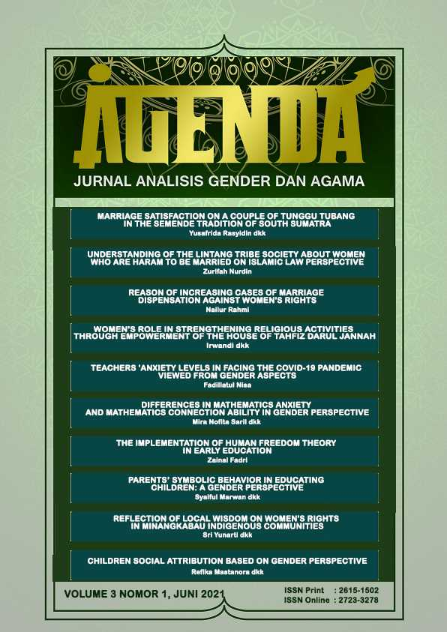
UNDERSTANDING OF THE LINTANG TRIBE SOCIETY ABOUT WOMEN WHO ARE HARAM TO BE MARRIED ON ISLAMIC LAW PERSPECTIVE
DOI:
https://doi.org/10.31958/agenda.v3i1.2593Abstract
The Lintang tribal people who are predominantly embracing Islam, with a patrilineal family system, have a different understanding of women who are forbidden to marry, therefore this paper reveals the understanding of the Intang tribe community about women who are haram to marry from the perspective of Islamic law. In terms of description, the writer finds that the understanding of the Lintang tribe about women who are haram to marry is in line with the maqashid syri'ah, namely in order to maintain the safety of religion, reason and safety of soul even though there are differences from those in the books of fiqh. The indication of maintaining the three matters of maqashid syari'ah is maintaining the marriage guardian order, maintaining the offspring to be physically and mentally healthy, intelligent both socially and spiritually and not physically or mentally defective. Therefore the understanding as found in the Lintang Tribe community needs to be preserved because it is part of the Islam of the Archipelago
 
References
Al-Habsyi, Muhammad Bagir Fiqh Praktis Menurut al-Qur’an, Sunnah, dan Pendapat para Ulama’ , Bandung: Mizan, 2002
Al-Zuhaili Wahbah”al Fiqh al-Islamy Wa Adilatuhu”diterjemahkan oleh Darul Fikri, Gema Insani jilid 9 Jakarta.
Aulawi, Asro Sastroatmodjo dan A. Wasit, Hukum Perkawinan di Indonesia, Jakarta; Bulan Bintang, 1975
Djazuli, Kaida-Kaidah Fikih, Kaidah-kaidah Hukum Islam dalam Menyelesaikan Masalah-Masalah yang Praktis, Jakarta, Kencana Prenada Media Group, 2011
Haroen, Nasrun, Ushul Fiqh I, Jakarta: Logos Wacana Ilmu , 1977,.
Rusdy, Ibnu, Bidayatu al- Mujtahid Analisis Para Mujtahid judul asli Bidayatul Mujtahid wa Nihayatul Muqtashid, diterjemahkan oleh Imam Ghazali Said dan Ahmad Zaidun, Jakarta; Pustaka Amani, 2007
https://ejournal.iainbengkulu.ac.id/index.php/syiar/article/view/910. Zurifah Nurdin, Etika Mencari Pendamping Hidup Menurut Islam, Jurnal Ilmiah Syi'ar, 2017, Vol. 17, hl 107-118
Ahmad Zainul Wafa AL-HUKAMA The Indonesian Journal of Islamic Family Law Volume 01, Nomor 01, Juni 2011; ISSN:2089-7480
http://etheses.uin-malang.ac.id/1690/6/03210037
Rahendra Maya, jurnal.staialhidayahbogor.ac.id Desember 2, hal 711-723
https://almanhaj.or.id/1741
-wanita-wanita-yang-dilarang-dinikahi.html Syaikh Abdullah bin Abdurrahman bin Shalih Ali Bassam
Zurifah Nurdin. Disertasi,UIN Raden Intan Lampung,
Downloads
Published
Issue
Section
License
Copyright (c) 2021 zurifah nurdin

This work is licensed under a Creative Commons Attribution-NonCommercial 4.0 International License.
Authors who publish with this journal agree to the following terms:
- Authors retain copyright and grant the journal right of first publication with the work simultaneously licensed under a?áCreative Commons Attribution-NonCommercial 4.0 International License?á(CC BY-NC 4.0) that allows others to share the work with an acknowledgment of the work's authorship and initial publication in this journal.
- Authors are able to enter into separate, additional contractual arrangements for the non-exclusive distribution of the journal's published version of the work (e.g., post it to an institutional repository or publish it in a book), with an acknowledgment of its initial publication in this journal.
- Authors are permitted and encouraged to post their work online (e.g., in institutional repositories or on their website) prior to and during the submission process, as it can lead to productive exchanges, as well as earlier and greater citation of published work (See?áThe Effect of Open Access).







