
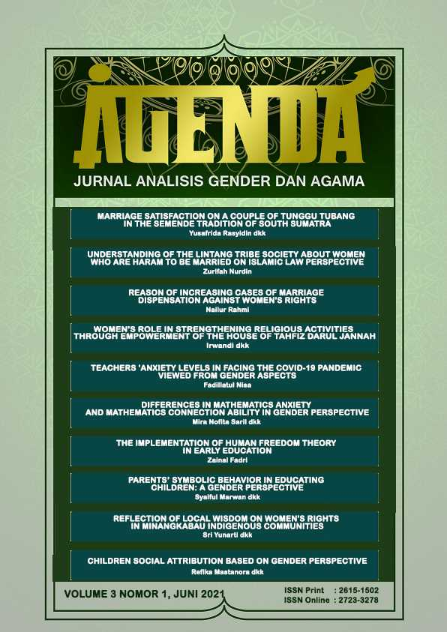
THE IMPLEMENTATION OF HUMAN FREEDOM THEORY IN EARLY EDUCATION
DOI:
https://doi.org/10.31958/agenda.v3i1.2597Abstract
Early childhood education is now an obligation to prepare children for further education. Education in primary schools has levels that must be taken first with the aim that the child is ready to attend lessons first, such as education in kindergarten and early childhood education. This study aims to look at human freedom in undergoing early childhood education and the values contained in education. The theory of freedom is used to examine the harmony between the spirit of preparing for education with the pure value of human freedom, so that it can be said that early childhood education is a freedom. The method used in this research is descriptive qualitative. Data analysis was carried out in a holistic manner to achieve an exploration of the theory of freedom contained in early childhood education. The results of this study prove that early childhood education can be said that the implementation of freedom will support the true free human being, that is, free from ignorance and backwardness.
References
Astuti, I. N. (2015). Efek Payoff Magnitude terhadap Kecendrungan Manajer dalam Pengambilan Keputusan Pemilihan Proyek.
Darmawi, H. (2008). Manajemen Risiko (Kesebelas). Jakarta: Bumi Aksara.
Hajek, V. G. (1984). Manajemen Proyek Perekayasaan (Ketiga). Jakarta: Erlangga.
Hasibuan, M. S. . (1990). Manajemen Dasar, Pengertian dan Masalah (Kelima). Jakarta: PT. Temprint.
Herwitasari, F., & Utomo, C. (2016). Studi Pengambilan Keputusan Investasi Dengan Risiko Pada Pengembangan Proyek Caspian Tower , Grand Sungkono Lagoon Surabaya, 5(2), 194–198.
Horne, J. C. Van. (2013). Prinsip-Prinsip Manajemen Keuangan. (E. S. Suharsi, Ed.) (Edisi Tiga). Jakarta Selatan.
J Keown, A. (2008). Manajemen Keuangan : Prinsip Dan Penerapan. (Indriani, Ed.) (Ke Sepuluh). New Jersey: PT Macanan Jaya Cemerlang.
Konopaske, J. M. I. & R. (2006). Perilaku Dan Manajemen Organisasi. (W. Hardani, Ed.) (Edisi Ketu). PT gelora Aksara Pratama.
Lock, D. (1984). Manajemen Proyek (Ketiga). Jakarta: Erlangga.
Machfoedz, M. (1991). Akuntansi Manajemen (Keempat). Yogyakarta: BPFE-Yogyakarta.
Prasetya, D. (2012). Pengaruh Kecendrungan Manajer Dalam Pembuatan Keputusan Terhadap Payoff Magnitude, (1987), 1–24.
Pudjiastuti, S. H. & E. (2012). Dasar-dasar Manajemen Keuangan (Keenam). Yogyakarta: UPP STIM YKPN.
Rue, T. & L. (1991). Dasar-Dasar Manajemen. (G. Ticoalu, Ed.) (Ketiga). Jakarta: Bumi Aksara.
Santoso, I. N. (2016). Hubungan Payoff Magnitude terhadap Kecendrungan Manajer Mengambil Risiko dalam Pengambilan Keputusan Pemilihan Proyek.
Sartono, A. (2012). Manajemen Keuangan Teori dan Aplikasi (Keempat). Yogyakarta: BPFE-Yogyakarta.
Sugiono. (2013). Metode Penelitian Kuantitatif Kualitatif dan R & D. Yogyakarta.
Sugiyono, P. D. (2006). Uji Validitas Dan Uji Reliabilitas. Retrieved from https://www.srcibd.com/.com/68052250/uji-validitas-&-uji-reabilitas
Sujarweni, V. . W. (2016). Penelitian Akuntansi dengan SPSS. (Mona, Ed.). Yogyakarta: Pustaka Baru Press.
Supriyono. (1987). konsep Dasar Akuntansi Manajemen dan Proses Perencanaan. (P.- Yogyakarta, Ed.) (Pertama). Yogyakarta.
Supriyono. (1989). Proses Pengendalian Manaemen. (Mulyadi, Ed.) (Tiga). Yogyakarta.
Syukri Abdullah, A. H. (2006). Hubungan dan Masalah Keagenan di Pemerintah Daerah, 2, 53–64.
TriHandoko, W. (2010). Pengambilan Keputusan Dalam Keadaan Risiko Untuk Penentuan Jumlah Produksi, IV, No. 2, 56–65.
Triton. (2005). SPSS 13.0 Terapan: Riset Stastistik Parametik. (R. W. Rosari, Ed.) (Pertama). Yogyakarta: Andi Offset.
Widi, R. K. (2010). Asas Metodelogi Penelitian (Pertama). Yogyakarta: Graha Ilmu
Downloads
Published
Issue
Section
License
Copyright (c) 2021 Zainal Fadri

This work is licensed under a Creative Commons Attribution-NonCommercial 4.0 International License.
Authors who publish with this journal agree to the following terms:
- Authors retain copyright and grant the journal right of first publication with the work simultaneously licensed under a?áCreative Commons Attribution-NonCommercial 4.0 International License?á(CC BY-NC 4.0) that allows others to share the work with an acknowledgment of the work's authorship and initial publication in this journal.
- Authors are able to enter into separate, additional contractual arrangements for the non-exclusive distribution of the journal's published version of the work (e.g., post it to an institutional repository or publish it in a book), with an acknowledgment of its initial publication in this journal.
- Authors are permitted and encouraged to post their work online (e.g., in institutional repositories or on their website) prior to and during the submission process, as it can lead to productive exchanges, as well as earlier and greater citation of published work (See?áThe Effect of Open Access).







