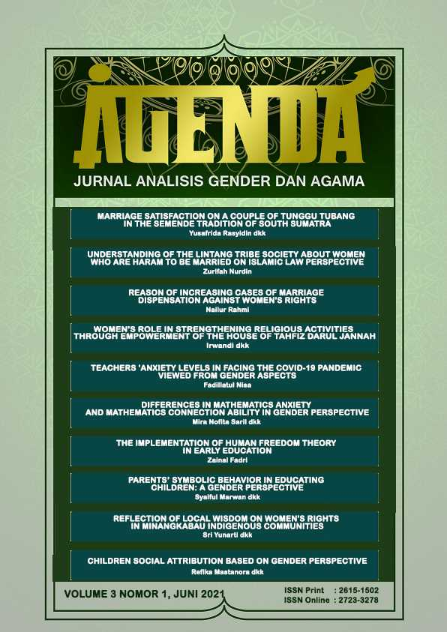
MARRIAGE SATISFACTION ON A COUPLE OF TUNGGU TUBANG IN THE SEMENDE TRADITION OF SOUTH SUMATRA
DOI:
https://doi.org/10.31958/agenda.v3i1.2613Abstract
The purpose of this research is to find out how marriage satisfaction is to know what are the factors that influence marriage satisfaction in the waiting couple tubang in the traditional traditions of Semende, South Sumatra. This research uses a qualitative approach with a case study method, the data analysis technique used is thematic analysis by coding the results of the interview transcripts that have been made verbatim. The results showed that effective communication and cooperation play a role in marital satisfaction, effective communication can solve problems related to finance, family, parenting and sex. Whereas role cooperation in the family is an absolute requirement for family function and the openness of the couple to recognize and solve problems that arise to get the best solution.References
Abi s. Febrianto, dkk., The Influence Of Psychological Empowerment and Islamic Spiritual Leadership On Organizational Commitments and Intrinsic Motivation, Jurnal Aplikasi Manajemen 17 (3) 2019, 381–390.
Agam Hyansantang Maulana, dkk., Kepemimpinan Profetik Islam oleh Kepala Madrasah, JAMP: Jurnal Administrasi dan Manajemen Pendidikan 2 (1) 2019, 26-31.
Ahmet Kaya, The Relationship Between Spiritual Leadership and Organizational Citizenship Behaviors: A Research on School Principals’ Behaviors, Educational Sciences: Theory & Practice 15 (3) 2015, 597-606.
Amlan Haque, dkk, Responsible Leadership, Affective Commitment and Intention to Quit: an Individual Level Analysis, Leadership & Organizational Development Journal 40 (1) 2019, 45-64.
Annabel Beerel, The Strategic Planner as Prophet and Leader: a Case Study Concerning a Leading Seminary Illustrates the New Planning Skills Required, Leadership & Organization Development Journal 18 (3) 1997, 136-144.
Askina Nurani Syams, Implementasi Prophetic Leadership di MI Nurul Ulum Bantul, Edukasia Islamika: Jurnal Pendidikan Islam 3 (1) 2018, 105-115.
David A. Waldman, dkk., Defining the Socially Responsible Leader: Revisiting Issues in Responsible Leadership, Journal of Leadership & Organizational Studies 27 (1) 2019, 5-20.
Duane Covrig, dkk., Integrating Four Types of Moral Leadership, Journal of Applied Christian Leadership 6 (1) 2012, 36-63.
George Gotsis & Katerina Grimani, The Role of Spiritual Leadership in Fostering Inclusif Workplaces, Personnel Review 46 (5) 2017, 908-935.
Hamdany B. Adz Dzaky, dkk., Prophetic Intelligence: Construct Development and Empirical Test for Its Role in The Perception of Unethical Conduct among Indonesian Goverment Employess, Jurnal Psikologi Islami 1 (1) 2005, 43-54.
Husein Muhammad, Mengaji Pluralisme Kepada Mahaguru Pencerahan, (Bandung: Mizan, 2011).
Indah Kusuma Dewi, Implementasi Nilai-Nilai Profetik dalam Kepemimpinan Modern pada Manajemen Kinerja di Perguruan Tinggi Islam Swasta Kota Metro, Ijtimaiyya: Jurnal Pengembangan Masyarakat Islam 12 (1) 2019, 47-76.
Jernej Belak, Management and Governance: Organizational Culture in Relation to Enterprise Life Cycle, Kybernetes 45 (4) 2016, 680-698.
Jill K. Gill, The Political Price of Prophetic Leadership: The National Council of Churches and the Vietnam War, Peace & Change, 27 (2) 2002, 271-300.
Joseph E. Sanders, dkk., From Transactional to Transcendental: Toward an Integrated Theory of Leadership, Journal of Leadership & Organizaional Studies 9 (4) 2003, 21-31.
Joseph Scott Gladstone & Donald D. Depion, Exploring Traditional Indegenous Leadership Concepts: A Spiritual Foundation for Blackfeet Leadership, Leadership 13 (5) 2017, 571-589.
Katelin Barron & Shih Yung Chou, Spirituality and Social Responsibility Performance: The Perspectives of Religiously and Non-Religiously Affiliated Individuals, Journal of Global Responsibility 8 (1) 2017, 63-82.
Kevin S. Groves, Testing a Moderated Mediation Model of Transformational Leadership, Values, and Organizational Change, Journal of Leadership & Organizaional Studies 27 (1) 2020, 35-48.
Khaliq Ahmad, Corporate Governance and Leadership from an Islam Perspective, International Journal of Engineering & Technology 7 (4.29) 2018, 25-27.
Kimberley Breevaart & Hannes Zacher, Main and Interactive Effect of Weekly Transformational and Laissez-Faire Leadership on Follower’s Trust in the Leader and Leader Effectiveness, Journal of Occupational and Organizational Psychology 92 (2) 2019, 384-409.
Kung Wong Lau, dkk., A Collective Organizational Learning Model for Organizational Development, Leadership & Organization Development Journa 40 (1) 2019, 107-123.
Laurel Beth Geise, Prophetic Leadership: A Call to Action, (United State: Xlibris, 2002).
Lauren Klaus & Mario Fernando, Enacting Spiritual Leadership in Business Through Ego-Transcendence, Leadership & Organization Development Journal 37 (1) 2016, 71-92.
Len Oakes, Prophetic Charisma: The Psychology of Revolutionary Religious Personalities, (New York: Syracuse University Press, 1997).
Lindsay J. Thompson, Moral Leadership in a Postmodern World, Journal of Leadership & Organizational Studies 11 (1) 2004, 27-37.
Machsun Rifaudin, Konsep Kepemimpinan Profetik dalam Membangun Sumber Daya Manusia Berbasis Islam di Perpustakaan, JIPI: Jurnal Ilmu Perpustakaan & Informasi 2 (1) 2017, 46-62.
Mahyarni, The Influence of Spiritual Leadership and Its Impacts on the Reduction of Workplace Deviant Behavior, International Journal of Public Leadership 15 (3) 2019, 170-188.
Mai Chi Vu & Roger Gill, Letting go of the Raft”-The Art of Spiritual Leadership in Contemporary Organizations from a Buddhist Perspective Using Skill Means, Leadership 6 (2) 2019, 360-380.
Maria Joelle & Arnaldo Coelho, The Impact of a Spiritual Environment on Performance Mediated by Job Resourcefulness, International Journal of Workplace Health Management 12 (4) 2019, 267-286.
Maria Kniazeva, Eastern Spirituality in The Western Marketplace, Qualitative Market Research 18 (4) 2015, 459-476.
Mary Ellen Brown, dkk., Strategic Compatibility, Collaboration and Collective Impact for Community Change, Leadership & Organization Development Journal 40 (4) 2019, 421-434.
Masduki, Pendidikan Profetik: Mengenal Gagasan Ilmu Sosial Profetik Kuntowijoyo, Toleransi: Media Ilmiah Komunikasi Umat Beragama 9 (1) 2017, 1-22.
Metthew R. Fairholm & Gilbert W. Fairholm, Understanding Leadership Pespective: Theoretical and Practical Approaches, (New York: Springer, 2009).
Mohamad Johdi Salleh, Educational Leadership Model: An Islamic Perspective, al-Shajarah: Journal of the International Institute of Islamic Thought and Civilization (ISTAC) Special Issue: Education 2018, 49-70.
Muhammad Fadhli, Internalisasi Nilai-Nilai Kepemimpinan Profetik dalam Lembaga Pendidikan Islam, at-Ta’dib: Jurnal Ilmiah Pendidikan Agama Islam 10 (2) 2018, 116-127.
Munardji, Konsep dan Apalikasi Kepemimpinan Profetik, Edukasi: Jurnal Pendidikan Islam 4 (1) 2016, 68-86.
Nik Maheran Nik Muhammad & Shahram Akbarzadeh, Prophetic Leadership and Financial Decision Making Quality: Partial Least Square (PLS) Path Modeling Analysis, International Journal of Business and Management Studies 2 (1) 2013, 195-213.
Nik Maheran Nik Muhammad, Prophetic Leadership Model: Conceptualizing a Prophet’s Leadership Behavior, Leader-Follower Mutuality and Altruism to Decision Making Quality, European Journal of Interdisciplinary Studies 1 (3) 2015, 93-106.
Nishant Kumar & Dharam Deo Sharma, The Role of Organisational Culture in The Internationalisation of New Ventures, International Marketing Review 35 (5) 2018, 806-832.
Peribadi, dkk., The Construction of Prophetic Development Paradigm: A Poverty and Impoverishment Resolution, Journal of Philosophy and Ethics 1 (1) 2019, 1-12.
Po Chung & Arthur H. Bell, 25 Principles of Services Leadership, (New York: Lexingford Publishing, 2015).
Prabowo Adi Widayat, Kepemimpinan Profetik: Rekonstruksi Model Kepemimpinan Berkarakter Keindonesiaan, Akademika: Jurnal Pemikiran Islam 19 (1) 2014, 18-34.
Riane Johnly Pio & Johny Revo Elia Tampi, The Influence of Spiritual Leadership on Quality of Work Life, Job Satisfaction and Organizational Citizenship Behavior, International Journal of Law and Management 60 (2) 2018, 757-767.
Ristapawa Indra & Martin Kustati, Ethical Leadership Assessment for The Islamic Secondary School Principals, Jurnal Pendidikan Islam 5 (1) 2019, 11-24.
Robingun Suyud el Syam, Prophetic Leadership: The Leadership Model of Prophet Muhammad in Political Relation of Social-Ummah, Jurnal Pendidikan Islam 6 (2) 2017, 371-396.
Sanerya Hendrawan, Spiritual Management: From Personal Enlightment Towards God Corporate Governance, (Bandung: Mizan, 2009), 158.
Sarah Alhouti & Giles D’Souza, Benefits of Corporate Society Responsibility, Journal of Consumer Marketing 35 (3) 2018, 277-286.
Sharmila Devi Ramachandaran, dkk., Effectiveness of the Use of Spiritual Intelligence in Women Academic Leadership Practice, International Journal of Educational Management 31 (2) 2017, 160-178.
Shilpa Kabra Maheshwari & Jaya Yadav, The Role of HR in Leadership Development, Development and Learning in Organizations 33 (5) 2019, 20-23.
Sus Budiharto & Fathul Himam, Konstruk Teoritis dan Pengukuran Kepemimpinan Profetik, Jurnal Psikologi: Universitas Gadjah Mada 33 (2) 2006, 133-146.
Syamsudin, Kepemimpinan Profetik: Kepemimpinan Umar bin Khattab dan Umar bin Abdul Aziz, Tesis Dipublikasikan, (Malang: UIN Maulana Malik Ibrahim Malang, 2015).
Thomas Armstrong, School Safety Starts from Within, Educational Leadership 77 (2) 2019, 48-52.
Tobroni, Spiritual Leadership: A Solution of The Leadership Crisis in Islamic Education in Indonesia, British Journal of Education 3 (11) 2015, 40-53.
Tony Yeigh, dkk., School Leadership and School Improvement: an Examination of School Readiness Factors, School Leadership & Management 39 (5) 2019, 434-456.
Tri Rahayuningsih, Kepemimpinan Profetik, Budaya Organisasi, dan Komitmen Organisasi Karyawan Universitas Abdurrab, Jurnal Psikologi 12 (2) 2016, 117-121.
Umar Sidiq & Qurrotul ‘Uyun, Prophetic Leadership in the Development of Religious Culture in Islamic Boarding Schools, Istawa: Jurnal Pendidikan Islam 4 (1) 2019, 80-97.
Umiarso, Kepemimpinan Transformasional Profetik dalam Mengembangkan Pesantren di Kabupaten Jember, Akademika: Jurnal Pemikiran Islam 23 (1) 2018, 87-106.
Umiarso, Kepemimpinan Transformasional Profetik: Kajian Paradigmatik Ontos Integralistik di Lembaga Pendidikan Islam, (Jakarta: Kencana, 2018).
Zaini Jamaludin & Zulkefli Aini, The Relationship Between Spiritual and Transformational Leadership Toward Intention to Say: A Study in a Political Environment, al-Hikmah: Journal of Islamic Dakwah 7 (1) 2015, 172-184.
Downloads
Published
Issue
Section
License
Copyright (c) 2021 Annisa - Fitriani

This work is licensed under a Creative Commons Attribution-NonCommercial 4.0 International License.
Authors who publish with this journal agree to the following terms:
- Authors retain copyright and grant the journal right of first publication with the work simultaneously licensed under a?áCreative Commons Attribution-NonCommercial 4.0 International License?á(CC BY-NC 4.0) that allows others to share the work with an acknowledgment of the work's authorship and initial publication in this journal.
- Authors are able to enter into separate, additional contractual arrangements for the non-exclusive distribution of the journal's published version of the work (e.g., post it to an institutional repository or publish it in a book), with an acknowledgment of its initial publication in this journal.
- Authors are permitted and encouraged to post their work online (e.g., in institutional repositories or on their website) prior to and during the submission process, as it can lead to productive exchanges, as well as earlier and greater citation of published work (See?áThe Effect of Open Access).