
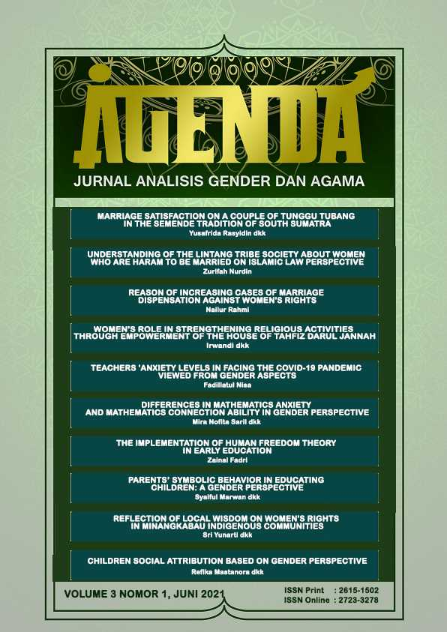
REFLECTION OF LOCAL WISDOM ON WOMEN'S RIGHTS IN MINANGKABAU INDIGENOUS COMMUNITIES
DOI:
https://doi.org/10.31958/agenda.v3i1.3705Abstract
Women in Minangkabau traditional culture are Limpepeh Rumah Nan Gadang which are symbols of the existence of harmonization of households; guarantee of the quality of human resources both in terms of inheritance and descendants, and guarantee of knowledge and availability of family food. This research is conducted in the Minangkabau community within Luhak Nan Tuo area, particularly in the Tanah Datar Regency community. By using the interview method, it reflects three stages of womenÔÇÖs position in Minangkabau descriptively. These stages are (1) in decision making to determine assets in the family economy, (2) in the working distribution, and (3) in managing family finances. From the result of the study, it can be seen that the position of women in making decisions is still in the second position even though in the end the women who act as bundo kanduang are still being asked for opinions in terms of protecting reproductive health which indicated in decreasing point. There has been a change in working distribution in which the women are allowed to work not only in domestic sectors but also in public sectors. However, womenÔÇÖs position in managing family finances are getting decreased. This is as a result of culture and its values in structural, solidarity, existence of the society. Bundo kanduang institution in Nagari is the basis for empirical empowerment and local wisdom on women's rights. It is just a sub-section of the institution that deals with women's, social, children, youth and women's issues. The social reality where the domestication of discrimination has implications for women. There is still a strong gender bias of community leaders. At least, there are female figures who are able to act as agents for women's empowerment in cultural studies.References
Women’s right, local wisdom, Minangkabau
Downloads
Published
2021-06-19
Issue
Section
Articles
License
Copyright (c) 2021 Sri Yunarti, Muhammad Syakir, Desmita Desmita, Elfi Elfi

This work is licensed under a Creative Commons Attribution-NonCommercial 4.0 International License.
Authors who publish with this journal agree to the following terms:
- Authors retain copyright and grant the journal right of first publication with the work simultaneously licensed under a?áCreative Commons Attribution-NonCommercial 4.0 International License?á(CC BY-NC 4.0) that allows others to share the work with an acknowledgment of the work's authorship and initial publication in this journal.
- Authors are able to enter into separate, additional contractual arrangements for the non-exclusive distribution of the journal's published version of the work (e.g., post it to an institutional repository or publish it in a book), with an acknowledgment of its initial publication in this journal.
- Authors are permitted and encouraged to post their work online (e.g., in institutional repositories or on their website) prior to and during the submission process, as it can lead to productive exchanges, as well as earlier and greater citation of published work (See?áThe Effect of Open Access).







