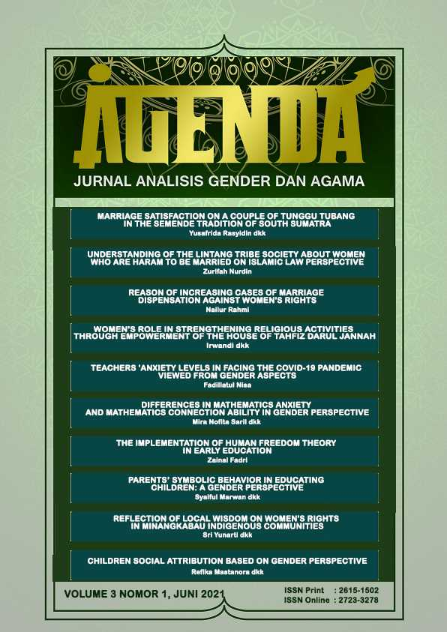
CHILDREN SOCIAL ATTRIBUTION BASED ON GENDER PERSPECTIVE
DOI:
https://doi.org/10.31958/agenda.v3i1.3709Abstract
Social attribution can appear spontaneously or through long considerations and thinking process. Factors influencing attribution is the attribution style; planned and unplanned attribution. This kind of behavior can arise due to emotional factors. Meanwhile, children's social attributions arise because of stereotypes or labeling that have been attached to society, thus it has an impact on children's understanding of gender since they were born. The existence of social construction regarding gender roles cannot be separated from how the paradigm views the labeling of the characteristics of women and men is. In children, this social attribution usually occurs because of the stereotype of gender roles taught to children. This stereotype is a labeling that begins based on the perception or point of view of a person. While gender role stereotypes are part of the discussion about gender "sex", namely social expectations that define how men and women think, feel, and act, which are part of the product of the stereotype itself.References
Abdul, Agus. 2014, Psikologi Sosial : Intergrasi Pegetahuan wahyu dan pengetahuan empiric. Jakarta : PT Rajagrafindo Persada.
Anggono, A. T. (2008). Atribusi sosial narapidana anak di Lembaga Pemasyarakatan Kelas IIA Sragen, Universitas Muhammadiyah Surakarta.
NN,. 2008. Makalah “Elimination of Gender Stereotypes: Mission (Im)Possible?” dipresentasikan di Lobi European Women’s
Nuraini, 2008, Menyoal Pendidikan Berbasis Gender, dalam http://www.majalahopini.co.cc, diakses pada tanggal 16 Mei 2021.
Rohmah, Siti. 2010. Atribusi Kekerasan dalam Rumah Tangga, Kesadaran terhadap kesetaraan gender dan strategi menghadapi masalah pada perempuan korban kekerasan dalam rumah tangga.
Santrock, J.W. 2008. Psikologi Pendidikan. Jakarta: Kencana, 2008.
Schneider , David J., The Psychology Of Stereotyping, (New York : The Guilford Press, 2004).
Secord & Backman, Social psychology. (New York: McGraw-Hill, 1964).
Widarmanto, T, Pendidikan yang Berperspektif Gender, http://203.130.242.190/artikel/2289.shtml, diakses pada tanggal 20 Mei 2021.
Zaduqisti, Esti.2009. Stereotipe Peran Gender Bagi Pendidikan Anak Muzawah, Vol 1,No. 1 Januari-Juni 2009.
Anggono, A. T. (2008). Atribusi sosial narapidana anak di Lembaga Pemasyarakatan Kelas IIA Sragen, Universitas Muhammadiyah Surakarta.
NN,. 2008. Makalah “Elimination of Gender Stereotypes: Mission (Im)Possible?” dipresentasikan di Lobi European Women’s
Nuraini, 2008, Menyoal Pendidikan Berbasis Gender, dalam http://www.majalahopini.co.cc, diakses pada tanggal 16 Mei 2021.
Rohmah, Siti. 2010. Atribusi Kekerasan dalam Rumah Tangga, Kesadaran terhadap kesetaraan gender dan strategi menghadapi masalah pada perempuan korban kekerasan dalam rumah tangga.
Santrock, J.W. 2008. Psikologi Pendidikan. Jakarta: Kencana, 2008.
Schneider , David J., The Psychology Of Stereotyping, (New York : The Guilford Press, 2004).
Secord & Backman, Social psychology. (New York: McGraw-Hill, 1964).
Widarmanto, T, Pendidikan yang Berperspektif Gender, http://203.130.242.190/artikel/2289.shtml, diakses pada tanggal 20 Mei 2021.
Zaduqisti, Esti.2009. Stereotipe Peran Gender Bagi Pendidikan Anak Muzawah, Vol 1,No. 1 Januari-Juni 2009.
Downloads
Published
2021-06-19
Issue
Section
Articles
License
Copyright (c) 2021 Refika Mastanora, Rudi Pranata, Oktri Permata Lani

This work is licensed under a Creative Commons Attribution-NonCommercial 4.0 International License.
Authors who publish with this journal agree to the following terms:
- Authors retain copyright and grant the journal right of first publication with the work simultaneously licensed under a?áCreative Commons Attribution-NonCommercial 4.0 International License?á(CC BY-NC 4.0) that allows others to share the work with an acknowledgment of the work's authorship and initial publication in this journal.
- Authors are able to enter into separate, additional contractual arrangements for the non-exclusive distribution of the journal's published version of the work (e.g., post it to an institutional repository or publish it in a book), with an acknowledgment of its initial publication in this journal.
- Authors are permitted and encouraged to post their work online (e.g., in institutional repositories or on their website) prior to and during the submission process, as it can lead to productive exchanges, as well as earlier and greater citation of published work (See?áThe Effect of Open Access).