
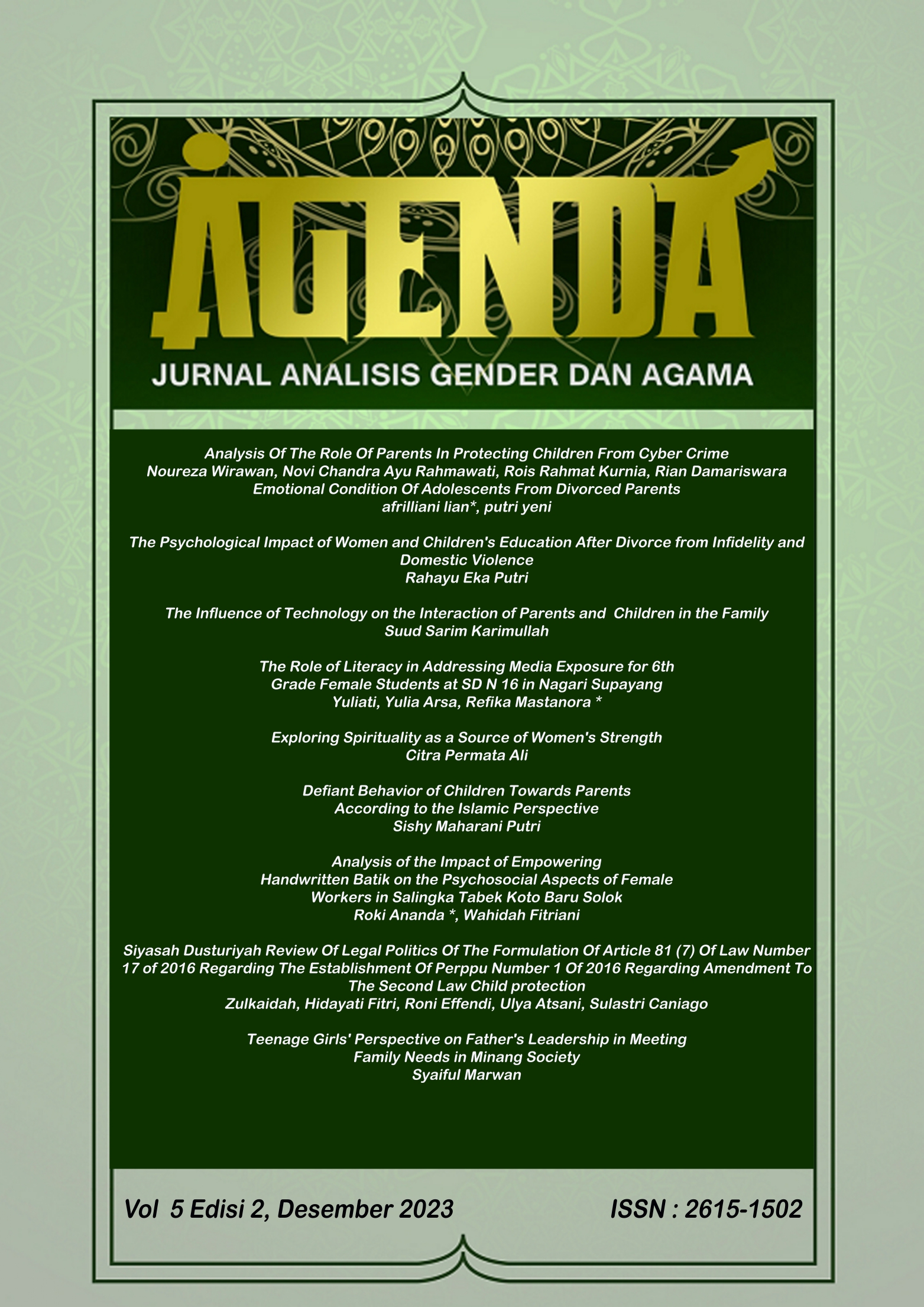
Emotional Condition Of Adolescents From Divorced Parents
DOI:
https://doi.org/10.31958/agenda.v5i2.9624Keywords:
Divorce, Emotions, TeensAbstract
Divorce in the family always has a profound impact on children. Divorce cases can cause stress, pressure, and cause physical and mental changes. Children whose parents have divorced tend not to be able to control their emotions, a child's behavior like this is due to frustration in him so that they can vent their emotions in themselves. Parents are an important role in shaping the character and development of their children. In adolescence to adulthood, this can be dangerous and can affect the psychology of children, because in adolescence they tend to be emotional in expressing something, because they are not yet able to fully control their physical and psychological functions. The research method used is to use a qualitative approach using references from various sources, including books, journals, articles, and other documents. Divorce is not the only way out for problems in a family to be resolved quickly, If there is a divorce in the family, it always has a deep impact, especially on their children. When a child is a teenager, they have begun to understand what divorce means. And because of the divorce of parents, there is a very big change in teenagers such as the problem of children becoming aggressive, not confident, pessimistic about love, and depression. And there are profound effects on a child's physical and emotional health, as well as their ability to get along with their peers.
References
Presindo.
A. King, Laura. 2010. Psikologi Umum Sebuah pandangan Apresiattif. Jakarta:
Salemba Humanika.
Amir Syarifuddin, Hukum Perkawinan Islam Di Indonesia: Antara Fiqih
Munakahat Dan Undang-Undang Perkawinan, Jakarta: Kencana, 2009.
Chaplin. J. P. 2011. Kamus Lengkap Psikologi. Jakarta : PT Raja Grafindo
Persada.
Dagun. Save M. Dagun. (2002). Psikologi Keluarga. Ed. Ke-2, Jakarta: Rineka
Cipta.
Darwis Hude.(2006). Penjelajahan Religio-Psikologis tentang Emosi Manusia
Dalam Al Qur‟an. Jakarta: Erlangga
Dariyo, Agoes. 2004. Psikologi Perkembangan Remaja. Bogor: Ghalia Indonesia
Dariyo, Agoes. 2007. Psikologi Perkembangan Anak Tiga Tahun Pertama.
Bandung; PT Refika Aditama
Gottman, J., De Claire, J. 2003. Kiat-Kiat Membesarkan Anak yang Memiliki
Kecerdasan Emosional. Jakarta : Gramedia Pustaka Utama.
Gunarsa, Singgih D. 2004. Psikologi Praktis Anak, Remaja dan Keluarga,
Cetakan. 7. Jakarta : PT. Gunung Mulia
Hurlock, Elizabeth B. 2002. Psikologi Perkembangan. Jakarta : Erlangga
Ihromi. (2004). Bunga Rampai Sosiologi Keluarga. Jakarta: Yayasan Obor
Indonesia.
Kartono, Dra Kartini. 1986. Psikologi Anak. Bandung. PT. Alumni
Monks, F J. 2006. Psikologi Perkembangan. Yogyakarta : Gajah Mada University
Press
Papalia, Diane E., Old, Feldman. 2011. Human Developmant Psikologi
Perkembangan Edisi Kesembilan. Jakarta : Kencana
Rosyidah, R., dkk. 2010. Dinamika Emosi Pecandu Narkotika dalam Masa Pemulihan. Jurnal Insan Media Psikologi, 12 (2): 113 - 118. Surabaya: Universitas Airlangga.
Santrock, Jhon W. 2007. Perkembangan Anak Edisi Ketujuh Jilid Dua. Jakarta :
Erlangga
Santrock. Jhon. W. 2012. Life - Span Development. Edisi Ketigabelas Jilid 2.
Jakarta : Erlangga.
Santrock, John W.. 2003. Adolescence. Jakarta. Erlangga.
Sarlito Wirawan Sarwono. (2006). Psikologi Remaja. Jakarta: Rajawali.
Downloads
Additional Files
Published
Issue
Section
License
Copyright (c) 2023 afrilliani lian, putri yeni

This work is licensed under a Creative Commons Attribution-NonCommercial 4.0 International License.
Authors who publish with this journal agree to the following terms:
- Authors retain copyright and grant the journal right of first publication with the work simultaneously licensed under a?áCreative Commons Attribution-NonCommercial 4.0 International License?á(CC BY-NC 4.0) that allows others to share the work with an acknowledgment of the work's authorship and initial publication in this journal.
- Authors are able to enter into separate, additional contractual arrangements for the non-exclusive distribution of the journal's published version of the work (e.g., post it to an institutional repository or publish it in a book), with an acknowledgment of its initial publication in this journal.
- Authors are permitted and encouraged to post their work online (e.g., in institutional repositories or on their website) prior to and during the submission process, as it can lead to productive exchanges, as well as earlier and greater citation of published work (See?áThe Effect of Open Access).







