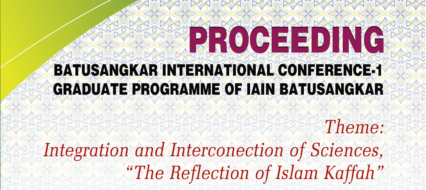
A STUDY ON ECONOMIC ASPECTS OF THE MATERIALS OF WORSHIP FIQH: The Reflection of Integration and Interconnection of Sciences
Abstract
The paradigm of science and education system has been placed dichotomously over years
which causes the birth of the term religion science, on the one hand, and general science, on
the other hand. The same is true for the educational system that dichotomizes religious
educational institutions, on the one hand, and public education institutions, on the other hand.
These eventually also influence the presentation of Islamic learning materials, such as Fiqh,
which stresses the material so as for only limited aspects of the laws and ordinances its
practice.While, in fact, the study of Fiqh materials, such as those of Worship Fiqh, can also be
seen from various other scientific perspectives and interconnective, and integrative ways, such
as from Economic Sciences view-point. It can be proved through the material of fasting during
Ramadan month. The learning materiasl are usually presented from Fiqh view-point. While, it
is a fact that fasting has some implications on the country's economic growth. Thus, the effect
of fasting can be studied, for example, from the theory of macroeconomics view-point. By the
enrichment of such a concept, it will not only show the philosophy of Islamic Kaffah, but also
give its own appeal to the learners studying Fiqh.
References
Ali, Yusuf A. The Holy Qur’an, Text, Translation and Commentary, (Leicester, Islamic Foundation, 1975).
Ansary,Tamim. Destinity Disrupted: A History of the World through Islamic Eyes. (USA: Public Affairs, 2009) dalamversiterjemahanSejarahDuniaVersi Islam, Jakarta: PenerbitZaman, 2012.
Anshari, Fazl-Ur Rahman., Anis Ahmad, danRoger Graudy, Islam and Western Civilization, (Karachi: World Federation of Islami Mission, 1973), dalamversiterjemahanIslam danPeradaban Barat Moderen, Bandung: Risalah, 1986.
Bagir, Haidar dan ZainalAbidin, “FilsafatSainsIslami: KenyataanatauKhayalan?” dalamFilsafatSainmenurut Al Qur’an, Mahdi Ghulsyani, Bandung: Mizan, 1989.
Hidayatullah, M. Furqon, PendidikanKarakter:MembangunPeradabanBangsa, (Surakarta: Yuma Pustaka, 2010).
Fuadi, Imam. The History of IslamCivilization, DirasahIslamiyah II, Yogyakarta: Teras, 2012.
Husain, Syed Sajjaddan Syed Ali Ashraf, Crisis Muslim Education, dalamversiterjemahanKrisisPendidikan Islam, Bandung: Risalah, 1986.
Khan, Muhammad Mojlum. 100 Muslim Paling BerpengaruhSepanjangSejarah, terjemahandariThe Muslim 100 The Lives, Thoughts and Achievements of the Most Influential Muslims in History, Jakarta: Mizan, 2012.
Maksum, Ali. “Aliran-AliranFilsafat” dalam Pengantar Filsafat, dari Masa Klasik Hingga Post modernisme, Jogyakarta: Ar-Ruzz Media, 2012.
Purwanto, Agus.NalarAyat-Ayat Semesta, Bandung: PenerbitMizan, 2012.
http://gaulglobal.wordpress.com/2013/01/01/hasil-survei-komnas-pa-62-remaja-smp-tidak-pera
http://pathmeaningoflife.blogspot.com/2012/12/kendalikan-pelajar-dari-tawuran-dengan.html vivanews.com 28 September 2012
http://www.bkkbn.go.id/beritadaerah/Pages/Seks-Bebas-dan-Narkoba-Masalah-Terbesar-Remaja.aspx Tribunnews.com, 17 Desember 2011
http://www.kemendagri.go.id/news/2011/08/10/pengguna-narkoba-di-indonesia-381-juta
Downloads
Published
Issue
Section
License
Authors who publish with this journal agree to the following terms:
- Authors retain copyright and grant the journal right of first publication with the work simultaneously licensed under a Creative Commons Attribution License that allows others to share the work with an acknowledgement of the work's authorship and initial publication in this journal.
- Authors are able to enter into separate, additional contractual arrangements for the non-exclusive distribution of the journal's published version of the work (e.g., post it to an institutional repository or publish it in a book), with an acknowledgement of its initial publication in this journal.
- Authors are permitted and encouraged to post their work online (e.g., in institutional repositories or on their website) prior to and during the submission process, as it can lead to productive exchanges, as well as earlier and greater citation of published work.
