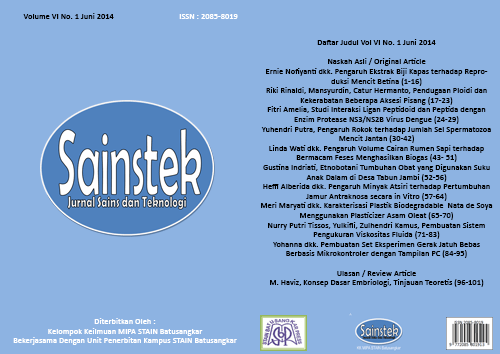
KARAKTERISASI PLASTIK BIODEGRADABLE NATA DE SOYA MENGGUNAKAN PLASTICIZER ASAM OLEAT
DOI:
https://doi.org/10.31958/js.v6i1.105Abstract
The purpose of this study were to analyze the morphology, tensile strength, power degradation and the degree of crystallinity of plastic nata de soya. This plastic using oleic acid plasticizer  with various volume 30 , 40 and 50 mL and 30 mL glycerol 3 %. Plastic morphology test using Scanning Electron Microscope ( SEM ). Tensile strength test using a test tensometer and crystallinity using X - ray diffraction instrument ( XRD ). Power degradation is determined by hoards of plastic in the soil for 10 days. The longer plastic soaked for 6 days then getting flat plastic surface morphology, the lower of  value of tensile strength is 7.87 MPa, the lower of power degradation is 23. 72 % and the higher the degree of crystallinity is 39.96 %.
 
Key words: oleic acid, plasticizer , biodegradable  plastic, nata de soyaReferences
Chrisnawati. 2004. Pengujian Efikasi Formula Pestisida Nabati Minyak Seraiwangi Ter-hadap Gloesporium piperatum Penyebab Penyakit Antraknosa Cabe Secara In Vitro. Prosiding Seminar Ekspor Teknologi Gambir, Kayumanis dan Atsiri. Hal 121-129. Balai Penelitian Tanaman Rempah dan Obat Sumatera Barat.
Dahlan S, Nasrun dan Syafri E. 1998. Pengu-jian Minyak Atsiri Daun Beberapa Jenis Tanaman terhadap Jamur Fusarium oxysporum Penyebab Penyakit Layu Tanaman Cabai (Capsicum annum L.) secara In Vitro. Prosiding Seminar Sehari Perhimpunan Fitopatologi Indonesia: 131-136. Padang: Perhimpu-nan Fitopatologi Indonesia.
Guenther E. 1990. Minyak Atsiri. Jakarta: Penerbit Universitas Indonesia.
Istianto M, Eliza dan Hermanto. 2006. Eva-luation of Essential Oils for Antifungal Activity Againts Antracnose Disease (Colletotrichum sp) Attacks Banana Fruit in Storage. Balai Penelitian Tanaman Buah Tropika Solok. (sedang dalam proses publikasi).
Manohara D, Dono W dan Sukamto. 1993. Pe-ngaruh Tepung dan Minyak Cengkeh ter-hadap Phytopthora, Rigidoporus, dan Sclerotium. Prosiding Seminar Hasil Penelitian dalam Rangka Pemanfaatan Pestisida Nabati: 19-27. Balai Penelitian Tanaman Rempah dan Obat Bogor.
Mayuni. 2006. Teknologi dan Analisa Minyak Atsiri. Andalas University Press, Padang.
Nurmansyah. 2004. Pengaruh Penambahan Mi-nyak Serai Wangi dan Limbah Kayu manis terhadap Daya Antifungal Pes-tisida Nabati Siri Sirih. Prosiding Seminar Ekspor Teknologi Gambir, Ka-yumanis dan Atsiri: 86-92. Balai Pe-nelitian Tanaman Rempah dan Obat Solok.
Nurmansyah, Jamalius dan Hilma. 1998. Pe-ngaruh Minyak Daun Ranting dan Kulit Batang Kayumanis terhadap Patogen Fusarium oxisporum Schl Penyebab Penyakit Busuk Batang Panili dan Busuk Kering Rimpang Jahe. Prosiding Seminar Sehari Perhimpunan Fitopatologi Indo-nesia: 179-186. Perhimpunan Fitopa-tologi Indonesia, Padang.
Robinson T. 1995. Kandungan Organik Tum-buhan Tinggi. Bandung: Penerbit ITB.
Rukmana R. 1995. Pepaya Budidaya dan Pascapanen. Yogyakarta: Penerbit Ka-nisius.
Satuhu S. 1998. Penanganan Mangga Segar untuk Ekspor. Jakarta: Penerbit Swadaya.
Semangun H. 1994. Penyakit Penyakit Tana-man Hortikultura di Indonesia. Jakarta: Gadjah Mada University Press.
Semangun H. 1996. Pengantar Ilmu Penyakit Tumbuhan. Gadjah Mada University Press. Yogyakarta.
Wilson CI, Solar JM, El-Ghaoth A dan Wisniewski ME. 1997. Rapid Evaluation of Plant Extracts and Essential Oil for Antifungal Activity Againts Botrytis cinerea. Plant Disease 81: 204-210.
Wiyono S. 2004. Optimisation of Biological Control of Damping-off of Sugar Beet Caused by Phytium ultimum Trow by Using Pseudomonas fluorescens B5. Disserttion. George-August University Gottingen, Gottinge.
Downloads
Published
Issue
Section
License
Copyright (c) 2016 Meri Maryati, Iryani Iryani, Fitri Amelia

This work is licensed under a Creative Commons Attribution-NonCommercial-NoDerivatives 4.0 International License.
Authors who publish with this journal agree to the following terms:
- Authors retain copyright and grant the journal right of first publication with the work simultaneously licensed under a Creative Commons Attribution License that allows others to share the work with an acknowledgement of the work's authorship and initial publication in this journal.
- Authors are able to enter into separate, additional contractual arrangements for the non-exclusive distribution of the journal's published version of the work (e.g., post it to an institutional repository or publish it in a book), with an acknowledgement of its initial publication in this journal.
- Authors are permitted and encouraged to post their work online (e.g., in institutional repositories or on their website) prior to and during the submission process, as it can lead to productive exchanges, as well as earlier and greater citation of published work.