POLA DISTRIBUSI MITOKONDRIA SEL-SEL TROFOBLAS BLASTOSIS MENCIT (Mus Muculus Albinus) DAN PENGARUHNYA TERHADAP KEGAGALAN HATCHING DAN IMPLANTASI
DOI:
https://doi.org/10.31958/js.v7i1.121Abstract
Implantation is the most critical stage in the establishment of pregnancy. In mammals, it has been estimated that between 25% and 60% of conceptuses are lost before or at the time of implantation. The objectives of  this study were to investigate  the ability of blastocyst hatching and attachment of trophoblast cells in in vitro, the outgrowth and differentiation of trophoblast cells in in vitro culture of hatched and non hatched blastocyst, the activity of mitochondria NADH-CoQ reductase and the pattern of mitochondrial distribution. Blastocysts were collected from mice cornua utery at day-4 of pregnancy and were divided into 3 groups: blastocysts undergo hatching within 24 hours, 48 hours and non hatching. Embryos were cultured in DMEM medium in 5% CO2 incubator at 37°C for 10 days. The trophoblasts monolayer were processed for Giemsa staining and histochemistry analysis of NADH-tetrazolium reductase activity. The outgrowth of trophoblast cells were measured using eyespiece micrometer. The results showed the ability of blastocyst hatching in in vitro were different. The trophoblast outgrowth diameter of 24 h hatched blastocyst was significantly different with the 48 h hatched and non hatched blastocyst. The activity of NADH-CoQ reductase of 24 h and 48 h hatched blastocysts showed higher intensity than the non hatched blastocysts (P<0,05) and the distribution of mitochondrial in trophoblast cell cytoplasma of 24 h and  48 h hatched blastocyst were homogen around nucleus whereas thoes of non hatched blastocyst were cluster and heterogen. In conclusion, in in vitro study the failure of blastocysts hatching and implantation was due to the failure of outgrowth and differentiation of the trofoblast cells and the impairment of NADH-CoQ reductase activity in complex I mitochondria to produce energy and the pattern of mitochondrial distribution.
Key words: mitochondrial distribution, NADH- tetrazolium reductase, trophoblast, implantation References
A.C. Bevilacqua, 1998. The standard fo Resistivity Measurements of Ultrapure Water. Semiconductor Pure Water and Chemicals Conference, Massachusetts.
Effendi, H, 2003, Telaah Kualitas Air Bagi Pengelolaan Sumber Daya dan Lingkungan Perairan. Yogyakarta: Kanisius.
Howard, A., 2003, Data Acquisition Techniques Using PC’s. San Diego: Academic Press.
Kementerian Kesehatan, 2010, Undang-Undang Nomor 492 Tahun 2010 tentang Persyaratan Kualitas Air Minum, Jakarta.
Mahida, U.N. 1986. Pencemaran dan Pemanfaatan Limbah Industri. Jakarta: Rajawali Press.
Sawyer, C. N., 1994. Chemistry For Environmental Engeneering, Fourth Edition. Singapore: McGraw-Hill Inc.
WHO, 2003. Total dissolved solids in Drinking-water. Geneva Switzerland: World Health Organization
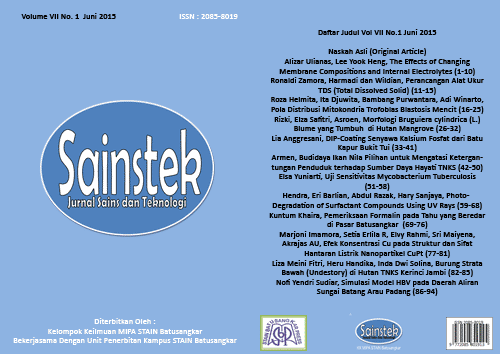
Downloads
Published
Issue
Section
License
Copyright (c) 2016 Roza Helmita, Ita Djuwita, Bambang Purwantara

This work is licensed under a Creative Commons Attribution-NonCommercial-NoDerivatives 4.0 International License.
Authors who publish with this journal agree to the following terms:
- Authors retain copyright and grant the journal right of first publication with the work simultaneously licensed under a Creative Commons Attribution License that allows others to share the work with an acknowledgement of the work's authorship and initial publication in this journal.
- Authors are able to enter into separate, additional contractual arrangements for the non-exclusive distribution of the journal's published version of the work (e.g., post it to an institutional repository or publish it in a book), with an acknowledgement of its initial publication in this journal.
- Authors are permitted and encouraged to post their work online (e.g., in institutional repositories or on their website) prior to and during the submission process, as it can lead to productive exchanges, as well as earlier and greater citation of published work.