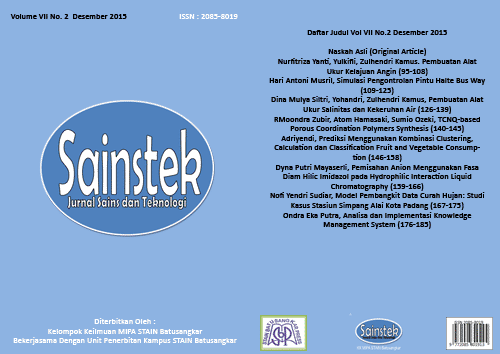
MODEL PEMBANGKIT DATA CURAH HUJAN: STUDI KASUS STASIUN SIMPANG ALAI KOTA PADANG
DOI:
https://doi.org/10.31958/js.v7i2.137Abstract
The effort on constructing weather data generator to cope with the scarcity of daily rainfall data is becoming essential recently. The objective of the paper is to generate rainfall daily data using stochastic spreadsheet. This technique can generate random values derived from the Gamma distribution which is initiated by the determination of rainfall probabilities, the occurrences on certain days and followed by the generation of rainfall height. The result showed that the rainfall data generator in Padang at period 1976-2005 showed consistent patterns with the observation eventhough simulation on day 180th the value is too high. Based on T-paired test, it showed no statistically significant different between simulation and observation (P-Value=0.000). Thus, the model can be employed as daily rainfall generator that can be further used to support the sustanaibility of agricultural activitiesin and food security in Padang.
Key words: the scarcity, Gamma distribution, food securityReferences
Albert, A.J. Hydrophilic-Interaction Chromatography for the Separation of Peptides, Nucleic Acids and Other Polar Compounds. J Chromatogr. 1990. 499. 177-196.
Alexander, L, N. Application of Hydrophilic Interaction Liquid Chromatography for the Analysis of Polar Contaminants in Food and Environmental Science. J. Chromatogr. 201
Alpert, Andrew J. Hydrophilic-interaction chromatography for the separation of peptides, nucleic acids and other polar compounds. J. Chromatogr. 1990. 499: 177–196.
Alpert, Andrew J. Electrostatic Repulsion Hydrophilic Interaction Chromatography for Isocratic Separation of Charged Solutes and Selective Isolation of Phosphopeptides. Anal. Chem. 2008. 80: 62–76.
Alpert, Andrew J. Peptide Orientation Affects Selectivity in Ion-Exchange Chromatography. Anal. Chem. 2010. 82: 5253– 5259
Braithwaite, A, Smith, F, J. Chromatographic Methods. Netherlands. 1999
Carrier, R, Bordanaro, J, Yip, K. Liquid Chromatography. 1997
Ding, W. Identification and Quantification of Glycoproteins Using Ion-Pairing Normal-Phase LC and MS. Molecular & Cellular Proteomics 2009. 8: 2170– 2185.
Eric S. Grumbach. Hydrophilic Interaction Chromatography Using Silica Columns for the Retention of Polar Analytes and Enhanced ESI-MS Sensitivity. 1999. LCGC Magazine.
Grimmet, M. Ross. Imidazole and Benzimidazole Synthesis. Academis Press
Guo Yong, Gaiki Shetal. Retention Behavior of Small Polar Compounds on Polar Stationary Phases in Hydrophilic Interaction Liquid Chromatography. J. Chromatogr. 2005. 71 – 80
Ikegami T. Separation Efficiencies in Hydrophilic Interaction Chromatography. J. Chromatogr. 2008. 1184. 474 – 503
Jandera, Pavel. Stationary Phases and Mobile Phases in Hydrophilic Liquid Chromatography. Analytica Chemica Acta 2011. 692. 11 -25
Michael, Cooke. Encyclopedia of Separation Science. USA
McKay, P. 2010. An Introduction to Chromatography.
Qiu, Hongdeng. Preparation and Evaluation of a Silica-based 1-alkyl-3(propyl-3-sulfonate) Imidazolium Zwitterionic Stationary Phases for High Performance Liquid Chromatography. J. Chromatogr. 2007. 1163. 63 – 69
Rees. 1984. Comprehensive Heterocyclic Chemistry. Vol 5. Page 469-498
Takeuchi T, Kawasaki T, Lim L. Separation of Inorganic Anions on a Pyridine Stationary Phase in Ion Chromatography. Analytical Science. 2010. Vol 26. 511 – 514Watson, G.D. The Hydrophilic Interaction Like Properties of Some Reversed Phase High Performance Liquid Chromatography Columns in The Analysis of Basic Compounds. J. Chromatogr. 2011. 1128. 1486 – 1491
Willey, John &Sons. 2004. Practical High Performace Liquid Chromatography. Fourth Edition. Switzerland
Yoshida, T. Peptide Separation in Normal Phase Liquid Chromatography. Analytical Chemistry. 1997. 69. 3038-3043.
Zein, R. Munaf, E. Takeuchi, T. Miwa, T. Application of microcolumnion chromatography using octadecylsilica immobilized with bovine serum albumin as stationary phase for the determination of inorganic anions. Journal of Abalitical Chemistry. 1996. 357 (4): 466 – 468.
Downloads
Published
Issue
Section
License
Copyright (c) 2016 Nofi Yendri Sudiar

This work is licensed under a Creative Commons Attribution-NonCommercial-NoDerivatives 4.0 International License.
Authors who publish with this journal agree to the following terms:
- Authors retain copyright and grant the journal right of first publication with the work simultaneously licensed under a Creative Commons Attribution License that allows others to share the work with an acknowledgement of the work's authorship and initial publication in this journal.
- Authors are able to enter into separate, additional contractual arrangements for the non-exclusive distribution of the journal's published version of the work (e.g., post it to an institutional repository or publish it in a book), with an acknowledgement of its initial publication in this journal.
- Authors are permitted and encouraged to post their work online (e.g., in institutional repositories or on their website) prior to and during the submission process, as it can lead to productive exchanges, as well as earlier and greater citation of published work.