
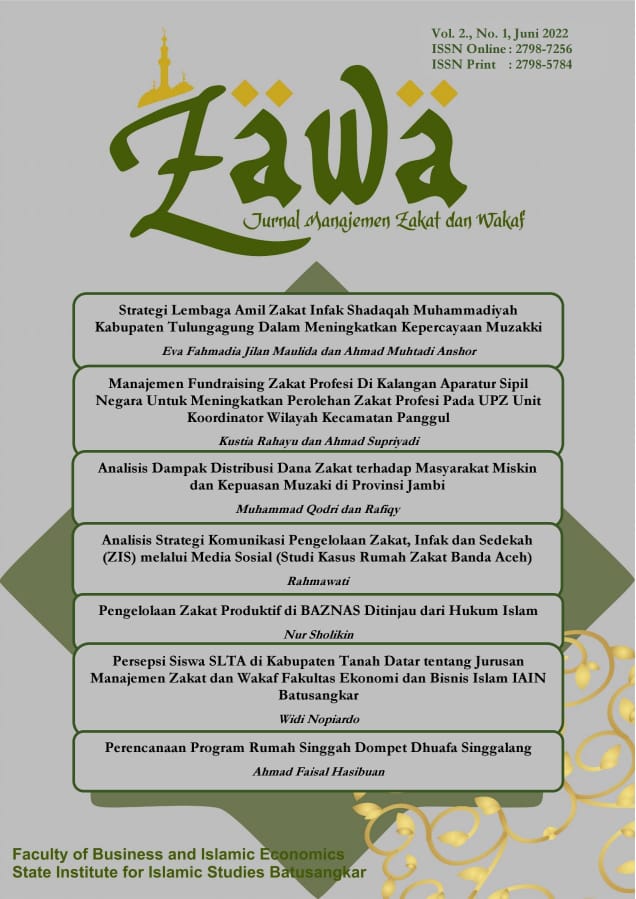
Pengelolaan Zakat Produktif di BAZNAS Ditinjau dari Hukum Islam
DOI:
https://doi.org/10.31958/zawa.v2i1.5739Keywords:
Baznas, Zakat Produktif, Teori KepemilikanAbstract
Zakat is one of the pillars of Islam that must be fulfilled by every Muslim who already has assets according to the nishab. Distribution of zakat by muzakki can be given directly to mustahik or through amil. The distribution of zakat in Baznas can be categorized into two forms, namely the distribution of zakat consumptively and productively. The purpose of this research is to find out how the management of productive zakat in Baznas will be reviewed from Islamic law/ownership theory. This research is a field research and to achieve this goal the author uses a descriptive qualitative approach. In this study, primary data was obtained from interviews with Baznas managers and the assistant team from Baznas. Secondary data is obtained from books, journals and related laws and regulations. The results of the study indicate that the management of zakat in Baznas is in accordance with Islamic law/ownership theory in which the management of zakat funds in Baznas has been distributed to those who are entitled to receive it, namely mustahik who are included in the 8 (eight) ashnaf category.
References
Antonio, Muhammad Syafi’i. 2001. Bank Syari’ah: Dari Teori ke Praktik. Jakarta: Gema Insani Press.
Arifin, Zainul. 1999. Memahami Bank Syari’ah, Lingkup, Peluang, Tantangan dan Prospek. Jakarta: Alvabet.
Ascarya. 2007. Akad dan Produk Bank Syariah. Jakarta: RajaGrafindo Persada.
Hardi, E. A. (n.d.). UANG FIAT DAN OPERASI PASAR TERBUKA : TINJAUAN EKONOMI ISLAM moneter . Pengendalian laju Inflasi dan peningkatan pertumbuhan PDB merupakan tujuan akhir money ) dalam perekonomian . Pengaturan percepatan perputaran uang di masyarakat dilakukan Pasar Terbuk.
Islahi, Abdul Azim. 1988. Economic Concepts of Ibn Taimiyah. London: The Islamic Foundation.
Karim, Adiwarman. 2007. Ekonomi Makro Islami. Jakarta: RajaGrafindo Persada.
Latifah, N. A. (2015). Kebijakan Moneter Dalam Perspektif Ekonomi Syariah. Jurnal Ekonomi MODERNISASI, 11(2), 124. https://doi.org/10.21067/jem.v11i2.873
Mannan, Muhammad Abdul. 1997. Islamic Economic, Theory and Practice, (terjemahan Nastangin). Yogyakarta: Dana Bhakti Wakaf.
Mansur. 2005. “Konsep Uang dan Bank: Studi Komparatif antara Ekonomi Konvensional dan Ekonomi Islam”, dalam Ontologi Kajian Islam, Seri 9.
Muhamad. 2002. Kebijakan Fiskal dan Moneter dalam Ekonomi Islam. Jakarta: Salemba Empat.
---------------. 2005. Dasar-Dasar Keuangan Islam, Yogyakarta.
---------------. 2005. Manajemen Bank Syari’ah. Yogyakarta: UPP AMP YKPN.
Nasution, Mustafa Edwin, dkk. 2006. Pengenalan Eksklusif Ekonomi Islam. Jakarta: Kencana.
Prasetyo, A. (2017). Peran Uang dalam Sistem Moneter Islam. Majalah Ekonomi, XXII(1), 104–110.
Purnomo, J. H. (2019). Uang Dan Moneter Dalam Sistem Keuangan Islam. Journal of Sharia Economics, 1(2), 80–100. https://doi.org/10.35896/jse.v1i2.71
Rahman, Afzalur. 2002. Economics Doctrines of Islam, (terjemahan Soeroyo dan Nastangin). Jakarta: Dana Bhakti Wakaf.
Rizal, M., & Irawan, N. (2020). Pengaruh Kualitas Produk , Harga Dan Promosi Terhadap Minat Beli Konsumen Pada Pt . Satria Nusantara Jaya. 05.
Rivai, Veithzal, dkk. 2007. Bank and Financial Institution Manajement Conventional and Sharia System. Jakarta: RajaGrafindo Persada.
Suprayitno, Eko. 2005. Ekonomi Islam, Pendekatan Ekonomi Makro Islam dan Konvensional. Yogyakarta: Graha Ilmu.
Downloads
Additional Files
Published
Issue
Section
License
Copyright (c) 2022 nur sholikin

This work is licensed under a Creative Commons Attribution-NonCommercial 4.0 International License.

Copyright Notice
Authors who publish with Zawa: Management of Zakat and Waqf Journal agree to the following terms:
- Authors retain copyright and grant the journal the right of first publication with the work simultaneously licensed under?áa Creative Commons Attribution-NonCommercial 4.0 International License that allows others to share the work with an acknowledgment of the work's authorship and initial publication in this journal.
- Authors are able to enter into separate, additional contractual arrangements for the non-exclusive distribution of the journal's published version of the work (e.g., post it to an institutional repository or publish it in a book), with an acknowledgment of its initial publication in this journal.
- Authors are permitted and encouraged to post their work online (e.g., in institutional repositories or on their website) prior to and during the submission process, as it can lead to productive exchanges, as well as earlier and greater citation of published work.