
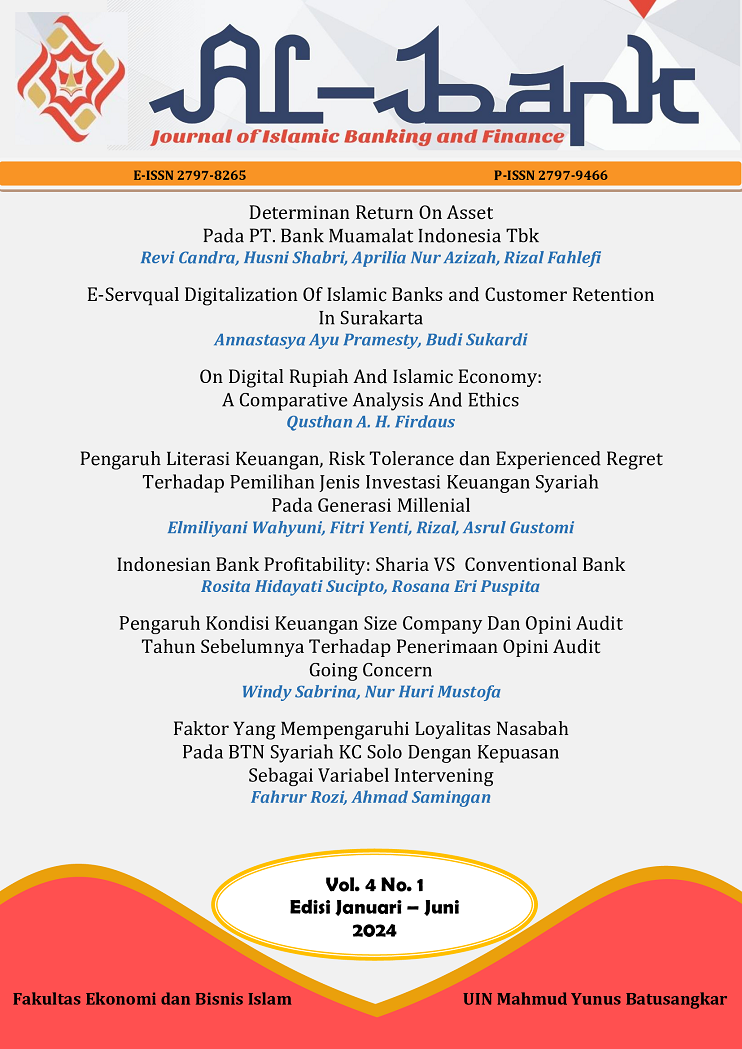
Pengaruh Literasi Keuangan, Risk Tolerance, Dan Experienced Regret Terhadap Pemilihan Jenis Investasi Keuangan Syariah Pada Generasi Millenial
DOI:
https://doi.org/10.31958/ab.v4i1.10911Keywords:
Financial Literacy, Risk Tolerance, Experienced Regret, Selection of Islamic financial investmentAbstract
The purpose of this study was to examine the effect of financial literacy, risk tolerance and experienced regret on the selection of types of Islamic financial investments in the millennial generation in Indonesia. This study used purposive sampling and convenience sampling there were 8,483,213 respondents and sampling using the Slovin formula with an error rate of 10% which obtained a sample of 100 respondents. The analysis technique uses multiple lieniar regression. The results showed that financial literacy affects the selection of Islamic financial investment types, while Risk Tolerance has no effect on the selection of Islamic financial investment types, and experienced regret has a positive and significant effect on the selection of Islamic investment types, and simultaneously the influence of financial literacy, Risk Tolerance and experienced regret affects the selection of Islamic investment types..  
References
Hati, S. W., & Harefa, W. S. (2019). Analisis Faktor-Faktor Yang Mempengaruhi Generasi Milenial ( Studi Pada Mahasiswi Jurusan Manajemen Bisnis Politeknik Negeri Batam ). Business Administration, 3(2), 281–295.
Mandagie, Y. R. O., Febrianti, M., & Fujianti, L. (2020). Analisis Pengaruh Literasi Keuangan, Pengalaman Investasi Dan Toleransi Risiko Terhadap Keputusan Investasi (Studi Kasus Mahasiswa Akuntansi Universitas Pancasila). RELEVAN : Jurnal Riset Akuntansi, 1(1), 35–47. https://doi. org/10.35814/relevan.v1i1.1814
OJK. (2017). Strategi Nasional Literasi Keuangan Indonesia (Revisit 2017) Otoritas Jasa Keuangan, 1–99.
Pangestika, T., & Rusliati, E. (2019). Literasi Dan Efikasi Keuangan Terhadap Minat Mahasiswa Berinvestasi Di Pasar Modal. Jurnal Riset Bisnis Dan Manajemen, 12(1), 37. https://doi.org/10.23969/jrbm .v12i1.1524
Pradikasari, E., & Isbanah, Y. (2018). Pengaruh Financial Literacy, Illusion of Control, Overconfidence, Risk Tolerance, dan Risk Perception Terhadap Keputusan Investasi Pada Mahasiswa di Kota Surabaya. Jurnal Ilmu Manajemen (JIM), 6(4), 424–434.
Putra, I. P. S., Ananingtiyas, H., Sari, D. R., Dewi, A. S., & Silvy, M. (2016). Pengaruh tingkat literasi keuangan, experienced regret, dan risk tolerance pada pemilihan jenis investasi. Journal of Business & Banking, 5(2), 271. https://doi. org/10.14414/jbb.v5i2.707
Putri, R., & Isbanah, Y. (2020). Faktor-Faktor yang Memengaruhi Keputusan Investasi Pada Investor Saham di Surabaya. Jurnal Ilmu Manajemen, 8(1), 197–209.
Ulfah. (2021). Motivasi berwirausaha generasi millennial Millennial generation entrepreneurship motivation. Akuntabel, 18(2), 336–345. https://journal.feb.unmul.ac .id/index.php/AKUNTABEL/article/view/9584%0Ahttps://journal.feb.unmul.ac.id/index.php/AKUNTABEL/article/download/9584/1312
Wulandari, P., & Pradesyah, R. (2023). Ekosistem Perbankan Syariah Dalam Mendukung. Tabarru’, 6(November).
Downloads
Published
How to Cite
Issue
Section
License
Copyright (c) 2024 Al-bank: Journal of Islamic Banking and Finance

This work is licensed under a Creative Commons Attribution-NonCommercial 4.0 International License.
Copyright Notice
Authors who publish with this journal agree to the following terms:
- Authors retain copyright and grant the journal the right of first publication with the work simultaneously licensed under?áa Creative Commons Attribution-NonCommercial 4.0 International License that allows others to share the work with an acknowledgment of the work's authorship and initial publication in this journal.
- Authors are able to enter into separate, additional contractual arrangements for the non-exclusive distribution of the journal's published version of the work (e.g., post it to an institutional repository or publish it in a book), with an acknowledgment of its initial publication in this journal.
- Authors are permitted and encouraged to post their work online (e.g., in institutional repositories or on their website) prior to and during the submission process, as it can lead to productive exchanges, as well as earlier and greater citation of published work.