
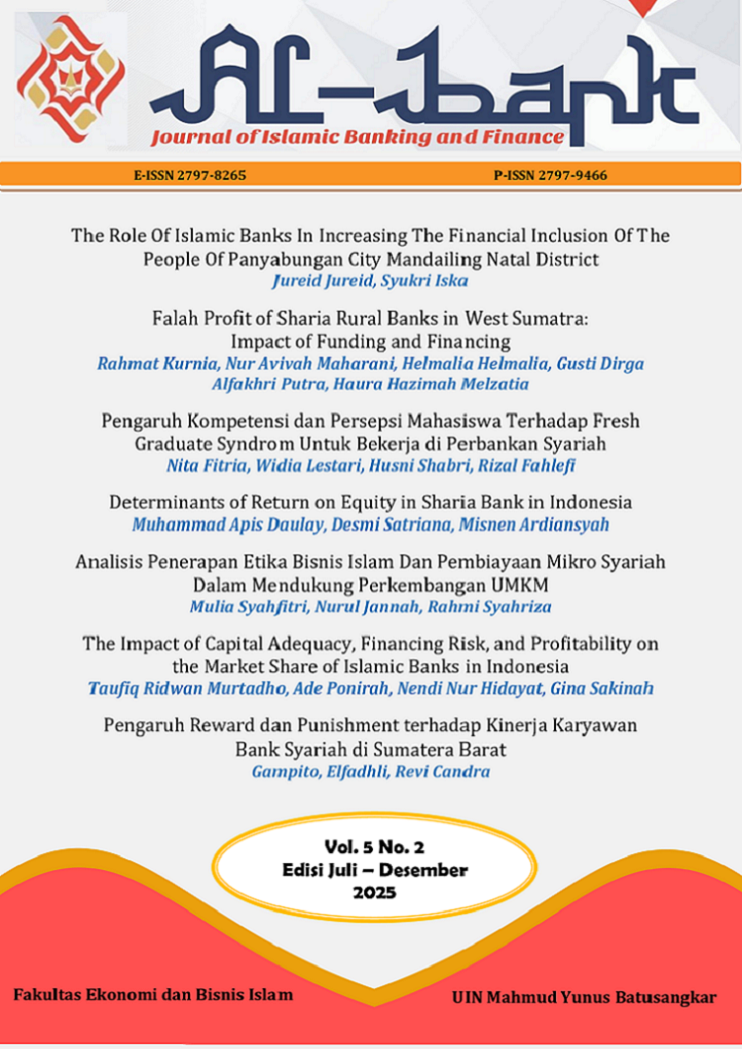
The Impact of Capital Adequacy, Financing Risk, and Profitability on the Market Share of Islamic Banks in Indonesia
DOI:
https://doi.org/10.31958/ab.v5i2.15943Keywords:
Islamic Commercial Bank, , Market Share Ratio, Capital Adequacy Ratio (CAR), Non-Performing Financing, Return on AssetsAbstract
This study aims to analyze the effect of the Capital Adequacy Ratio, Net Non-Performing Financing, and Return on Assets on the market share of Islamic Commercial Banks in Indonesia. Market share is measured as the percentage of Islamic Commercial Banks assets relative to total national banking assets. The study employs a quantitative approach using multiple linear regression analysis with quarterly aggregate data of Islamic Commercial Banks from Q1 2010 to Q4 2024. Data were obtained from the Islamic Banking Statistics published by the Financial Services Authority. The results reveal that Capital Adequacy Ratio and Net Non-Performing Financing significantly influence market share, while Return on Assets does not. Simultaneously, the three variables significantly affect market share with a coefficient of determination of 70.4%. These findings highlight that capital adequacy and financing quality are the primary factors driving the competitiveness of BUS, while profitability Return on Assets does not have a direct impact on market share expansion
References
Adawiyah, A. Z., & Suprihhadi, H. (2017). Pengaruh Modal, Aset, dan Ukuran Perusahaan Terhadap Profitabilitas Perbankan. Jurnal Ilmu Dan Riset Manajemen (JIRM), 6(1).
Akbar, D. A. (2016). Inflasi, gross domesctic product (GDP), capital adequacy ratio (CAR), dan finance to deposit ratio (FDR) terhadap non performing financing (NPF) pada bank umum syariah di Indonesia. I-ECONOMICS: A Research Journal on Islamic Economics, 2(2), 19–37.
Allen, I. (2007). Global Entrepreneurship Monitor Report on Women and Entrepreneurship. (No Title).
Alnajjar, A., & Othman, A. H. A. (2021). The impact of capital adequacy ratio (CAR) on Islamic banks’ performance in selected MENA countries. International Journal of Business Ethics and Governance (IJBEG), 116–133.
Anwar, C., & Miqdad, M. (2017). Pengaruh Dana Pihak Ketiga (DPK), Capital Adequacy Ratio (CAR), Return On Asset (ROA) Terahadap Pembiayaan Mudharabah Pada Bank Umum Syariah Tahun 2008-2012. Owner: Riset Dan Jurnal Akuntansi, 1(1).
Ashraf, D., Rizwan, M. S., & L’Huillier, B. (2016). A net stable funding ratio for Islamic banks and its impact on financial stability: An international investigation. Journal of Financial Stability, 25, 47–57.
Berger, A. N., & Mester, L. J. (1997). Inside the black box: What explains differences in the efficiencies of financial institutions? Journal of Banking & Finance, 21(7), 895–947.
Bothwell, J. L., Cooley, T. F., & Hall, T. E. (1984). A new view of the market structure—Performance debate. The Journal of Industrial Economics, 32(4), 397–417.
Brigham, E. F., & Houston, J. F. (2019). Fundamentals of Financial Management: Concise by Cengage. Cengage Learning.
Buchory, H. A. (2015). Banking intermediation, operational efficiency and credit risk in the banking profitability. 7(2), 141–152.
Damodaran, A. (2008). Strategic risk taking: A framework for risk management. Pearson Prentice Hall.
Doan, N. T., Hoang, D. P., & Pham, A. H. T. (2020). Media reputation: A source of banks’ financial performance. International Journal of Bank Marketing, 38(6), 1399–1419.
Duho, K. C. T., Onumah, J. M., Owodo, R. A., Asare, E. T., & Onumah, R. M. (2020). Bank risk, profit efficiency and profitability in a frontier market. Journal of Economic and Administrative Sciences, 36(4), 381–402.
Effendi, J., Thiarany, U., & Nursyamsiah, T. (2017). Factors Influencing Non-Performing Financing (Npf) At Sharia Banking. Walisongo: Jurnal Penelitian Sosial Keagamaan, 25(1).
El-Ansary, O., & Yousery, Z. (2019). Determinants of capital adequacy ratio (CAR) in MENA region: Islamic vs. Conventional banks. International Journal of Accounting and Financial Reporting, 9(2), 287–313.
Fasnacht, D. (2018). Open innovation in the financial services. In Open innovation ecosystems: Creating new value constellations in the financial services (pp. 97–130). Springer.
Gobat, J., Yanase, M., & Maloney, J. (2014). The net stable funding ratio: Impact and issues for consideration. International Monetary Fund.
Harun, U. (2016). Pengaruh Ratio-ratio Keuangan Car, Ldr, Nim, Bopo, Npl Terhadap Roa. Jurnal Riset Bisnis Dan Manajemen, 4(1), 67–82.
Heikal, M., Khaddafi, M., & Ummah, A. (2014). Influence analysis of return on assets (ROA), return on equity (ROE), net profit margin (NPM), debt to equity ratio (DER), and current ratio (CR), against corporate profit growth in automotive in Indonesia Stock Exchange. International Journal of Academic Research in Business and Social Sciences, 4(12), 101.
Hussein, K. (2010). Bank-level stability factors and consumer confidence–A comparative study of Islamic and conventional banks’ product mix. Journal of Financial Services Marketing, 15(3), 259.
Iqbal, M., Nisha, N., & Rashid, M. (2018). Bank selection criteria and satisfaction of retail customers of Islamic banks in Bangladesh. International Journal of Bank Marketing, 36(5), 931–946.
Kasmir. (2012). Bank dan Lembaga keuangan lainnya. Raja Wali Press.
Katuuk, P. M., Kumaat, R. J., & Niode, A. O. (2018). Pengaruh Dana Pihak Ketiga, Loan to Deposit Ratio, Biaya Operasional Pendapatan Operasional terhadap Return on Asset Bank Umum di Indonesia periode 2010.1-2017.4. Jurnal Berkala Ilmiah Efisiensi, 18(2).
Kovalenko, V., Bolgar, T., Yevtushenko, O., & Pestovska, Z. (2019). Competitiveness of banks in the modern conditions of financial market development. Financial and Credit Activity Problems of Theory and Practice, 2(29), 3–12.
Lestari, R. M. E., & Sari, P. P. (2015). Komparasi Pengaruh Arus Kas Terhadap Nilai Perusahaan Antara Pt Hero Supermarket Tbk Dengan Pt Matahari Putra Prima Tbk. Jurnal Ilmiah Akuntansi Fakultas Ekonomi, 1(1), 33–37.
Mangesti Rahayu, S. (2019). Mediation effects financial performance toward influences of corporate growth and assets utilization. International Journal of Productivity and Performance Management, 68(5), 981–996.
Mishkin, F. S. (2007). The economics of money, banking, and financial markets. Pearson education.
Mutua, M. M., & Kori, B. (2022). Growth strategies and performance of commercial banks in Nairobi County, Kenya. Journal of Strategic Management, 6(6), 22–34.
Nasution, L. A., Zuliansyah, A., & Syarif, A. H. (2024). Pengaruh Inflasi, Bi Rate, Fdr, Car, & Bopo Terhadap Npf Pada Bank Umum Syariah Tahun 2016-2023. Nisbah: Jurnal Perbankan Syariah, 10(2), 210–227.
OJK. (2024). Siaran Pers: Kinerja Positif Perbankan Syariah 2024. Otoritas Jasa Keuangan. https://ojk.go.id/id/berita-dan-kegiatan/siaran-pers/Pages/Kinerja-Positif-Perbankan-Syariah-2024.
Olawale, A. (2024). Capital adequacy and financial stability: A study of Nigerian banks’ resilience in a volatile economy. GSC Advanced Research and Reviews, 21(1), 001–012.
Panjaitan, R. Y. (2018). Pengaruh Current Ratio, Debt to Equity Ratio, Net Profit Margin dan Return On Asset terhadap pertumbuhan laba pada perusahaan consumer goods yang terdaftar di bursa efek indonesia periode 2013-2016. Jurnal Manajemen, 4(1), 61–72.
Rustan, D. M., & Andi, G. (2024). Analisis Laporan Keuangan untuk Mengukur Kinerja Keuangan pada PT. Bank Neo Commerce TBK. Journal of Economic Education and Entrepreneurship Studies, 5(2), 317–333.
Shin, H. S. (2010). Financial intermediation and the post-crisis financial system.
Simanjuntak, J. (2017). Pengaruhcapital Adequacy Ratio (Car), Loan To Deposit Ratio (Ldr) Dannon Performing Loan (Npl) Terhadapreturn On Assets (Roa) Pada Sektor Perbankan Di Bursa Efek Indonesia. Bisman-Jurnal Bisnis & Manajemen, 2(02), 102–111.
Syakhrun, M., Anwar, A., & Amin, A. (2019). Pengaruh CAR, BOPO, NPF dan FDR terhadap profitabilitas pada Bank Umum Syariah di Indonesia. BJRM (Bongaya Journal of Research in Management), 2(1), 1–10.
Utami, M. S. M., & Muslikhati, M. (2019). Pengaruh Dana Pihak Ketiga (DPK), Capital Adequacy Ratio (CAR), Non Performing Financing (NPF) terhadap Likuiditas Bank Umum Syariah (BUS) Periode 2015-2017. Falah: Jurnal Ekonomi Syariah, 4(1), 33–43.
Van Horne, J. C., & Wachowicz, J. M. (2005). Fundamentals of financial management. Pearson education.
Wahyuni, T., Siregar, P. A., & Bancin, K. (2020). Faktor Makroekonomi dan Mikroekonomi dalam Pembiayaan Bermasalah Bank Syariah di Indonesia. Equilibrium, 8(1), 89–108.
Widiarti, A. W., Siregar, H., & Andati, T. (2015). The determinants of bank’s efficiency in Indonesia. Bulletin of Monetary Economics and Banking, 18(2), 129–156.
Yusuf, M. (2017). Dampak indikator rasio keuangan terhadap profitabilitas bank umum syariah di Indonesia. Jurnal Keuangan Dan Perbankan, 13(2), 141–151.
Downloads
Published
How to Cite
Issue
Section
License
Copyright (c) 2025 Taufiq Ridwan Murtadho, Ade Ponirah, Nendi Nur Hidayat, Gina Sakinah

This work is licensed under a Creative Commons Attribution-NonCommercial 4.0 International License.
Copyright Notice
Authors who publish with this journal agree to the following terms:
- Authors retain copyright and grant the journal the right of first publication with the work simultaneously licensed under?áa Creative Commons Attribution-NonCommercial 4.0 International License that allows others to share the work with an acknowledgment of the work's authorship and initial publication in this journal.
- Authors are able to enter into separate, additional contractual arrangements for the non-exclusive distribution of the journal's published version of the work (e.g., post it to an institutional repository or publish it in a book), with an acknowledgment of its initial publication in this journal.
- Authors are permitted and encouraged to post their work online (e.g., in institutional repositories or on their website) prior to and during the submission process, as it can lead to productive exchanges, as well as earlier and greater citation of published work.