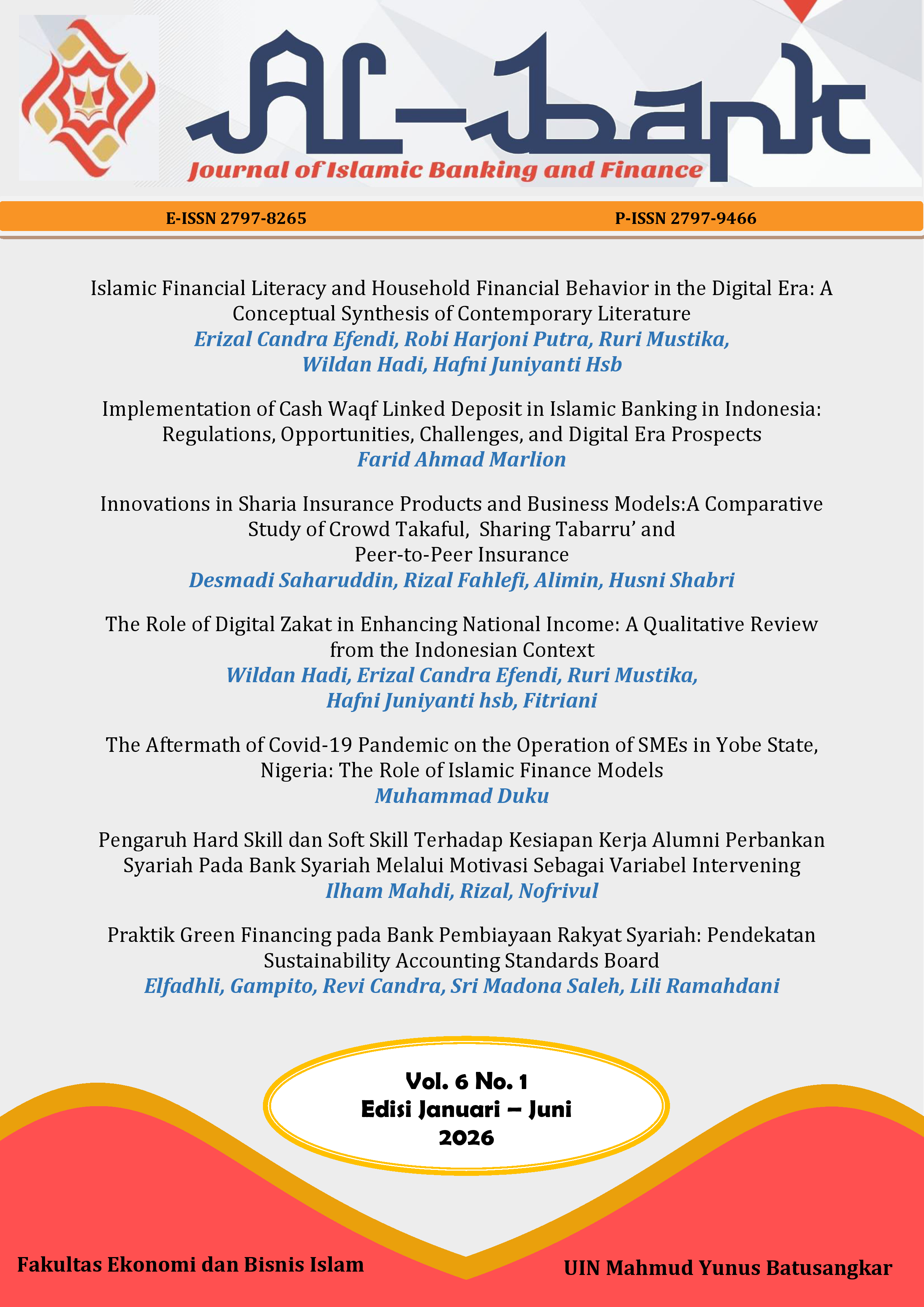
Implementation of Cash Waqf Linked Deposit in Islamic Banking in Indonesia: Regulations, Opportunities, Challenges, and Digital Era Prospects
DOI:
https://doi.org/10.31958/ab.v6i1.16075Keywords:
Cash Waqf Linked Deposit (CWLD), Digital Islamic Banking, Islamic Financial Inclusion, Cash Waqf Regulation, Islamic Financial Technology TransformationAbstract
This study aims to analyze the implementation of CWLD in Islamic banking within the digital era by examining its regulatory framework, institutional challenges, and prospects in Indonesia. Using a qualitative literature-based research approach, this study reviews academic publications, regulatory documents, and institutional reports related to cash waqf, Islamic banking, and digital financial innovation. The findings indicate that although CWLD has substantial potential to promote financial inclusion and strengthen Muslim community empowerment, its development remains constrained by the absence of comprehensive technical regulations, institutional fragmentation, low public literacy on cash waqf, limited digital infrastructure, and inadequate managerial capacity of nazhir institutions. Nevertheless, the digital era presents significant opportunities for CWLD development through the integration of technological platforms such as blockchain, Islamic crowdfunding, and digital banking systems. This study contributes to the literature on Islamic social finance by providing a structured analysis of CWLD as an innovative instrument and offers practical insights for policymakers, Islamic banks, and waqf institutions to strengthen regulatory support, enhance public literacy, and foster institutional collaboration to position CWLD as a key pillar of an inclusive and sustainable Islamic financial system
References
Book
OJK. (2024). Pedoman Implementasi Cash Waqf Linked Deposit (CWLD). Departemen Perbankan Syariah Otoritas Jasa Keuangan. https://ojk.go.id/id/berita-dan-kegiatan/publikasi/ Documents/Pages/Pedoman-Implementasi-Cash-Waqf-Linked-Deposit-CWLD/Pedoman Implementasi CWLD - OJK.pdf
Journal
Adinugraha, H. H., Shulhoni, M., & Achmad, D. (2023). Islamic social finance in Indonesia: Opportunities, challenges, and its role in empowering society. Review of Islamic Social Finance and Entrepreneurship, 2(1), 45–62. https://doi.org/10.20885/risfe.vol2.iss1.art4
Arafah, S. (2025). Perspektif Maqashid Syariah Dalam Cash Waqf Linked Deposit: Implikasi Mashlahat Ekonomi Dan Sosial. PROFJES: Profetik Jurnal Ekonomi Syariah, 4(1).
Asy’arie, B. F., & Ahmad Djalaludin. (2023). Instrumen Ekonomi Islam untuk Kesejahteraan Sosial: Eksplorasi Potensi Wakaf Uang di Indonesia. Istithmar, 8(1), 25–41. https://doi.org/10.30762/istithmar.v8i1.1047
Aufa, I. W., Pratama, A. M., & Pati, U. K. (2023). Cash Waqf Linked Sukuk through Securities Crowdfunding in Indonesia. Jambura Law Review, 5(1), 98–117. https://doi.org/10.33756/jlr.v5i1.15225
Berakon, I., Aji, H. M., & Hafizi, M. R. (2022). Impact of digital Sharia banking systems on cash-waqf among Indonesian Muslim youth. Journal of Islamic Marketing, 13(7), 1551–1573. https://doi.org/10.1108/JIMA-11-2020-0337
Gultom, M. S., & Mihajat, M. I. S. (2024). Cash Waqf Linked Deposit: A Proposed Waqf Model for Education Program and Poverty Alleviation in Indonesia. Contributions to Management Science, Part F3298, 313–325. https://doi.org/10.1007/978-3-031-61778-2_17
Hassan, M. K., & Aliyu, S. (2018). A contemporary survey of Islamic banking literature. Journal of Financial Stability, 34, 12–43. https://doi.org/10.1016/j.jfs.2017.11.006
Hilmi, H. (2024). Pengelolaan Wakaf Uang Berkeadilan Sosial: Pengelolaan Investasi Dan Manfaat Wakaf Uang Melalui Pembiayaan Mikro Oleh BMT. AL RASIKH Jurnal Hukum Islam, 13(November), 256–269.
Hosen, M. N., Maulana, A., Farhand, M. Z., & Rahman, M. F. (2022). Evaluating The Fundraising Process Of The World's First Cash Waqf-Linked Sukuk In Indonesia Agung Maulana A.. Introduction The limited financial budget has forced central and regional governments to find other alternative financing sources to accelerate. Qudus International Journal of Islamic Studies (QIJIS) Volume, 10(1), 175–214.
Madani, R. I., Nurhidayati, & Thomafy, K. (2024). Examining The Potential of Cash Waqf and Development Model. MUNAZZAMA : Journal of Islamic Management and Pilgrimage, 4(2), 83–103.
Mohd Thas Thaker, M. A., Amin, M. F., Mohd Thas Thaker, H., Khaliq, A., & Allah Pitchay, A. (2020). Cash waqf model for micro enterprises’ human capital development. ISRA International Journal of Islamic Finance, 13(1), 66–83. https://doi.org/10.1108/IJIF-08-2018-0091
Nur Arbaien, M. F., & Nurkaromah, S. R. (2025). Cash Waqf Linked Deposits: Maqashid Al-Syariah Perspective. La Zhulma | Jurnal Ekonomi Dan Bisnis Islam, 6(1), 1–13. https://doi.org/ 10.70143/lazhulma.v6i1.395
Pujiyono, A., Fauzi, U., Lubis, H., Andrini, R., Zahra, K. A., Gultom, M. S., & Shofawati, A. (2025). Transformasi Pengembangan Wakaf Di Tanah Air. In Penerbit Az-Zahra Media Society.
Sihite, N., Kamal, H., Sayuti, A., Safrina, E., & Afdhilah, N. (2025). Inovasi Akad Cash Waqf Linked Deposit (Cwld) Untuk Sinergi Fungsi Sosial Dan Komersial Bank Syariah. Aksioma Al-Musaqoh, 8(1), 18–28.
Sundana, E. (2025). Manajemen Literasi Wakaf Uang Di Yayasan Edukasi Wakaf Indonesia Yogyakarta Dalam Perspektif Maqasid Wakaf. Universitas Islam Indonesia.
Utomo, G. S., & Ismal, R. (2024). Cash Waqf Linked Deposit Potential for Revitalizing Islamic Banking in Indonesia. Share: Jurnal Ekonomi Dan Keuangan Islam, 13(1), 71–91. https://doi.org/10.22373/share.v13i1.22087
Wahyudi, I., Qizam, I., Amelia, E., & Yama, I. (2024). Potensi Bisnis Perbankan Syariah Indonesia Tahun 2024: Peluang Dan Tantangan. Jurnal Lentera Bisnis, 13(1), 11. https://doi.org/10.34127/jrlab.v13i1.945
Proceding
Haisyah, N. (2024). Business and Risk Management Approaches in Managing Cash Waqf to Empower MSMEs in Indonesia. International Conference On Islamic Education Management and Sharia Economics, 157–178. https://prosiding.stainim.ac.id
Website
AAPJII. (2024). Asosiasi Penyelenggara Jasa Internet Indonesia (APJII). https://apjii.or.id/berita/d/apjii-jumlah-pengguna-internet-indonesia-tembus-221-juta-orang
BPS. (2024). Badan Pusat Statistik. https://bandungkab.bps.go.id/news/2025/02/18/206/peran-penggunaan-internet-di-indonesia.html#:~:text=Sekilas info untuk %23SahabatData bahwa,tergantikan oleh internet/paket data?
BWI. (2024). Badan Wakaf Indonesia. https://www.bwi.go.id/
BWI. (2025). Badan Wakaf Indonesia. https://www.bwi.go.id/9336/2024/02/25/bwi-sebut-perlu-akselerasi-wakaf-uang-agar-potensinya-terserap-maksimal/
Kemenag. (2024). Kementerian Agama Republik Indonesia. https://kemenag.go.id/nasional/kemenag-bwi-ojk-rilis-panduan-produk-inovasi-wakaf-uang-dan-deposito-cwld-K64Zn
Kementerian keuangan. (2025). State of the Global Islamic Economy (SGIE) Report 2024/2025. https://www.kemenkeu.go.id/informasi-publik/publikasi/berita-utama/Indonesia-Peringkat-Tiga-Ekonomi-Syariah-Global
OJK. (2024). Pedoman Implementasi Cash Waqf Linked Deposit (CWLD). Departemen Perbankan Syariah Otoritas Jasa Keuangan. https://ojk.go.id/id/berita-dan-kegiatan/publikasi/Documents/Pages/Pedoman-Implementasi-Cash-Waqf-Linked-Deposit-CWLD/Pedoman Implementasi CWLD - OJK.pdf
Downloads
Published
How to Cite
Issue
Section
License
Copyright (c) 2026 Farid Ahmad Marlion SE

This work is licensed under a Creative Commons Attribution-NonCommercial 4.0 International License.
Copyright Notice
Authors who publish with this journal agree to the following terms:
- Authors retain copyright and grant the journal the right of first publication with the work simultaneously licensed under?áa Creative Commons Attribution-NonCommercial 4.0 International License that allows others to share the work with an acknowledgment of the work's authorship and initial publication in this journal.
- Authors are able to enter into separate, additional contractual arrangements for the non-exclusive distribution of the journal's published version of the work (e.g., post it to an institutional repository or publish it in a book), with an acknowledgment of its initial publication in this journal.
- Authors are permitted and encouraged to post their work online (e.g., in institutional repositories or on their website) prior to and during the submission process, as it can lead to productive exchanges, as well as earlier and greater citation of published work.