
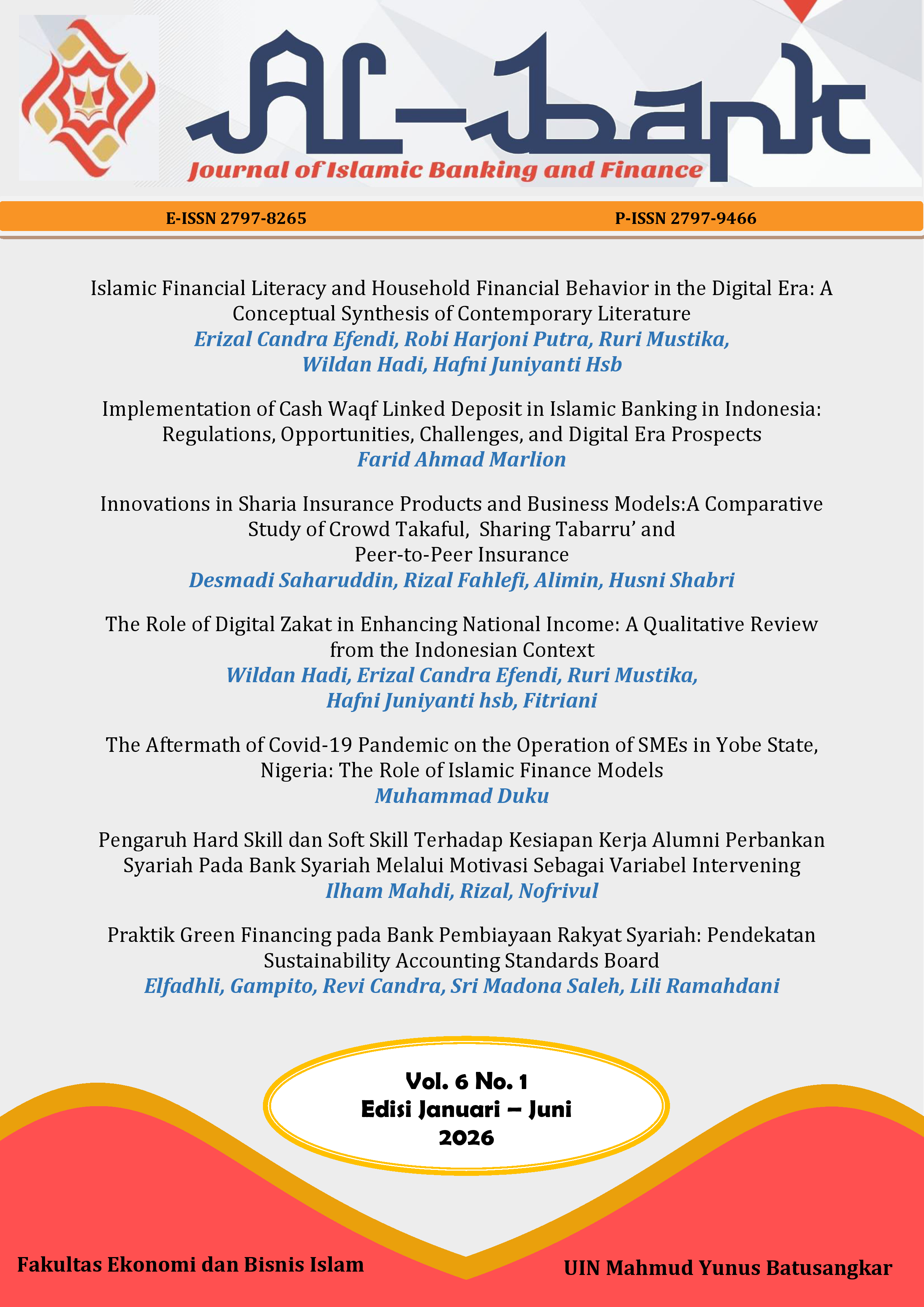
Praktik Green Financing pada Bank Pembiayaan Rakyat Syariah: Pendekatan Sustainability Accounting Standards Board
DOI:
https://doi.org/10.31958/ab.v6i1.16571Keywords:
Green Financing, SASB Index, BPRS, Islamic Rural Bank, West SumatraAbstract
This study examines the implementation of Green Financing in Islamic Rural Bank in West Sumatra using the Sustainable Accounting Standards Board (SASB) Index as an analytical framework. A descriptive qualitative approach was employed, utilizing interviews and surveys to evaluate Environmental, Social, and Governance (ESG) dimensions. The findings indicate that environmental initiatives have been initiated; however, their implementation remains informal and lacks systematic documentation. In contrast, the social dimension demonstrates a strong commitment to employee welfare and community empowerment, reflecting the social objectives inherent in Sharia banking principles. Meanwhile, the governance dimension shows that environmental risk considerations have been partially integrated into standard operating procedures (SOP), aligned with Sharia compliance requirements. Overall, the results suggest that while Islamic Rural Bank practices are generally consistent with basic SASB standards, the absence of comprehensive written policies and standardized reporting mechanisms limits the effectiveness and sustainability of green financing implementation. This study highlights the need for formalized governance structures and documented environmental policies to strengthen sustainable finance practices within Islamic rural banking institutions
References
Book
Ajija, S. R., et al. (2020). Koperasi BMT. Jawa Tengah: CV Inti Media Komunika.
Antonio, M. S., & Muhammad, A. (2001). Bank syariah: Dari teori ke praktik. Jakarta: Gema Insani Press.
Askari, Z., et al. (2020). Metodologi penelitian kualitatif, kuantitatif, action research, research and development. Kolaka: Yayasan Pondok Pesantren Al-Mawaddah Warrahmah.
Fardillah, F., et al. (2021). Perbankan syariah Indonesia. Cirebon: Penerbit Insania.
Meo, M. S., & Staniewski, M. W. (Eds.). (2022). Green bonds and sustainable finance: The evolution of portfolio management in conventional markets. London: Routledge.
Panjaitan, L. T. (2015). Bank ramah lingkungan: Panduan keberlanjutan (sustainability). Jakarta: Penebar Plus.
Lehner, O. M., Harrer, T., Silvola, H., & Weber, O. (Eds.). (2021). The Routledge handbook of green finance. London: Routledge.
https://doi.org/10.4324/9780429290990
Pranata, R., et al. (2022). Manajemen risiko bank syariah di Indonesia. Yogyakarta: UAD Press.
Sodik, S. S. (2015). Dasar metodologi penelitian. Yogyakarta: Literasi Media Publishing.
Sumantrie, P. (2020). Manajemen dalam berorganisasi. Malang: Ahlimedia Press.
Syahron Al Rosyid, et al. (2022). Implementasi manajemen sumber daya manusia. Pekalongan: NEM.
Wahid, N. (2021). Perbankan syariah: Tinjauan hukum normatif dan hukum positif. Jakarta: Kencana.
International Finance Corporation. (2017). Green bonds: A guide to the market. Washington, DC: International Finance Corporation.
Journal
Agus, M., et al. (2015). Perkembangan bank syariah di Indonesia. Jurnal Ilmiah Ekonomi Islam, 7(6), 76–85.
Bashir, M., & Noor, M. (2020). Islamic green finance: Instruments, applications, and the role of Islamic banks in supporting sustainable development. Journal of Sustainable Finance & Investment, 10(2), 128–145. https://doi.org/10.1080/20430795.2019.1592880
Berini, H. O. (2021). Analisis pengaruh green banking pada risiko penyaluran pembiayaan di bank umum syariah (Skripsi). UIN Raden Intan Lampung Repository.
Ariffin, J., & Kassim, S. H. (2012). Green financing: Perspectives on Islamic finance and its role in environmental sustainability. International Journal of Islamic and Middle Eastern Finance and Management, 5(3), 266–278. https://doi.org/10.1108/17538391211255243
Güzel, F., & Küçük, S. (2019). Islamic finance and green financing: Prospects and challenges. European Journal of Sustainable Development, 8(4), 34–47. https://doi.org/10.14207/ejsd.2019.v8n4p34
Hasan, M. M., & Ahmed, K. (2021). Financing green projects in Islamic banks: The role of green sukuk. International Journal of Islamic Banking and Finance, 8(4), 45–58.
Iqbal, M. (2024). Transformasi pembiayaan berbasis green financing pada Bank Syariah Indonesia. Jurnal Syahada, 12(1), 1–15.
Mutmainna, N. (2021). Analisis implementasi green banking pada Bank Muamalat Indonesia (Skripsi). IAIN Palopo Repository.
Othman, J., & Abdul Rahman, A. (2020). The role of Islamic financial institutions in green financing: A study of BPRS in Indonesia. Journal of Islamic Economics, 15(2), 105–121.
Pambekti, G. T. (2024). Green productivity in Sumatra Island: The potential of rural bank’s green lending, digitalization, and financial literacy. Sumatra Economics, 3(1), 22–38.
Zaki, M., & Al-Makky, S. (2017). The role of Islamic financial instruments in environmental sustainability: Case study of sukuk and ijarah. Journal of Islamic Business and Management, 5(1), 66–78
Downloads
Published
How to Cite
Issue
Section
License
Copyright (c) 2026 Elfadhli, Gampito, Revi Candra, Sri Madona Saleh, Lili Ramahdani

This work is licensed under a Creative Commons Attribution-NonCommercial 4.0 International License.
Copyright Notice
Authors who publish with this journal agree to the following terms:
- Authors retain copyright and grant the journal the right of first publication with the work simultaneously licensed under?áa Creative Commons Attribution-NonCommercial 4.0 International License that allows others to share the work with an acknowledgment of the work's authorship and initial publication in this journal.
- Authors are able to enter into separate, additional contractual arrangements for the non-exclusive distribution of the journal's published version of the work (e.g., post it to an institutional repository or publish it in a book), with an acknowledgment of its initial publication in this journal.
- Authors are permitted and encouraged to post their work online (e.g., in institutional repositories or on their website) prior to and during the submission process, as it can lead to productive exchanges, as well as earlier and greater citation of published work.