
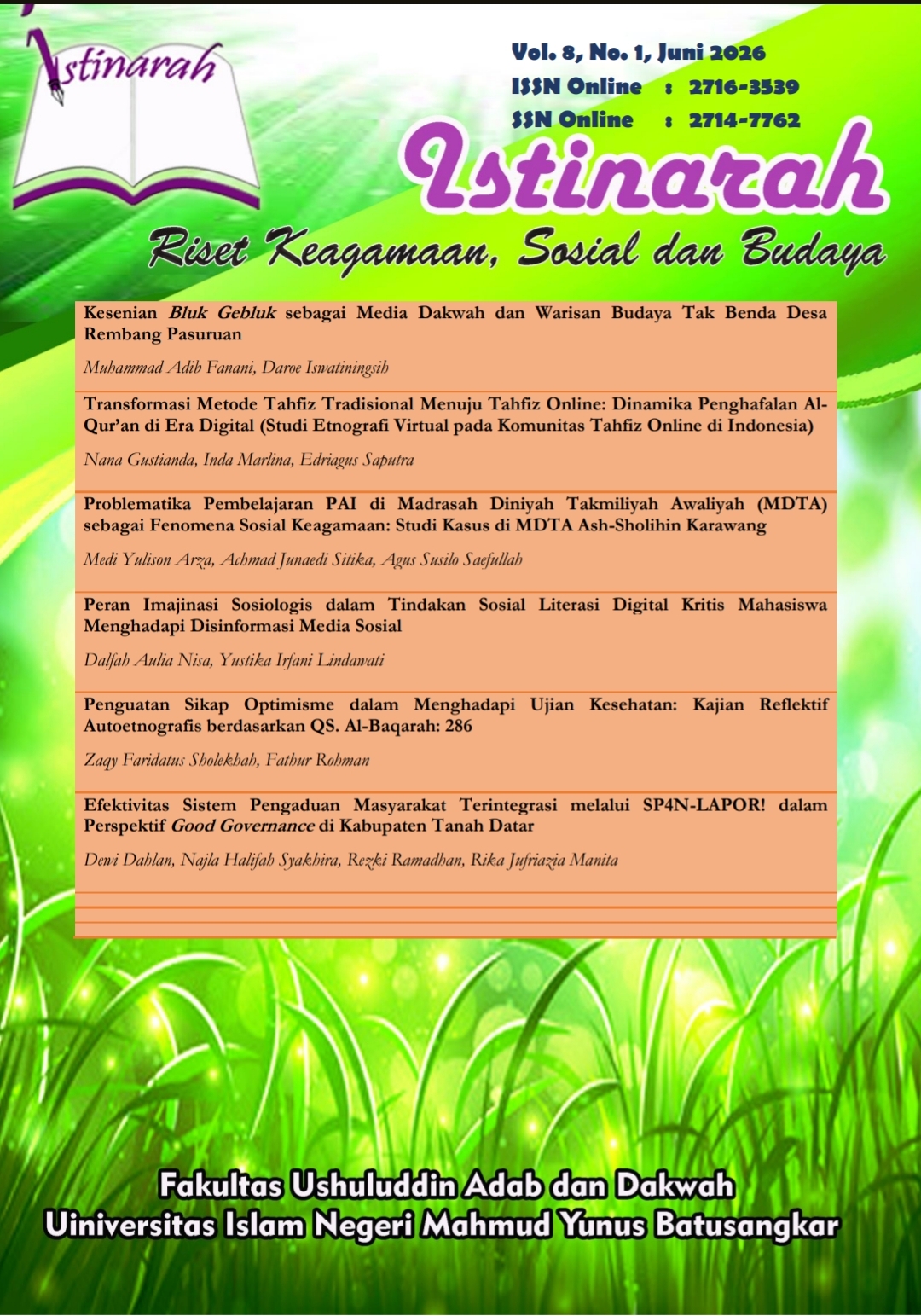
Kesenian Bluk Gebluk sebagai Media Dakwah dan Warisan Budaya Tak Benda Desa Rembang Pasuruan
DOI:
https://doi.org/10.31958/istinarah.v8i1.16926Keywords:
Bluk Gebluk, Intangible Cultural Heritage, Local Wisdom, Da'wah Media, Rembang Village, PasuruanAbstract
This study aims to describe the history, local wisdom values, performance procession, and analyze the status of Bluk Gebluk art as an intangible cultural heritage in Rembang Village, Pasuruan Regency. This research employs a qualitative approach with ethnographic and phenomenological methods. Data were collected through participatory observation, in-depth interviews with five key informants (chairperson of jam’iyah, two active members, religious leader, and representative of Pasuruan Culture and Tourism Agency), and documentation. The findings reveal that Bluk Gebluk was initiated by KH. Zainal Abidin as a medium for Islamic da'wah, developed together with KH. Abdurrasyid, and disseminated by KH. Abdul Hamid before 1924. Since 1950, routine weekly activities have been established and continue to this day. The local wisdom values contained in Bluk Gebluk include religiosity, mutual cooperation (gotong royong), and simplicity. The performance procession involves three functional roles: the main vocalist as spiritual leader, the pillow beater as rhythm keeper, and other members clapping hands as collective participation. Based on UNESCO 2003 criteria and Law Number 5 of 2017 on Cultural Advancement, Bluk Gebluk qualifies as an intangible cultural heritage because it is passed down orally and through direct practice, forms community identity, contains living cultural values, and is still practiced regularly. This study contributes to the documentation and preservation of Nusantara's cultural heritage rich in religious and social meaning.
References
Abdullah. (2011). Pemikiran dan Perjuangan Dakwah Hamka dan M. Natsir: Kajian terhadap Dakwah Kultural dan Struktural.
Fusnika, D. (2022). Implementasi Nilai Gotong Royong Dalam Kehipupan Bermasyarakat (Studi Kasus Kegiatan Kerja Bakti Di RT/RW: 009/002 Dusun Keladan Tunggal …. Jurnal Pendidikan …, 7(1), 15–28. http://jurnal.stkippersada.ac.id/jurnal/index.php/PEKAN/article/view/1628%0Ahttp://jurnal.stkippersada.ac.id/jurnal/index.php/PEKAN/article/download/1628/1183
Khodafi, M. dan, & Novitasari, H. (2019). Upaya Membranding Stigma Negatif Tradisi Nikah Sirri di Desa Kalisat, Rembang, Pasuruan Melalui Pelestarian Tradisi Gebluk. SULUK: Jurnal Bahasa, Sastra, Dan Budaya, 1(2), 87–93. https://doi.org/10.15642/suluk.2019.1.2.87-93
Koeswinarno. (2015). Memahami Etnografi Ala Spradley. 257–265.
Kurnia, Heri, D. (2023). Gotong Royong Sebagai Sarana dalam Mempererat Solidaritas Masyarakat Dusun Kalangan. EJOIN : Jurnal Pengabdian Masyarakat, 1(4), 277–282. https://doi.org/10.55681/ejoin.v1i4.754
Kurniawan, M. A. (2021). Penerapan Nilai-Nilai Religius dalam Pembentukan Karakter Siswa Di SDN Jambean 01 Pati. Dwijaloka Jurnal Pendidikan Dasar & Menengah, 2(2), 197–204.
Mashabi, M. Ali, D. (2025). Multicultural Islamic Education Through Syi’iran Bluk Gebluk: A Case Study At The Grogolan Taklim Council, Pasuruan, Indonesia. Fikroh: Jurnal Pemikiran Dan Pendidikan Islam, 18(2), 219–231. https://doi.org/10.37812/fikroh.v18i2.1849
Mashabi, M. A. (2025). Syi ’iran Bluk Gebluk ; Dari Penelitian Mahasiswa Pascasarjana Menuju Warisan.
Naamy, N. (2019). Metodologi Penelitian Kualitatif Dasar-Dasar & Aplikasinya. https://repository.uinmataram.ac.id/2853/1/buku Metode Penelitian.pdf
Nainggolan, D. N. dan S. D. (2025). Implementasi Nilai Kesederhanaan dalam Kehidupan Sehari-hari Taruna Akademi Kepolisian. Indonesian Journal of Law, 1(1), 38–44.
Rianto, P. (2020). Modul Metode Penelitian Kualitatif. In London: SAGE PublicationSAGE Publications.
Rozinda, Ellen Icha, D. (2022). Pengembangan WBTB (Warisan Budaya Tak Benda) di Kota Semarang. Jurnal Riptek, 6(2), 125–136. http://riptek.semarangkota.go.id
Sugiyono. (2020). Metode Penelitian Kuantitatif, Kualitatif dan R & D. Alfabeta Bandung.
Tsabita, A. N. (2026). Mengenal Bluk Gebluk, Tradisi Unik Pasuruan Menjadikan Bantal sebagai Alat Musik. Nucl. Phys., 13(1), 104–116. https://www.preventionweb.net/news/preliminary-report-february-6-2023-earthquakes-turkiye
Utami, A. T. (2014). Pelaksanaan Nilai Religius dalam Pendidikan Karakter Di SD Negeri 1 Kutowinangun Kebumen. Developing Employability for Business.
Yasmin, Y. El. (2021). Nilai-Nilai Pendidikan Islam dalam Tradisi Seni Gebluk Di Desa Rembang Kecamatan Rembang Kabupaten Pasuruan. 2, 306–312.
Zainudin, A. (n.d.). Penanaman Nilai-nilai Religius dalam Membentuk Akhlak Karimah bagi Peserta Didik Di MI Ar-Rahim Kecamatan Arjasa Kabupaten Jember. 19–38.
Downloads
Published
Issue
Section
License
Copyright (c) 2026 Muhammad Adib Fanani, Daroe Iswatiningsih

This work is licensed under a Creative Commons Attribution-NonCommercial 4.0 International License.
Authors who publish with?áIstinarah: Riset Keagamaan, Sosial dan Budaya?áagree to the following terms:
- Authors retain copyright and grant the journal right of first publication with the work simultaneously licensed under a?áCreative Commons Attribution-NonCommercial 4.0 International License?á(CC BY-NC 4.0) that allows others to share the work with an acknowledgment of the work's authorship and initial publication in this journal.
- Authors are able to enter into separate, additional contractual arrangements for the non-exclusive distribution of the journal's published version of the work (e.g., post it to an institutional repository or publish it in a book), with an acknowledgment of its initial publication in this journal.
- Authors are permitted and encouraged to post their work online (e.g., in institutional repositories or on their website) prior to and during the submission process, as it can lead to productive exchanges, as well as earlier and greater citation of published work (See?áThe Effect of Open Access).

