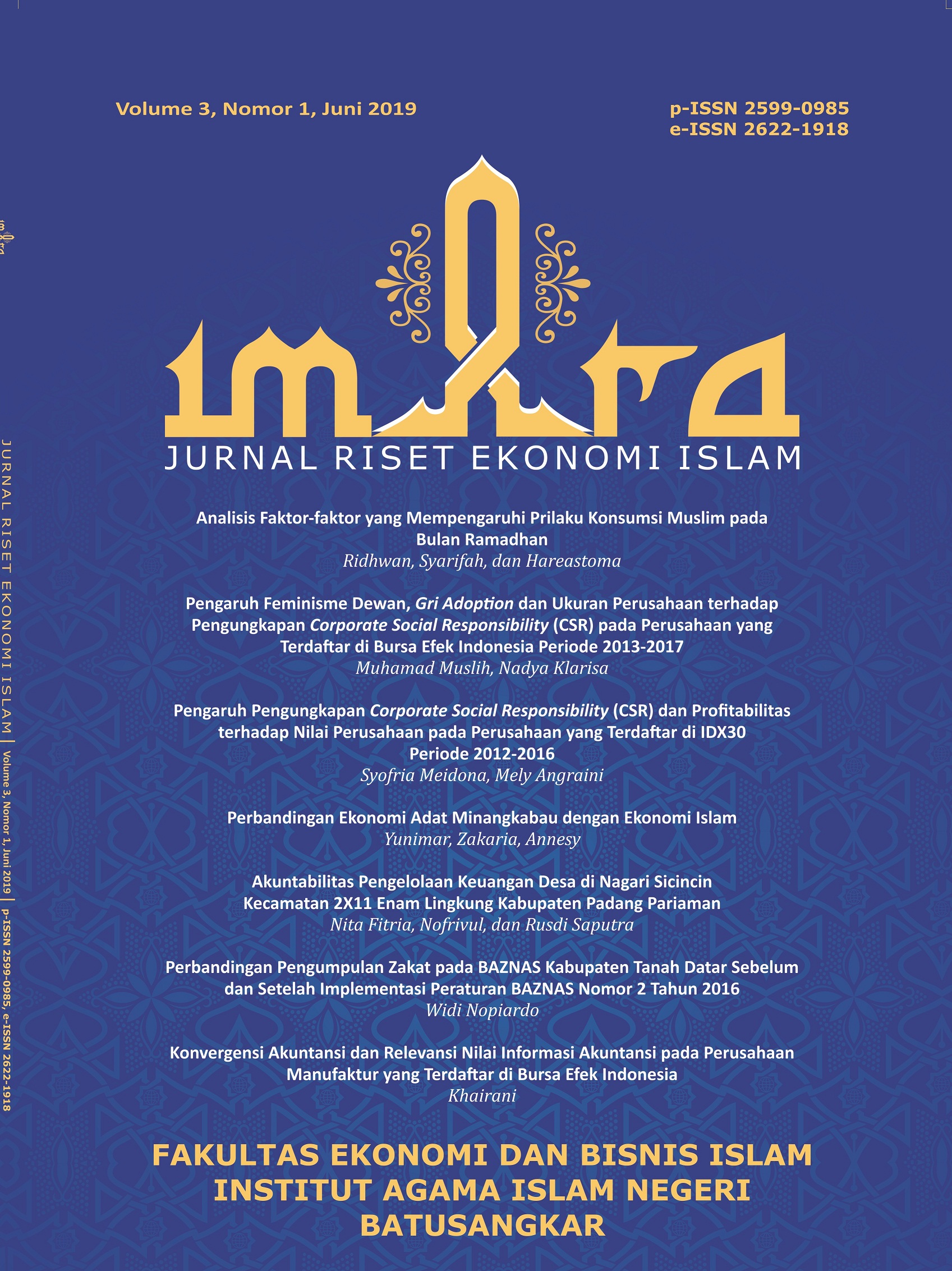
KONVERGENSI AKUNTANSI DAN RELEVANSI NILAI INFORMASI AKUNTANSI PADA PERUSAHAAN MANUFAKTUR YANG TERDAFTAR DI BURSA EFEK INDONESIA
DOI:
https://doi.org/10.31958/imara.v3i1.1472Keywords:
Penerapan PSAK berbasis IFRS, Relevansi Nilai, Price model.Abstract
This study aims to explore the value relevance of accounting information in the period before an after the implemented of IFRS in Indonesia uses the price models. Implementation of IFRS was predicted will be increase of value relevance of accounting information. This study uses the value of accounting earnings and book value of equity as a proxy for the value relevance of accounting information. The value relevance of accounting information in the decision-making of investors as reflected in the stock price. The population of this research is a listed public company on the Indonesia Stock Exchange in the period 2009-2015. The data are choice using purposive sampling method, with the result that total sample are 45 companies.  This research analyzed using Linier Regretion, Paired-Sample T Test and significance simultant test. Results of this study indicate that the adoption of IFRS -based standards in Indonesia has been able to improve the value relevance of accounting information.
References
Bailey, Kathleen M. (2005). Practical English Language Teaching Speaking. New York: The McGraw-Hill Companies.
Barwick, John. (1998). Targeting Text Middle Primary (series). Blake Education: Glebe N.S.W.
Briggs, Leslie. (1977). Instructional Design Principles and Application. New Jersey: Educational Technology Publication.
Brown, H.D. (1994). Teaching by principles: an interactive approach to language pedagogy. Englewood Cliffs, NJ: Prentice Hall Regents.
Brumfit, C., Jayne Moon & Ray K. Tongue. (1995). Teaching English to Children: from Practice to Principle. Harlow: Longman.
Bruner, J. (1983). Child’s Talk: Learning to Use Language. Oxford: Oxford University Press.
Burns, A., & Joyce, H. (1997). Focus on speaking. Sydney: National Center for English Language Teaching and Research.
Celce-Murcia, M. (2001). Teaching English as a Second or Foreign Language.3rd ed. Boston, MA: Heinle & Heinle.
Chaney, A.L and F. L Burk. (1998). Teaching Oral Communication. In Grades K: 2005. Boston. Allyn and Bacon.
Cook, G. (2000). Language Play, Language Learning. Oxford, UK: Oxford University Press.
Crystal, David. (1997). English as a Global Language. Cambridge: Cambridge University Press.
Crystal, David, (2001). An Encyclopedic Dictionary of Language and Languages. Second Edition.
Dempsey, P. A., & Dempsey, A.D. (1996). Nursing Research: Text and Workbook. 4th edition. East Washington Square, Philadelphia, USA: Lippincott- Raven Publishers.
Florez, M.A.C. (1999). Improving Adult English Language Learners’ Speaking Skill. ERIC Digest National Center for ESL Literacy Education.
Free dictionary. https://www.commonsensemedia.org/app-reviews/the-free-dictionary-by-farlex. Retrieved on March 22, 2016.
Gagne, E. D. (2006). The Cognitive Psychology of School Learning. Little, and Brown Company: Boston, Toronto.
Harmer, Jeremy. (2007). How to Teach English. Cina: Pearson Longman.
Harmer, Jeremy. (2007). The Practice of English Language Teaching. England: Pearson Longman.
Hornby. (1995).Definition of Speaking Skill .New York: Publisher.
Krauber, Kati and Lucht, Martina (2012). Inegration of Exer-Learning Games in School: The Evaluation of Hopscotch as Teaching Aid in Specialized School. The Fourth International Conference on Mobile, Hybride and On-Line Learning.
Linse, Caroline T. (2006). Practical English Language Teaching Young Learners. New York: Mc Graw Hill Companies, Inc.
Mc Donough, J., and Shaw, C. (2003). Materials and Methods in ELT: A Teacher’s Guide. Oxford: Blackwell Publishers.
Nunan, David. (2003). Practical English Language Teaching. New York: Mc Grow Hill Contemporary.
Pennington, Marta. (1995). A Situated Process View of Grammar Learning. In M. Pennington (ed.), New Ways of Teaching Grammar. Alexandria, VA: TESOL, 135-154
Pesce, Andrea. (2014).http://busyteacher.org/21186-young-learners-14-great-esl-topics.html. Retrieved on 25 March, 2016.
Philips, Sarah. (1993). Young Learners. New York: Oxford University Press.
Piaget, J. (1970). Science of Education and the Psychology of the Child. New York: Wiley.
Prensky, M., (2001). Digital Game–based Learning, New York: McGraw-Hill.
Rattigan, Peter (2006). An Interdisciplinary Twist on Traditional Games. Teaching Elementary Physical Education. v17 n6 p.63-66 Nov 2006.
Scott, Wendy A., and Lisbeth H Ytreberg. (1990). Teaching English to Children. London: Longman.
Slattery, M., and J. Willis. (2003). English for Primary Teachers: Resource Book for Teachers of Young Students. Oxford, UK: Oxford University Press.
Thornburry, Scott. (2005). How to Teach Speaking. Edinburgh Gate: Longman.
Tomlinson, Brian. (2012). Material Development for Language Learning and Teaching. Cambridge journals, 45-2, 143-179.
Ur, Penny. (1996). A Course in Language Teaching. Cambridge: Cambridge University Press.
Venkateswaran, Nirmala Solanky. (2014).https://kiddozone.wordpress.com/. Retrieved on 23 March, 2016.
Vygotsky. (1962). Thought and Language. Cambridge: Massachusetts Institute of Technology.
Wright, Andrew and Betteridge, David et al. (2006).Games for Language Learning. New York: Cambridge University Press.
Downloads
Published
How to Cite
Issue
Section
License
Copyright (c) 2019 khairani khairani

This work is licensed under a Creative Commons Attribution-ShareAlike 4.0 International License.
Authors who publish with this journal agree to the following terms:
- Authors retain copyright and grant the journal the right of first publication with the work simultaneously licensed under?áa Creative Commons Attribution-NonCommercial 4.0 International License?áthat allows others to share the work with an acknowledgment of the work's authorship and initial publication in this journal.
- Authors are able to enter into separate, additional contractual arrangements for the non-exclusive distribution of the journal's published version of the work (e.g., post it to an institutional repository or publish it in a book), with an acknowledgment of its initial publication in this journal.
- Authors are permitted and encouraged to post their work online (e.g., in institutional repositories or on their website) prior to and during the submission process, as it can lead to productive exchanges, as well as earlier and greater citation of published work.