
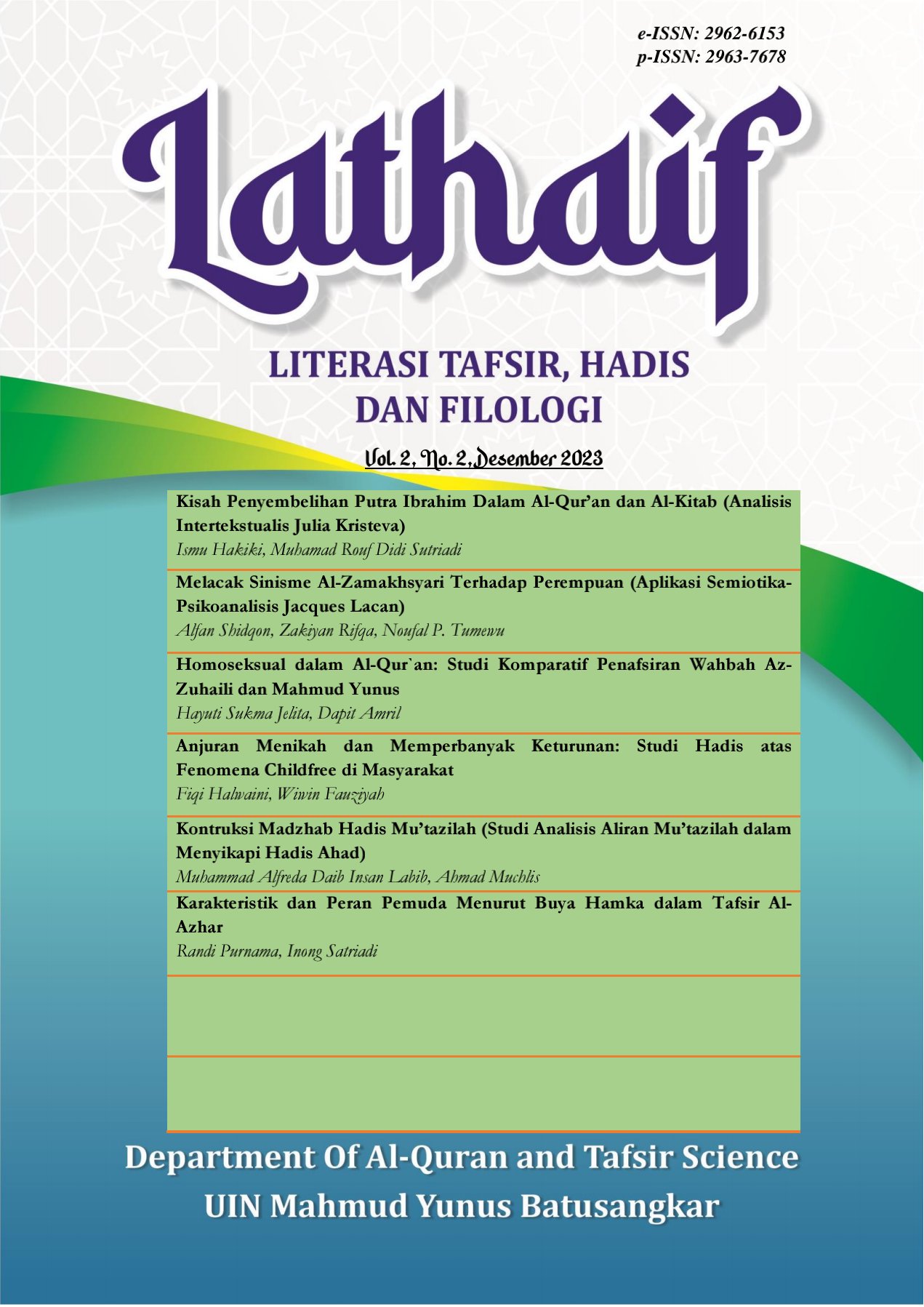
Melacak Sinisme Al-Zamakhsyari Terhadap Perempuan (Aplikasi Semiotika-Psikoanalisis Jacques Lacan)
DOI:
https://doi.org/10.31958/lathaif.v2i2.10800Keywords:
al-Zamakhshari, cynicism, women.Abstract
This article will review the bias of al-Zamakhshari, a lifelong single mufasir, when interpreting Qur'anic verses concerning women. To what extent does his singleness trigger a negative view of women. This research departs from the perspective of Lacanian semiotics-psychoanalysis that human desires have a strong influence on their views on things and this can be observed through the language they produce. There are two issues to be answered: first, what is the desire behind al-Zamakhshari's slovenliness; second, how does it relate to the interpretation of verses about women. Based on a literature review of al-Zamakhshari's historical literature and his tafseer al-Kasysyaf, this study finds that al-Zamakhshari's desire for singleness is covered by various factors; ranging from religious priorities, patriarchal environment, to personal trauma. Indications of cynicism in his interpretation then lead to the glorification of the negative side of women, male superiority, and resistance to the concept of living in pairs as absolute human nature. However, the cynicism is not radical because in many interpretations of verses about women, al-Zamakhshari presents a legal-normative review so that it appears proportional.
References
Al-Imanni, S.H. (2019). Praktek Pagang Gadai Sawah di Nagari Sungai Tunu Kecamatan Ranah Pesisir Sumatera Barat Menurut Pandangan Fiqih Muamalah. Pekanbaru: UIN Suska Riau.
An-Nawawi (t.t), Al-Minhaj: Syarhu An-Nawawi ‘ala Muslim. Damaskus: Dar Al-Fikr.
Arianti, F. (2014). Fiqh Mu’amalah II. Batusangkar: STAIN Batusangkar Press.
Az-Zuhaili, W. (1989). Al-Fiqh Al-Islami wa Adillatuhu. Damaskus: Dar Al-Fikr.
Djastimar (2022). Warga Nagari Padang Tarok, wawancara, Minggu 15 Mei.
Faradillah, A. (2022). Pemikiran Mazhab Hanafi Tentang Kedudukan Ba’i Al-Wafa’. Pare-Pare: IAIN Pare-Pare.
Fasiha, (2017). Pemikiran Ekonomi Ibnu Taimiyyah. Al-Amwal : Journal of Islamic Economic Law, 2(2).
Mayurni (2022). Warga Nagari Padang Tarok, wawancara, Sabtu 21 Mei.
Mufid, M. (2016). Ushul Fiqh Ekonomi dan Keuangan Kontemporer. Jakarta: Prenada Media Group.
Muhamad, Alimin (2004). Etika dan Perlindungan Konsumen: Perspektif Ekonomi Islam. Yogyakarta: BPFE Fakultas Ekonomi Universitas Gajah Mada.
Nidewi, O. (2022). Gadai Sawah dalam Meningkatkan kesejahteraan Keluarga di Jorong Cendrawasih Nagari Tigo jangko kecamatan Lintau Buo dalam Perspesktif Ekonomi Islam. Skripsi tidak diterbitkan. Batusangkar:PPS IAIN Batusangkar.
Oktavian, B., Noer, M., Jafrinur (2021). Analisis Bentuk Komunikasi pada Pagang Gadai Sawah di Kabupaten Tanah Datar (Studi Kasus Nagari Jaho Kecamatan X Koto). Jurnal Niara, 13(2).
Taimiyyah, I. (1398 H). Majmu’ Al-Fatawa Vol.29. Beirut: Dâr al-‘Arabiyyah.
UU No.5 Tahun 1960 tentang Peraturan Dasar Pokok-Pokok Agraria
Wirasaputra, A. (2017). Pagang Gadai Tanah Ulayat di Minangkabau dalam Kacamata Hukum Nasional. Journal of Law and Policy Transformation, 2(2).
Downloads
Additional Files
Published
Issue
Section
License
Copyright (c) 2023 Alfan Shidqon, Zakiyan Rifqa, Nufal P. Tumewu

This work is licensed under a Creative Commons Attribution-NonCommercial 4.0 International License.
Authors who publish with?áLathaif: Literasi Tafsir, Hadis dan Filologi?áagree to the following terms:
- Authors retain copyright and grant the journal right of first publication with the work simultaneously licensed under a?áCreative Commons Attribution-NonCommercial 4.0 International License?á(CC BY-NC 4.0) that allows others to share the work with an acknowledgment of the work's authorship and initial publication in this journal.
- Authors are able to enter into separate, additional contractual arrangements for the non-exclusive distribution of the journal's published version of the work (e.g., post it to an institutional repository or publish it in a book), with an acknowledgment of its initial publication in this journal.
- Authors are permitted and encouraged to post their work online (e.g., in institutional repositories or on their website) prior to and during the submission process, as it can lead to productive exchanges, as well as earlier and greater citation of published work (See?áThe Effect of Open Access).


