
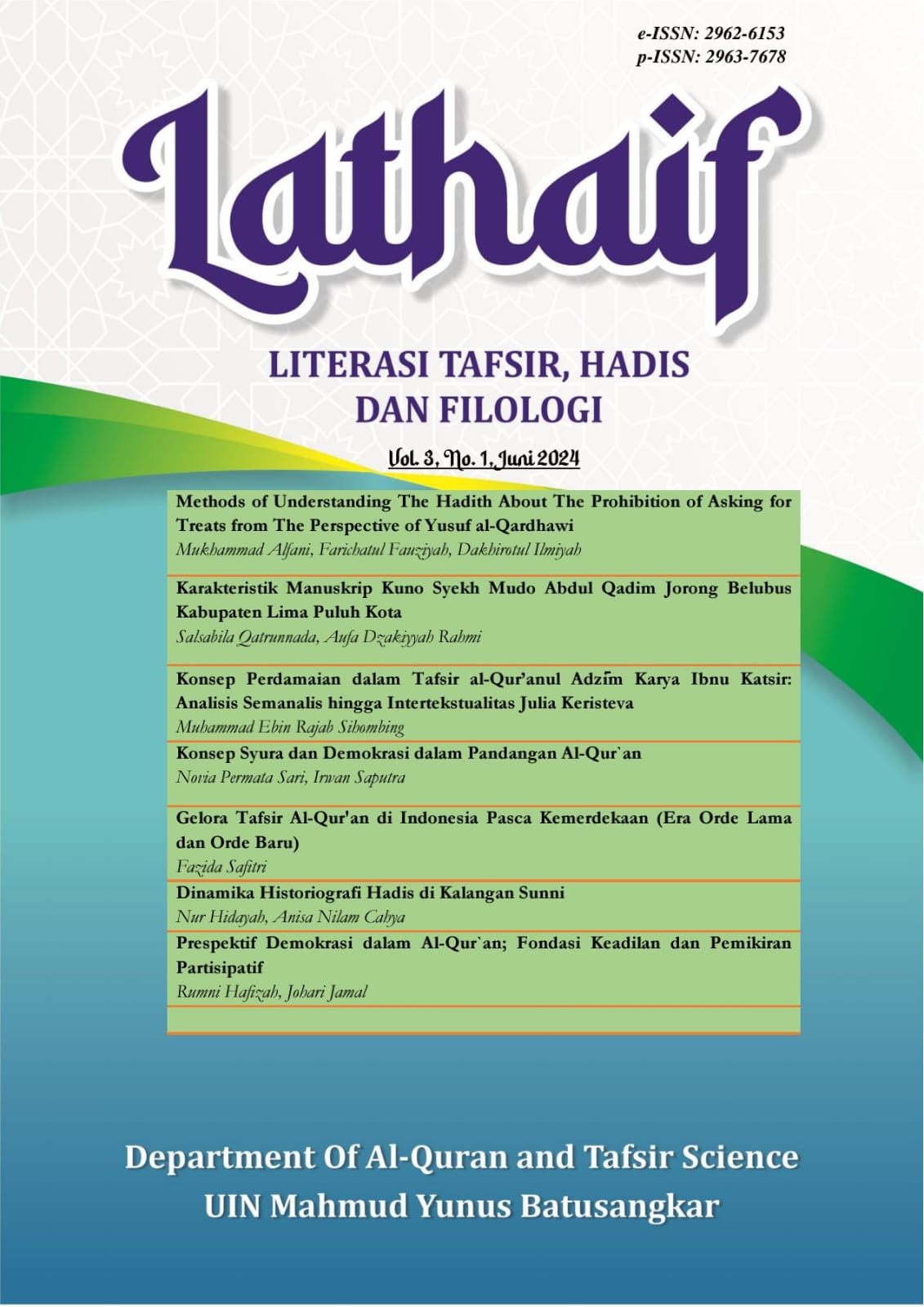
Dinamika Historiografi Hadis di Kalangan Sunni
DOI:
https://doi.org/10.31958/lathaif.v3i1.11832Keywords:
Dinamika, Hadis, Sunni.Abstract
This article explores the history of hadith writing among the Sunnis from its inception to its development. This research applied the qualitative method using the literature study technique. The desk study approach was used to collect the necessary data to identify relevant models and processes of hadith historiography among the Sunnis, as well as to provide information on the role of Sunni scholars of hadith in the digital era. The study found that Hadith historiography among the Sunnis is not only limited to the political issues between the Sunnis and the Shias. The article reveals most of the emergence of the sunni school as well as the historiography of hadith starting from the time of the Prophet, companions, tabi'in, mutaqadimin and muta'akhirin. Then, along with the books produced during the period of writing up to the present day. Meanwhile, the historical evolution of writing about hadith is more inclined towards topics that specifically aim to intertextualize it with various multidisciplinary sciences.  In addition, to generate more knowledge, Sunni scholars have followed and provided insight into the Hadith to the wider community and Hadith academics using digital media in the form of applications that are easily accessible to the wider community and others.
References
Afrizal, I. D., Farkhatin, N., & Ramliyana, R. (2023). No Title. Seminar Nasional Riset Dan Inovasi Teknologi, 7(1).
Alhasanah, J. U. (2014). (2014). Pengaruh kegunaan, kualitas informasi dan kualitas interaksi layanan web e-commerce terhadap keputusan pembelian online (Survei pada Konsumen www. getscoop. com). Jurnal Administrasi Bisnis (JAB), 15(2).
Berkowitz, M. W., & Schwartz, M. (2006). Character education. Children’s needs III: Development, prevention, and intervention. Journal of Enterpreneur Education, 35(4), 495–518.
Birhan, W., Shiferaw, G., Amsalu, A., Tamiru, M., & Tiruye, H. (2021). Exploring the context of teaching character education to children in preprimary and primary schools. Social Sciences & Humanities Open, 4(1), 100–171.
Bosma, N., Schøtt, T., Terjesen, S. A., & Kew, P. (n.d.). Global entrepreneurship monitor 2015 to 2016: special topic report on social entrepreneurship.
Cahyani, I. A. C., Pulawan, I. M., & Santini, N. M. (2019). Analisis Persediaan Bahan Baku Untuk Efektivitas dan Efesiensi Biaya Persediaan Bahan Baku Terhadap Kelancaran Proses Produksi pada Usaha Industri Tempe Murnisingaraja di Kabupaten Badung. Wacana Ekonomi (Jurnal Ekonomi, Bisnis Dan Akuntansi), 18(2), 116-125.
Cahyono, B. D. (2017). Manajemen Pengembangan Pendidikan Kewirausahaan Guna Peningkatan Kecakapan Hidup Bagi Santri Di Pondok Modern Darussalam Gontor Kampus 2 Ponorogo. UIN Sunan Kalijaga.
Chotimah, C. (2014). Pendidikan kewirausahaan di pondok pesantren sidogiri pasuruan. INFERENSI: Jurnal Penelitian Sosial Keagamaan, 8(1), 11–136.
Dewey, J. (1986). Experience and education. In The educational forum. Taylor & Francis, 50(3), 241–252.
Dewi, R. (2021). “Konsep Zuhud Pada Ajaran Tasawuf Dalam Kehidupan Santri Pada Pondok Pesantren.” MAWA IZH JURNAL DAKWAH DAN PENGEMBANGAN SOSIAL KEMANUSIAAN, 12(2), 122–142.
Falah, S. (2020). Pendidikan karakter berbasis keluarga pada kisah Nabi Ibrahim dan Ismail. Ta’dibuna: Jurnal Pendidikan Islam, 9(1), 133–150.
Fatmawaty, R. (2017). Memahami psikologi remaja. Reforma: Jurnal Pendidikan Dan Pembelajaran, 6(2).
Fayolle, A. (2018). Personal views on the future of entrepreneurship education. In A research agenda for entrepreneurship education. Edward Elgar Publishing., 127–138.
Gable, S., Belsky, J., & Crnic, K. (1992). Marriage, parenting, and child development: Progress and prospects. Journal of Family Psychology, 5(3), 276.
Graham, K. E., Schellinger, A. R., & Vaughn, L. M. (2015). Developing strategies for positive change: Transitioning foster youth to adulthood. Children and Youth Services Review., 5(4), 71–79.
Hastuti, R. (2021). Psikologi Remaja. Penerbit Andi.
Henry, C., Hill, F., & Leitch, C. (2005). Entrepreneurship education and training: can entrepreneurship be taught? Part I. Education+ Training, 47(2), 98–111.
Hetherington, E. M., Parke, R. D., & Locke, V. O. (1999). No Title. McGraw-Hill.
Huberman, M., & Miles, M. B. (2002). The qualitative researcher’s companion. Sage.
Junaedi, M. (2022). "Strategies For Delivering Islamic Religious Education Learning Materials in The Post-Truth Era. " NUANSA: Jurnal Penelitian Ilmu Sosial Dan Keagamaan Islam, 19(2), 127–145.
Khulafa, Faris Nur, Fahry Zatul Umami, and R. H. P. (2017). Pengembangan pendidikan kewirausahaan di sekolah dasar.
Kuratko, D. F. (2005). The emergence of entrepreneurship education: Development, trends, and challenges. Entrepreneurship Theory and Practice, 29(5), 577–597.
Kuspriyono, T. (2017). Pengaruh promosi online dan kemasan terhadap keputusan pembelian kosmetik merek Sariayu Martha Tilaar. Perspektif: Jurnal Ekonomi Dan Manajemen Akademi Bina Sarana Informatika, 15(2), 147–154.
Lamb, M. E. (Ed. ). (2004). The role of the father in child development. In John Wiley & Sons.
Liefbroer, A. C. (2006). Transition from youth to adulthood in the Netherlands. In Globalization, Uncertainty and Youth in Society, 80–100.
Manshur, F. M. (1999). No Title. Tasawuf Dan Sastra Tasawuf Dalam Kehidupan Pesantren., 11(1), 102–109.
Maulana, F. (2019). No Title. Pendidikan Kewirausahaan Dalam Islam, 2(01), 30–44.
Miles, M. B., & Huberman, A. M. (1994). Qualitative data analysis: An expanded sourcebook. sage.
Mufreni, A. N. (2016). Pengaruh desain produk, bentuk kemasan dan bahan kemasan terhadap minat beli konsumen (studi kasus teh hijau serbuk tocha). Jurnal Ekonomi Manajemen, 2(2), 48–54.
Mutakin, Jejen Jenal, Ahmad Sarbini, and M. F. (2019). . “Gaya Kepemimpinan KH. Asep Noor Ilyas dalam Meningkatkan Motivasi Kerja Pembimbing Santri.” . . “Gaya Kepemimpinan KH. Asep Noor Ilyas Dalam Meningkatkan Motivasi Kerja Pembimbing Santri.,” 4(1), 77–96.
Nasikhin, Ikhrom, A. S. (2020). SEKOLAH ONLINE DI MASA PANDEMI COVID-19, BAGAIMANA TANGGAPAN GURU DAN SISWA SEKOLAH DASAR? 7(1), 47–59. https://www.ejournal.stkip-mmb.ac.id/index.php/mp/article/download/709/460
Nasikhin, N., & Raaharjo, R. (2022). Moderasi Beragama Nahdlatul Ulama dan Muhammadiyah dalam Konsep Islam Nusantara dan Islam Berkemajuan. Islamic Review: Jurnal Riset Dan Kajian Keislaman, 11(1), 18–34.
Pittaway, L., & Cope, J. (2007). Entrepreneurship education: A systematic review of the evidence. International Small Business Journal, 25(5), 479–510.
Pollock, G. (1997). Individualization and the transition from youth to adulthood. Young, 5(1), 55–67.
Pratiwi, H. D. (2013). Pengaruh reputasi perusahaan dan kualitas website terhadap tingkat kepercayaan konsumen dalam bertransaksi secara online (studi pada konsumen Ongisnadestore. com). In Fakultas Psikologi Universitas Brawijaya: Malang.
Rachmadyanti, Putri, and V. D. W. (2016). “Pendidikan Kewirausahaan bagi Anak Usia Sekolah Dasar.” Prosiding Seminar Nasional Inovasi Pendidikan.
Rahadi, D. R. (2011). Pengaruh Karateristik Website Terhadap Kepuasan Pelanggan. Jurnal Teknologi Informasi, 1(1), 20–25.
Rese, A., Baier, D., Mißler-Behr, M., & Kaiser, M. J. (Eds. ). (2010). Entrepreneurship education. In BoD–Books on Demand.
Rohmah, M. (2017). Mekanisme produksi usaha makanan tradisional dalam meningkatkan perekonomian pengusaha dumbek Desa Kesamben Plumpang Tuban. In Doctoral dissertation, UIN Sunan Ampel Surabaya.
Rohmawati, O., & Watini, S. (2022). Pemanfaatan TV sekolah sebagai media pembelajaran dan pendidikan karakter anak usia dini. Jurnal Pelita PAUD, 6(2), 196–207.
Sarah, D. M., Vika, A. I. V., Hasibuan, N., Sipahutar, M. S., & Simamora, F. E. M. (2022). Pengaruh Pemberian Reward dan Punishment Terhadap Motivasi Belajar Siswa. Edu Cendikia: Jurnal Ilmiah Kependidikan, 2(01), 210–219.
Sinta, A. (2022). Strategi Pemasaran Pondok Pesantren Husnul Amal Kotabumi Lampung Utara dalam Meningkatkan Jumlah Santri. In Uin Raden Intan Lampung.
Statistik, B. P. (2020). “Pertumbuhan ekonomi Indonesia triwulan IV-2019.”
Supinganto, A., Mawati, A. T., Silitonga, B. N., Purba, B., Ardiana, D. P. Y., Yuniwati, I., ... & Purba, S. (2021). Metodologi Penelitian Bidang Pendidikan.
Suprapto, R., & Azizi, Z. W. (2020). Pengaruh Kemasan, Label Halal, Label Izin P-IRT Terhadap Keputusan Pembelian Konsumen UMKM Kerupuk Ikan. Jurnal REKOMEN (Riset Ekonomi Manajemen), 3(2), 125–133.
Syam, F., Mangunjaya, F. M., Rahmanillah, A. R., & Nurhadi, R. (2020). Narrative and the politics of identity: Patterns of the spread and acceptance of radicalism and terrorism in indonesia. Religions. https://doi.org/10.3390/rel11060290
Vesper, K. H., & Gartner, W. B. (1997). Measuring progress in entrepreneurship education. Journal of Business Venturing, 12(5), 403–421.
Wahyuni, Arisna, and S. S. (2020). “Best Practice Pendidikan Kewirausahaan Pada Anak Usia Dini Di Tk Khalifah Baciro Yogyakarta.” Yaa Bunayya: Jurnal Pendidikan Anak Usia Dini, 4(1), 15–22.
Wekke, I. S. (2012). Pesantren dan pengembangan kurikulum kewirausahaan: Kajian pesantren roudahtul khuffadz sorong papua barat. Inferensi: Jurnal Penelitian Sosial Keagamaan, 6(2), 205–226.
Yaqutunnafis, Lale, and N. N. (2021). “Manajemen Pondok Pesantren dalam Meningkatkan Pendidikan Kewirausahaan Siswa.” Jurnal Ilmu Manajemen, 10(2), 143–154.
Zuhriy, M. S. (2011). “Budaya pesantren dan pendidikan karakter pada pondok pesantren salaf.” Walisongo: Jurnal Penelitian Sosial Keagamaan, 19(2), 287–310.
Downloads
Published
Issue
Section
License
Copyright (c) 2024 Nur Hidayah

This work is licensed under a Creative Commons Attribution-NonCommercial 4.0 International License.
Authors who publish with?áLathaif: Literasi Tafsir, Hadis dan Filologi?áagree to the following terms:
- Authors retain copyright and grant the journal right of first publication with the work simultaneously licensed under a?áCreative Commons Attribution-NonCommercial 4.0 International License?á(CC BY-NC 4.0) that allows others to share the work with an acknowledgment of the work's authorship and initial publication in this journal.
- Authors are able to enter into separate, additional contractual arrangements for the non-exclusive distribution of the journal's published version of the work (e.g., post it to an institutional repository or publish it in a book), with an acknowledgment of its initial publication in this journal.
- Authors are permitted and encouraged to post their work online (e.g., in institutional repositories or on their website) prior to and during the submission process, as it can lead to productive exchanges, as well as earlier and greater citation of published work (See?áThe Effect of Open Access).


