
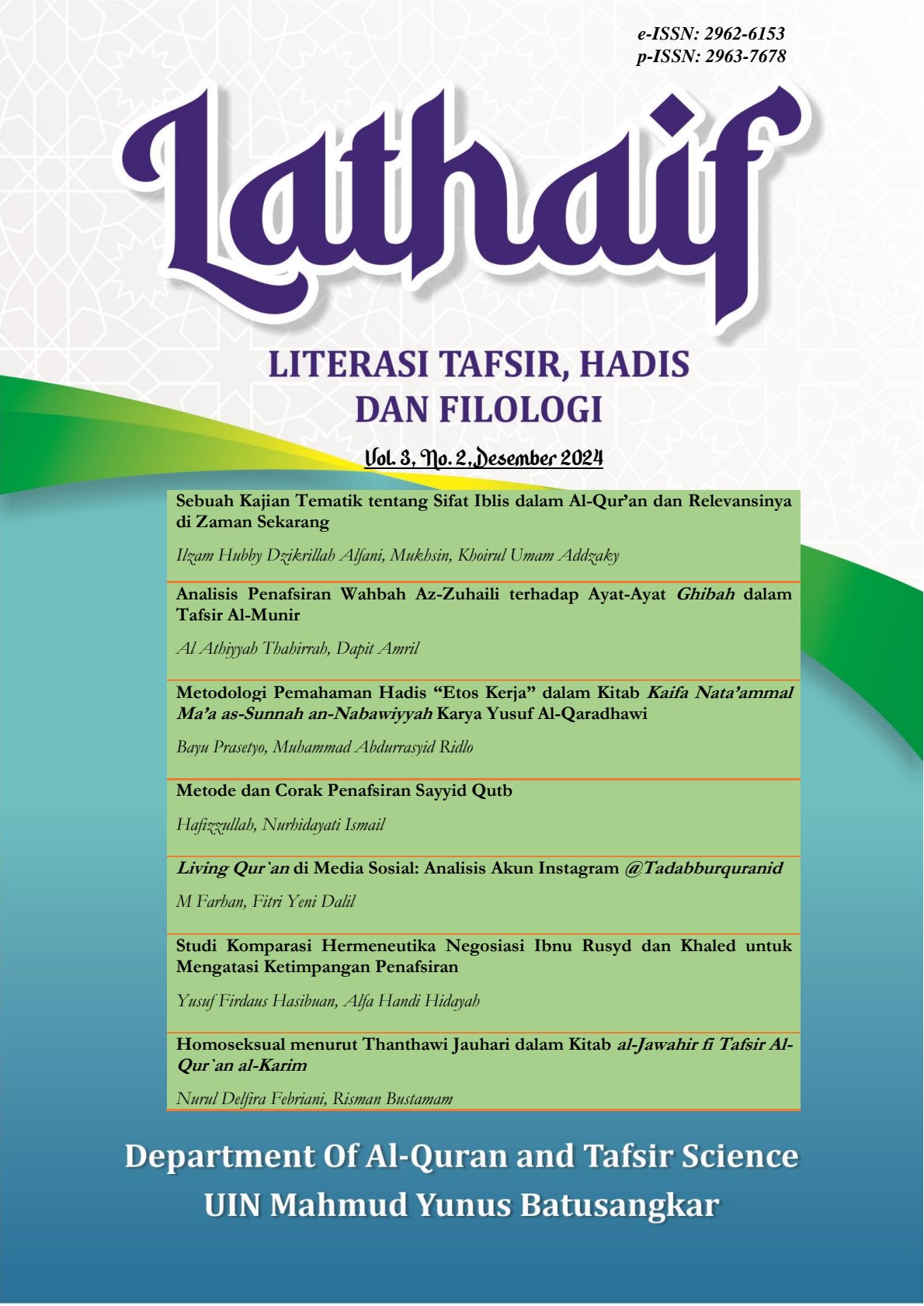
Sikap Kesombongan dan Kejahatan Iblis dalam Al-QurÔÇÖan dan Relevansinya di Zaman Sekarang: Sebuah Kajian Tematik
DOI:
https://doi.org/10.31958/lathaif.v3i2.13449Keywords:
Iblis, Qur'an, ThematicAbstract
This study aims to review the pride and evil of the devil in the Qur'an and relate it to today's times. This research uses a qualitative method by relying on various literature. The data is analyzed descriptively. This study concludes that the devil is a creature of the jinn who has ghuluw characteristics including arrogance, evil, and disobedience to Allah's commands. The consequence of the devil's ghuluw nature is humiliation and kufr. Then, the relevance of the devil's arrogant and evil attitude to today, the emergence of phenomena that are not in accordance with religious and state norms such as the Pursuit of Power and Fame, Vanity in the Digital Age, Materialism and Greed, Polarization and Online Hatred, and Neglect of Moral Responsibility.
References
Alkharusi, H. A., Sulaimani, H. Al, & Neisler, O. (2019). Predicting critical thinking ability of Sultan Qaboos University students. International Journal of Instruction, 12(2), 491–504. https://doi.org/10.29333/iji.2019.12231a
Ambarwati, S., Suhartono, S., & Nurhasanah, N. (2021). Pengaruh Kepercayaan Diri dan Motivasi Belajar terhadap Kemampuan Berpikir Kritis pada Siswa Sekolah Dasar. Edukatif : Jurnal Ilmu Pendidikan, 3(4), 1974–1984. https://doi.org/https://doi.org/10.31004/edukatif.v3i4.1047
Amtu, O., Makulua, K., Matital, J., & Pattiruhu, C. M. (2020). Improving student learning outcomes through school culture, work motivation and teacher performance. International Journal of Instruction, 13(4), 885–902. https://doi.org/10.29333/iji.2020.13454a
Anam Siddique, M., Danial Aslam Senior Lecturer, H., Khan Senior Lecturer, M., Urooj Fatima, M., & Victor, J. (2011). Impact of Academic Leadership on Faculty’s Motivation, and Organizational Effectiveneess in Higher Education System. International Journal of Business and Social Science, 2(8), 184–191. http://eric.ed.gov/?id=ED183043
Andriani, S., Kesumawati, N., & Kristiawan, M. (2018). The influence of the transformational leadership and work motivation on teachers performance. International Journal of Scientific and Technology Research, 7(7), 19–29.
Arias, J., Soto-Carballo, J. G., & Pino-Juste, M. R. (2022). Emotional intelligence and academic motivation in primary school students. Psicologia: Reflexao e Critica, 35(1). https://doi.org/10.1186/s41155-022-00216-0
Atma, B. A., Azahra, F. F., & Mustadi, A. (2021). Teaching style, learning motivation, and learning achievement: Do they have significant and positive relationships? Jurnal Prima Edukasia, 9(1), 23–31. https://doi.org/10.21831/jpe.v9i1.33770
Atwa, Z., Sulayeh, Y., Abdelhadi, A., Jazar, H. A., & Eriqat, S. (2022). Flipped Classroom Effects on Grade 9 Students’ Critical Thinking Skills, Psychological Stress, and Academic Achievement. International Journal of Instruction, 15(2), 737–750. https://doi.org/10.29333/iji.2022.15240a
Ayu Sakdiyyah, D., Wahjoedi, & Lisa Rokhmani. (2022). Design and Implementation of Economics Teaching Module Based on Discovery Learning, Its Effect on Students’ Critical Thinking Ability. International Journal Of Humanities Education and Social Sciences (IJHESS), 2(1), 93–104. https://doi.org/10.55227/ijhess.v2i1.213
Berestova, A., Burdina, G., Lobuteva, L., & Lobuteva, A. (2022). Academic Motivation of University Students and the Factors that Influence it in an E-Learning Environment. Electronic Journal of E-Learning, 20(2), 201–210. https://doi.org/10.34190/ejel.20.2.2272
Bibbings, H., & Bieluga, P. A. (2018). Enhancing creativity and independent learning of architectural technology students through the use of a real life design competition module. Proceedings of 33rd PLEA International Conference: Design to Thrive, PLEA 2017, 2, 2213–2219. https://doi.org/https://doi.org/10.26687/archnet-ijar.v12i1.1409
Bowen, T. (2020). Work-integrated learning placements and remote working: Experiential learning online. International Journal of Work-Integrated Learning, 21(4), 377–386. https://doi.org/https://www.ijwil.org/files/IJWIL_21_4_377_386.pdf
Cicciu, & Vitello. (2002). Exploring emotional intelligence. JONA: The Journal of Nursing Administration, 32(4), 203–210. https://doi.org/https://doi.org/10.1097/00005110-200204000-00009
Collins, C. S., & Cooper, J. E. (2014). Emotional intelligence and the qualitative researcher. International Journal of Qualitative Methods, 13(1), 88–103. https://doi.org/10.1177/160940691401300134
Dhani, P., & Sharma, T. (2016). EMOTIONAL INTELLIGENCE ; HISTORY ,. International Journal of Science Technology & Management, 5(7), 189–201. http://www.ijstm.com/images/short_pdf/1470035076_1065ijstm.pdf
Dr. Chandrakant Jamadar, & Sindhu A. (2015). The Impact of Socio Economic Status on Emotional Intelligence and Creativity among Tribal Adolescent Students. International Journal of Indian Psychology, 3(1). https://doi.org/10.25215/0301.014
Fathoni, F., Amin, S. M., & Khabibah, S. (2019). Improve Critical Thinking Ability and Motivation in Learning Mathematics Through the Adobe Flash Cs 5.0 Game. International Journal for Educational and Vocational Studies, 1(8), 869. https://doi.org/10.29103/ijevs.v1i8.2241
Fuad, N. M., Zubaidah, S., Mahanal, S., & Suarsini, E. (2017). Improving junior high schools’ critical thinking skills based on test three different models of learning. International Journal of Instruction, 10(1), 101–116. https://doi.org/10.12973/iji.2017.1017a
Gavronskaya, Y., Larchenkova, L., Berestova, A., Latysheva, V., & Smirnov, S. (2022). The Development of Critical Thinking Skills in Mobile Learning: Fact-Checking and Getting Rid of Cognitive Distortions. International Journal of Cognitive Research in Science, Engineering and Education, 10(2), 51–68. https://doi.org/10.23947/2334-8496-2022-10-2-51-68
Gudnanto, Mappiare, A., Atmoko, A., & Muslihati. (2021). The Influence of Intelligence and Emotional Intelligence on Religious Attitudes and Their Influence on Entrepreneurial Motivation Among Vocational Students During The COVID-19 Pandemic. İlköğretim Online, 20(1), 681–690. https://doi.org/10.17051/ilkonline.2021.01.58
Hakim, M. F. Al, Sariyatun, S., & Sudiyanto, S. (2018). Constructing Student`s Critical Thinking Skill through Discovery Learning Model and Contextual Teaching and Learning Model as Solution of Problems in Learning History. International Journal of Multicultural and Multireligious Understanding, 5(4), 175. https://doi.org/10.18415/ijmmu.v5i4.240
Hanim Rahmat, N., Aripin, N., Maizura Lin, N., Whanchit, W., & Khairuddin, Z. (2020). Exploring the Connection between Critical Thinking Skills and Academic Writing. International Journal of Asian Social Science, 10(2), 118–128. https://doi.org/10.18488/journal.1.2020.102.118.128
Hendarsyah, H., Hendriana, H., & Sudrajat, R. T. (2022). the Influence of Independent Learning on the Ability To Write Exposition Texts in Class X. JLER (Journal of Language Education Research), 5(1), 44. https://doi.org/10.22460/jler.v5i1.9878
Hendri, S., & Setiawan, W. (2016). the Development of Earth Quake Teaching Material for Junior High School By Four Step Teaching Materials Development Method Pengembangan Bahan Ajar Tema Gempa Bumi Menggunakan Four Step Teaching Materials Development. 12(1), 65–76. https://doi.org/10.15294/jpfi
I Wayan, W., I Made, S., & I Wayan, C. (2019). Work Motivation and Creativity on Teacher Ability to Develop HOTS-based Assessments. International Journal of Social Sciences and Humanities, 3(3), 188–200. https://doi.org/https://doi.org/https://doi.org/10.29332/ijssh.v3n3.378
In’am, A., & Sutrisno, E. S. (2020). Strengthening Students’ Self-efficacy and Motivation in Learning Mathematics through the Cooperative Learning Model. International Journal of Instruction, 14(1), 395–410. https://doi.org/10.29333/IJI.2021.14123A
Kardoyo, Nurkhin, A., Muhsin, & Pramusinto, H. (2020). Problem-based learning strategy: Its impact on students’ critical and creative thinking skills. European Journal of Educational Research, 9(3), 1141–1150. https://doi.org/10.12973/EU-JER.9.3.1141
Khairani, S., Suyanti, R. D., & Saragi, D. (2020). The Influence of Problem Based Learning (PBL) Model Collaborative and Learning Motivation Based on Students’ Critical Thinking Ability Science Subjects in Class V State Elementary School 105390 Island Image. Budapest International Research and Critics in Linguistics and Education (BirLE) Journal, 3(3), 1581–1590. https://doi.org/10.33258/birle.v3i3.1247
Kholmuratovich, M. K. (2020). Methodology of Improving Independent Learning Skills of Future Fine Art Teachers (On the Example of Still Life in Colorful Paintings). International Journal of Psychosocial Rehabilitation, 24(5), 2043–2048. https://doi.org/10.37200/ijpr/v24i5/pr201880
Kopzhassarova, U., Akbayeva, G., Eskazinova, Z., Belgibayeva, G., & Tazhikeyeva, A. (2016). Enhancement of students’ independent learning through their critical thinking skills development. International Journal of Environmental and Science Education, 11(18), 11585–11592. https://doi.org/. https://files.eric.ed.gov/fulltext/EJ1121248.pdf
Kubravi, S. U., Shah, S. O., & Jan, K. (2018). Digital Storytelling: The Impact on Student Academic Achievement, Critical Thinking, and Learning Motivation. International Journal of Research in Engineering, Science, and Management, 1(12), 787–791. https://ijresm.com/Vol_1_2018/Vol1_Iss12_December18/IJRESM_V1_I12_184.pdf
Lee, S. Y. (2019). Promoting active learning and independent learning among primary school students using flipped classroom. International Journal of Education, Psychology and Counseling, 4(30), 324–341. https://doi.org/10.29332/ijssh.v3n3.378
Listiqowati, I., Budijanto, Sumarmi, & Ruja, I. N. (2022). The Impact of Project-Based Flipped Classroom (PjBFC) on Critical Thinking Skills. International Journal of Instruction, 15(3), 853–868. https://doi.org/10.29333/iji.2022.15346a
MacCann, C., Jiang, Y., Brown, L. E. R., Double, K. S., Bucich, M., & Minbashian, A. (2019). Emotional Intelligence Predicts Academic Performance: A Meta-Analysis. Psychological Bulletin, 146(2), 1–98. https://doi.org/10.1037/bul0000219
Mahanal, S., Zubaidah, S., Sumiati, I. D., Sari, T. M., & Ismirawati, N. (2019). RICOSRE: A learning model to develop critical thinking skills for students with different academic abilities. International Journal of Instruction, 12(2), 417–434. https://doi.org/10.29333/iji.2019.12227a
Mardi, Fauzi, A., & Respati, D. K. (2021). Development of students’ critical thinking skills through guided discovery learning (Gdl) and problem-based learning models (pbl) in accountancy education*. Eurasian Journal of Educational Research, 2021(95), 210–226. https://doi.org/10.14689/EJER.2021.95.12
Mayer, J. D., Salovey, P., & Caruso, D. (2000). Models of emotional intelligence. In Handbook of intelligence. In Cambridge University Press. (Vol. 2). https://books.google.co.id/books?hl=id&lr=&id=HvXLCgAAQBAJ&oi=fnd&pg=PA396&dq=Mayer,+J.+D.,+Salovey,+P.,+%26+Caruso,+D.+(2000).+Models+of+emotional+intelligence.+In+Handbook+of+intelligence+(Vol.+2).+Cambridge+University+Press.&ots=F7BkJ_e9xR&sig=erwS3RRW
Menhard. (2022). Pengaruh Kepercayaan Diri, Minat Belajar, Kecerdasan Emosional Terhadap Tingkat Pemahaman Melalui Berfikir Kritis Sebagai Variabel Intervening. Journal of Social Science and Digital Marketing, II(1), 44–54. https://doi.org/https://doi.org/https://doi.org/10.47927/jssdm.v2i1.326
Moh Ghoizi Eriyanto, M.V. Roesminingsih, Soedjarwo, & Ivan Kusuma Soeherman. (2021). The Effect of Learning Motivation on Learning Independence and Learning Outcomes of Students in the Package C Equivalence Program. IJORER : International Journal of Recent Educational Research, 2(4), 455–467. https://doi.org/10.46245/ijorer.v2i4.122
Munawaroh, Setyani, N. S., Susilowati, L., & Rukminingsih. (2022). The Effect of E-Problem Based Learning on Students’ Interest, Motivation and Achievement. International Journal of Instruction, 15(3), 503–518. https://doi.org/10.29333/iji.2022.15328a
Muratov, K. K., & Tadjieva, F. M. (2021). International Journal of Multicultural and Multireligious Understanding Issues of Improving the Technology of Organization and Management of Independent Learning Activities of Students in the Fine Arts. International Journal of Multicultural and Multireligious Understanding, 8(11), 521–525. https://doi.org/15/ijmmu.v8i11.3258
Musfikhuna, K., Parlyna, R., & Fidhyallah, N. F. (2021). the Influence of Learning Media and Learning Motivation on Critical Thinking Ability of Fe Unj Students. Jurnal Pendidikan Ekonomi, Perkantoran, Dan …, 2663, 1–15. https://doi.org/doi.org/10.21009/JPEPA.007
Muwaffiq, M. N., Fatah, H. M., & Ibrahim. (2022). HUBUNGAN ANTARA MOTIVASI BELAJAR DENGAN KEMAMPUAN BERFIKIR KRITIS SISWA KELAS IX MADRASAH TSANAWIYAH (MTs). PYTHAGORAS: Jurnal Program Studi Pendidikan Matematika, 11(1), 19–28. https://doi.org/https://doi.org/https://doi.org/10.33373/pythagoras.v11i1.3615
Nasution, L. M. (2017). STATISTIK DESKRIPTIF. Jurnal Hikmah, 14(1), 49–55. https://doi.org/10.1021/ja01626a006
Nazari, abolhassan, Tabatabaei, O., & Heidari Shahreza, M. A. (2021). Impact of STAD model of Cooperative Learning on Iranian EFL Learners’ Critical Thinking and Motivation. International Journal of Foreign Language Teaching and Research, 9(38), 191–203. https://doi.org/10.52547/jfl.9.38.191
Noviyanto, W. Y., & Wardani, N. S. (2020). Meta Analisis Pengaruh Pendekatan Discovery Learning Terhadap Kemampuan Berpikir Kritis Siswa Kelas V Tematik Muatan Ipa. Thinking Skills and Creativity Journal, 3(1), 1–7. https://doi.org/10.23887/tscj.v3i1.27959
Nugraha, A. J., Suyitno, H., & Susilaningsih, E. (2017). Analisis Kemampuan Berpikir Kritis Ditinjau dari Keterampilan Proses Sains dan Motivasi Belajar melalui Model PBL. Journal of Primary Education, 6(1), 35–43.
Nur’Azizah, R., Utami, B., & Hastuti, B. (2021). The relationship between critical thinking skills and students learning motivation with students’learning achievement about buffer solution in eleventh grade science program. Journal of Physics: Conference Series, 1842(1), 0–9. https://doi.org/10.1088/1742-6596/1842/1/012038
Nurfalah, A., Prihatini, D., Hidayat, W., & Rohaeti, E. E. (2019). Hubungan Antara Kemampuan Berpikir Kritis Matematis Dan Kemandirian Belajar Siswa SMA Cimahi. Journal on Education, 2(1), 167–172. https://doi.org/10.31004/joe.v2i1.289
Nurhayati, L., Maula, L. H., & Nurasiah, I. (2021). Kecerdasan Emosional dan Kemampuan Berpikir Kritis pada Materi Bangun Datar di Kelas Tinggi Sekolah Dasar. Mimbar Ilmu, 26(2), 274. https://doi.org/10.23887/mi.v26i2.36919
Nuryanto, A., & Ramadani, R. (2022). Learning independence and teacher teaching skills: Does it affect learning outcomes when face-to-face learning is limited. Jurnal Pendidikan Vokasi, 12(2), 110–116. https://doi.org/10.21831/jpv.v12i2.50603
Putri, Y. A., Susetyo, B., & Tarsidi, I. (2022). Analysis of Learning Independence of Children with Special Needs. Jassi Anakku, 22(1), 41–44. https://doi.org/10.17509/jassi.v22i1.34066
Qomariyah, S. N. (2019). Effect of Problem Based Learning Learning Model to Improve Student Learning Outcomes. International Journal of Educational Research Review, 4(2), 217–222. https://doi.org/10.24331/ijere.518056
Rajagukguk, W., Bina, N. S., & Samosir, K. (2022). The Effect of Prior Knowledge, Emotional Intelligence and Motivation on Mathematical Communication. Education Quarterly Reviews, 5(4), 146–159. https://doi.org/10.31014/aior.1993.05.04.581
Retnawati, E. (2019). Efforts To Support and Expand the Use of Educational Technology As a Means of Delivering Learning. IJIET (International Journal of Indonesian Education and Teaching), 3(1), 128–137. https://doi.org/10.24071/ijiet.v3i1.1725
Rovai, A. P., & Jordan, H. M. (2004). Blended learning and sense of community: A comparative analysis with traditional and fully online graduate courses. International Review of Research in Open and Distance Learning, 5(2). https://doi.org/10.19173/irrodl.v5i2.192
Saeed, I., & Waseem, M. (2014). The relationship of turnover intention with job satisfaction, job performance, Leader member exchange, emotional intelligence and organizational commitment. International Journal of Learning & Development, 4(2). https://doi.org/https://doi.org/10.5296/ijld.v4i2.6100
Sekreter, G. (2019). Emotional Intelligence as a Vital Indicator of Teacher Effectiveness. International Journal of Social Sciences & Educational Studies, 5(3), 286–302. https://doi.org/10.23918/ijsses.v5i3p286
Sriyono, H. (2017). The Effect of Emotional Intelligence and Student Learning Interest on the Achievement of Economic Learning at Madrasah Aliyah in Indonesia. International Journal Of Environmental & Science Education, 12(10), 2177–2183. http://www.ijese.net/makale/1985.html
Sudrajat, D. R., & Disman. (2021). The effect of learning motivation on students’ critical thinking ability in Economics subject during the Covid-19 pandemic. The International Conference of Universitas Pekalongan 2021, 167–171. https://proceeding.unikal.ac.id/index.php/icunikal2021/article/view/638
Sukenda Egok, A. (2016). Kemampuan Berpikir Kritis Dan Kemandirian Belajar Dengan Hasil Belajar Matematika. Jurnal Pendidikan Dasar, 7(2), 186–199. https://doi.org/https://journal.unj.ac.id/unj/index.php/jpd/article/view/2186
Supratman, Zubaidah, S., Corebima, A. D., & Ibrohim. (2021). The effect size of different learning on critical and creative thinking skills of biology students. International Journal of Instruction, 14(3), 187–206. https://doi.org/10.29333/iji.2021.14311a
Teoh, G. B. S., & Liau, A. W. L. (2021). Emotional intelligence in distance learning: A case study of english as a second language via distance learning. Journal of Language and Education, 7(3), 151–165. https://doi.org/10.17323/JLE.2021.12624
Valentina, H. S., Nugrahadi, E. W., & Budiarta, K. (2019). The Effect of Learning Strategy and Thinking Ability on The Students’ Learning Outcomes in Economics Subject of XI Social Students in Senior High School State 1 in Pematang Siantar. Budapest International Research and Critics in Linguistics and Education (BirLE) Journal, 2(4), 451–460. https://doi.org/10.33258/birle.v2i4.543
Wayan Santyasa, I., Agustini, K., & Eka Pratiwi, N. W. (2021). Project based e-learning and academic procrastination of students in learning chemistry. International Journal of Instruction, 14(3), 909–928. https://doi.org/10.29333/iji.2021.14353a
Yusuf, Y. Q., Natsir, Y., & Hanum, L. (2015). A Teacher’s experience in teaching with student teams-achievement. International Journal of Instruction, 8(2), 99-112. https://doi.org/https://doi.org/10.12973/iji.2015.828a
Downloads
Published
Issue
Section
License
Copyright (c) 2024 Ilzam Hubby Dzikrillah Alfani, Khoirul Umam Addzaky

This work is licensed under a Creative Commons Attribution-NonCommercial 4.0 International License.
Authors who publish with?áLathaif: Literasi Tafsir, Hadis dan Filologi?áagree to the following terms:
- Authors retain copyright and grant the journal right of first publication with the work simultaneously licensed under a?áCreative Commons Attribution-NonCommercial 4.0 International License?á(CC BY-NC 4.0) that allows others to share the work with an acknowledgment of the work's authorship and initial publication in this journal.
- Authors are able to enter into separate, additional contractual arrangements for the non-exclusive distribution of the journal's published version of the work (e.g., post it to an institutional repository or publish it in a book), with an acknowledgment of its initial publication in this journal.
- Authors are permitted and encouraged to post their work online (e.g., in institutional repositories or on their website) prior to and during the submission process, as it can lead to productive exchanges, as well as earlier and greater citation of published work (See?áThe Effect of Open Access).


