
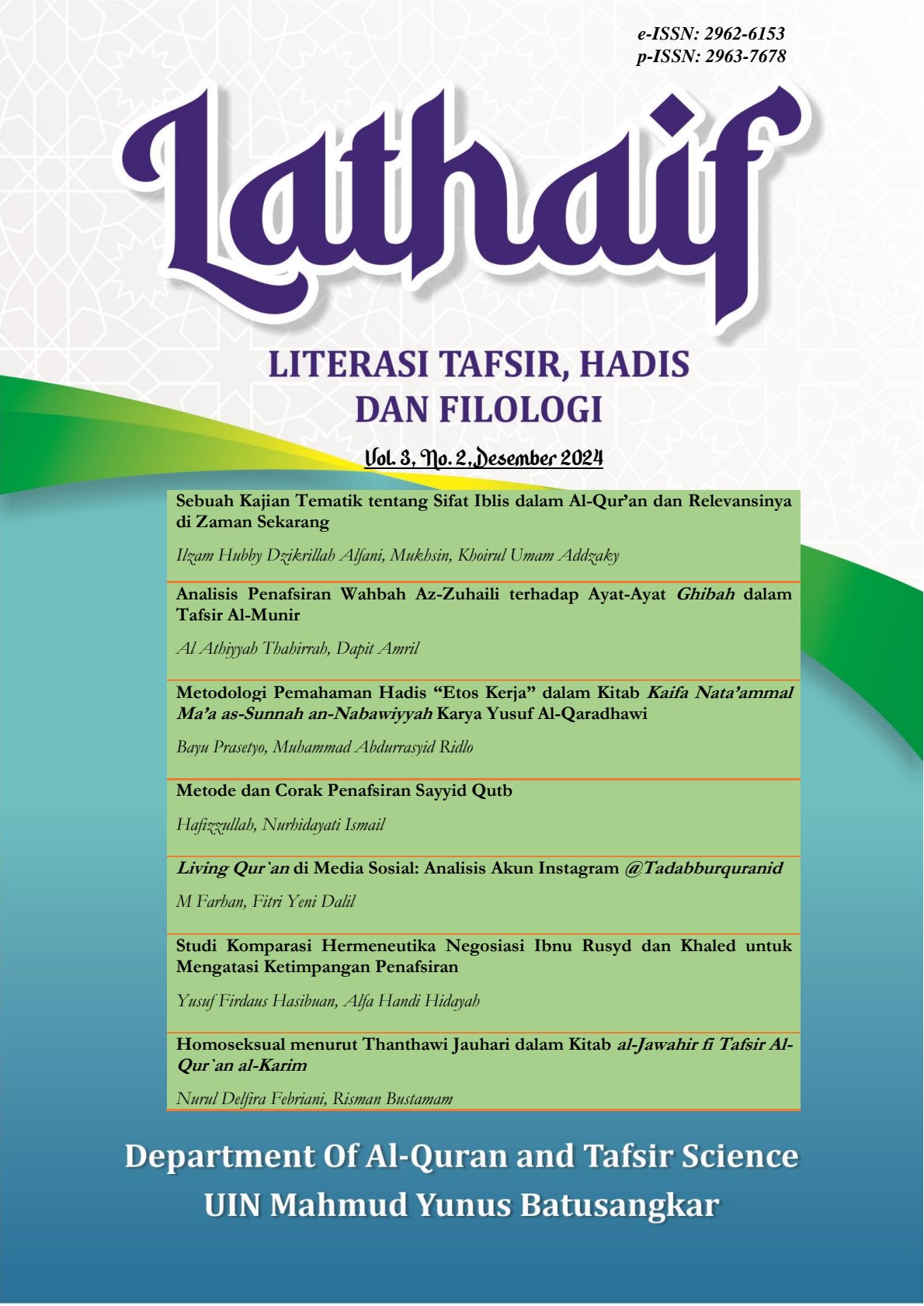
Homoseksual menurut Thanthawi Jauhari dalam Kitab al-Jawahir fi Tafsir Al-Qur`an al-Karim
DOI:
https://doi.org/10.31958/lathaif.v3i2.13755Keywords:
Homosexual, Thanthawi Jauhari, al-Jawahir fi Tafsir al-Qur'an al-KarimAbstract
The aim of this research is to find out the interpretation of verses about homosexuality in the Al-Qur'an according to Thanthawi Jauhari as a mufassir 'ilmi and how relevant Thanthawi Jauhari's thoughts are regarding the current homosexual phenomenon. The type of research used is library research. The analytical method used is the thematic interpretation method using the keyword Ϻ┘ä┘ü┘ÄϺϡ┘ÉÏ┤┘ÄÏ®. Meanwhile, to analyze the interpretation of homosexual verses by Thanthawi Jauhari, the character-based maudu'i interpretation method was used, through content analysis, interpretive science approaches, and hermeneutics. The results of this research conclude that as a mufassir 'ilmi, Thanthawi Jauhari interprets verses about homosexuals using a scientific approach with the following details: 1) Thanthawi Jauhari in his book interprets the meaning of the word Ϻ┘ä┘ü┘ÄϺϡ┘ÉÏ┤┘ÄÏ® contained in the QS. al-A'raf [7]: 80, QS. an-Naml [27]: 54, QS. al-'Ankabut [29]: 28 textually means a heinous act and contextually (the meaning of the verse QS. al-A'raf [7]: 81, QS. an-Naml [27]: 55, QS. al-' Ankabut [29]: 29) means homosexual. He explained that the Sodomites had ignored the wisdom of creating humans in pairs and cut off the path of descent by committing sexual deviations in the form of having sex with the same sex which resulted in the fertilization process not occurring. 2) Thanthawi Jauhari's scientific thinking is very relevant to the current homosexual phenomenon. According to science, if a sperm cell meets an egg cell, fertilization will occur. Psychologically, sexual deviant behavior will result in the perpetrator experiencing a decrease in their ability to think.References
Dachi, F. A., & Perdana, D. N. (2021). Pengembangan Lembar Kerja Peserta Didik (LKPD) dengan menggunakan Model Pembelajaran Science, Technology, Engineering and Mathematics (STEM) untuk Meningkatkan Efikasi Diri pada Siswa Kelas XI Busana SMK Negeri 6 Padang. Jurnal Pendidikan Matematika Ekasakti, 1(1), 38–48.
Delfita, R., Haviz., M., N. & U. R. K. (2018). Pengembangan Modul Sistem Pencernaan Makanan berbasis Sains Kelas VIII mtsn Padang Japang. Natural Science Jurnal, 4(1), 480–491.
Haristah, H., Azka, A., Setyawati, R. D., & Albab, I. U. (2019). Pengembangan Modul Pembelajaran. Jurnal Matematika Dan Pendidikan Matematika, 1(5), 224–236.
Haviz. (2013). Research and development ; penelitian di bidang kependidikan yang inovatif, produktif dan bermakna. Ta’dib, 16(1), 28–43. https://ojs.iainbatusangkar.ac.id/ojs/index.php/takdib/article/view/235/233
Insani, S. U., & Widjajanti, D. B. (2019). Pengembangan Perangkat Pembelajaran Matematika Model Learning Cycle 7E siswa kelas X SMA tahap Preliminary Research. Jurnal Cendekia Pendidikan Matematika, 3(1), 64–72.
Lestari, L., Alberida, H., & Rahmi, Y. L. (2018). Validitas dan Praktikalitas Lembar Kerja Peserta Didik ( LKPD ) Materi Kingdom Plantae Berbasis Pendekatan Saintifik untuk Peserta. Jurnal Eksakta Pendidikan, 2(2), 170–177.
Mazidah, I. N., Widodo, W., & Purnomo, A. R. (2019). Kevalidan LKPD Berbasis Predict-Observe-Explain untuk Melatihkan Kemampuan Literasi Sains Peserta Didik Kelas VII. E-Journal Pensa, 07(02), 239–243.
Mirza, G. A., & Handayani, R. D. (2019). Pengembangan Lembar Kegiatan Peserta Didik Bernuansa Emotional Spritual Quotient tentang Materi Sel , Jaringan , Organ dan Organisme untuk Peserta Didik Kelas VII SMP / MTs Development of Students Worksheet Nuanced of Emotional Spiritual Quotient about Cell , Organ , Tissue and Organism for Seventh Grade Students of SMP / MTs. 3(1), 27–36.
Rahmawati, T., Poernomo, J. B., & Pratama, F. R. (2022). Pengembangan Electronic Student Worksheet Bercirikan Higher Order Thinking Skill dan Model Learning Cycle 7E pada Materi Elastisitas. Jurnal Eksakta Pendidikan, 6(1), 28–35.
Samawati, Z., & Rahayu, Y. S. (2021). Profil Validitas dan Pratikalitas E-LKPD Tipe Flip Book Berbasis Contextual Teaching and Learning untuk Melatihkan Keterampilan Berfikir Kritis pada Materi Transpor Membran. E-Journal Lunesa, 10(2), 385–396.
Trianto. (2009a). Mendesain Model Pembelajaran Inovati-Prog resif Konsep, Landasan dan Implementasi Pada Kurikulum Tingkat Satuan Pendidikan (KTSP). Kencana Prenada Media Group.
Trianto. (2009b). Mendesain Model Pembelajaran Inovatif-Progresif Konsep, Landasan dan Implementasi pada Kurikulum Tingkat Satuan Pendidikan. Kencana Prenada Media Group.
Widyastuti, I. N., & Wiryokusumo, I. (2019). Pengembangan Modul Pembelajaran Dengan Model Dick and Carey Dan Menggunakan Concept Mapping Pada Mata Pelajaran Ekonomi Kelas Xi Ips Di Sma Negeri 1 Sampang Semester Ganjil Tahun Ajaran 2018/2019. Jurnal Education and Development, 7(2), 175–180.
Yuliana, T., Sari, M., & Meria, A. (2020). Pengembangan Modul Berbasis Learning Cycle 7E Berbantuan Video pada Materi Teori Kinetik Gas dan Termodinamika. Jurnal Penelitian Bidang IPA Dan Pendidikan IPA, 6(1), 7–21.
Downloads
Published
Issue
Section
License
Copyright (c) 2024 Nurul Delfira Febriani, Risman Bustamam

This work is licensed under a Creative Commons Attribution-NonCommercial 4.0 International License.
Authors who publish with?áLathaif: Literasi Tafsir, Hadis dan Filologi?áagree to the following terms:
- Authors retain copyright and grant the journal right of first publication with the work simultaneously licensed under a?áCreative Commons Attribution-NonCommercial 4.0 International License?á(CC BY-NC 4.0) that allows others to share the work with an acknowledgment of the work's authorship and initial publication in this journal.
- Authors are able to enter into separate, additional contractual arrangements for the non-exclusive distribution of the journal's published version of the work (e.g., post it to an institutional repository or publish it in a book), with an acknowledgment of its initial publication in this journal.
- Authors are permitted and encouraged to post their work online (e.g., in institutional repositories or on their website) prior to and during the submission process, as it can lead to productive exchanges, as well as earlier and greater citation of published work (See?áThe Effect of Open Access).


