
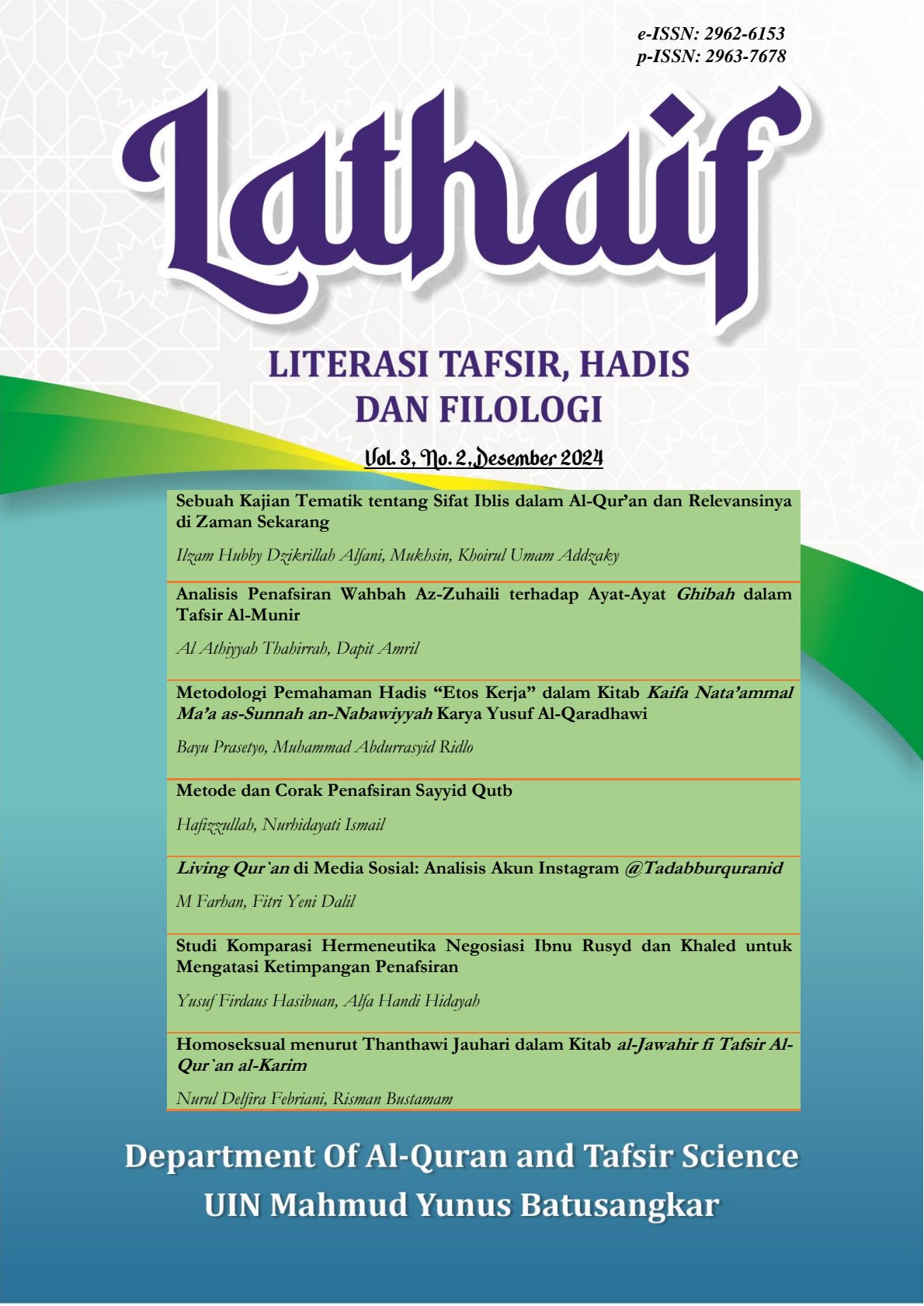
Metode dan Corak Penafsiran Sayyid Qutb
DOI:
https://doi.org/10.31958/lathaif.v3i2.13756Keywords:
Sayyid Qutb, Fi Zilal al-Qur'an, Methods, Patterns, Tafsir Al-Qur'anAbstract
Interpretation of the Qur'an is one of the important fields of study in the science of interpretation, with various methods and patterns developed by the mufassir according to the context of their time. Sayyid Qutb, a prominent Muslim thinker, made a significant contribution through his work Fi Zilal al-Qur'an. This study focuses on the methods and patterns of interpretation used by Sayyid Qutb in his interpretation, by examining its characteristics, approaches, and implications for the understanding of the Qur'an in the modern era. This study aims to answer three main questions: (1) What is the interpretation method used by Sayyid Qutb in Fi Zilal al-Qur'an? (2) What are the patterns of interpretation that dominate the work? (3) How to apply it in the aspects of Aqidah, muamalah worship and morals. To answer this question, the research was carried out with a qualitative-descriptive approach, using the content analysis method of Sayyid Qutb's main work, and supported by the literature. . The results of the study show that this interpretation uses the Iqtirani tafsir method, which combines the tafsir bi al-ma'tsur method and tafsir bi al ra'yi, by using the tafsir tahlili method and the pattern (laun) of the interpretation is Al-adab wal ijtima'i, which is an interpretation that prioritizes literature and social society, the haraki pattern (movement) and also the Sufi style (isyari). Based on the explanation of the form of interpretation in the Tafsir Fî Zhilâlil Qur'an, it appears that in terms of Aqidah, Sayyid Qutb has a tendency to think of tasawwuf, while in interpreting verses related to worship and mu'amalah, such as zakat, and the prohibition of usury, Sayyid Qutb uses a social approach, by looking at social phenomena that occur in society, and finally, in understanding the verses about morality,  like understanding the meaning of uswatun hasanah, Sayyid Qutb tries to understand the meaning of the verse based on the context of the nuzul of the verse.References
Abbas, F. H. (2016). At-Tafsir wa Al-Mufassirun: Asasiyatuh Wa Ittijahatuh wa Manahijuh fi Al-Ashr Al-Hadits. Yordania: Dâr An-Nafâis.
Al-'Alâ', A. b. (1425 H). Mashâbih Ad-Durar fi Tanâsub Ayât Al-Quran Al-Karim wa As-Suwar. Madinah: Jami'ah Madinah Al-Munawwarah.
Al-'Anazy, A. b. (2001). Al-Muqaddimat Al-Asâsiyah fi 'Ulûm Al-Qur`an. Inggris: Markaz Buhuts Al-Islamiyah London.
Aliyah, S. (2013). Kaedah-Kaedah Tafsir Fi Zhilaali Al-Qur`An. Jurnal Ilmu Agama: Mengkaji Doktrin, Pemikiran, Dan Fenomena Agama, 14(2), Article 2. https://doi.org/10.19109/jia.v14i2.468
Al-Mubarakfury, S. (2001). Ar-Rahîq Al-Makhtûm. Beirut: Dâr Al-Hilâl.
Al-Qatthan, M. b. (2000). Mabâhits fil Ulûm al-Qur`an. Kairo: Maktabah Al-Ma'ârif.
Ar-Rumi, F. A. (1986). Ittijahât At-Tafsir fi al-Qarni Ar-Rabi' 'Asyara. Riyadh: Dar Al-Hjr.
Ar-Rumi, F. b. (2017). Ushûl Al-Tafsîr wa Manâhijuh. Riyadh: Maktabah Al-Malik Fahd Al-Wathaniyah.
Kesuma, A. S. (2018). Re-interpretasi Pemikiran Ukhuwwah Sayyid Quthb. MIQOT: Jurnal Ilmu-Ilmu Keislaman, 42(1), Article 1. https://doi.org/10.30821/miqot.v42i1.536
Metodologi dan Corak Penafsiran Tafsir Fî Zhilâlil Qur`an Karya Sayyid Qutb. (t.t.). Darus.id - Wahana Literasi dan Edukasi Masyarakat. Diambil 14 November 2024, dari https://www.darus.id/2022/04/tafsir-fi-zhilalil-Qur`an-sayyid-qutb.html
Muhajirin, M. (2017). Sayyid Qutb Ibrahim Husain Asy-Syazali (Biografi, Karya Dan Konsep Pemaparan Kisah dalam Al-Qur’an). Tazkiyya: Jurnal Keislaman, Kemasyarakatan Dan Kebudayaan, 18(01), Article 01.
Rahman, M. T. (2014). Social Justice in Western and Islamic Thought: A Comparative Study of John Rawls’s and Sayyid Qutb’s Theories. Scholars’ Press. https://digilib.uinsgd.ac.id/11613/
Quthb, S. (2003). Fi Zhilâl Al-Qur`an. Beirut: Dâr As-Syuruq.
Al-'Alâ', A. b. (1425 H). Mashâbih Ad-Durar fi Tanâsub Ayât Al-Quran Al-Karim wa As-Suwar. Madinah: Jami'ah Madinah Al-Munawwarah.
Al-'Anazy, A. b. (2001). Al-Muqaddimat Al-Asâsiyah fi 'Ulûm Al-Qur`an. Inggris: Markaz Buhuts Al-Islamiyah London.
Aliyah, S. (2013). Kaedah-Kaedah Tafsir Fi Zhilaali Al-Qur`An. Jurnal Ilmu Agama: Mengkaji Doktrin, Pemikiran, Dan Fenomena Agama, 14(2), Article 2. https://doi.org/10.19109/jia.v14i2.468
Al-Mubarakfury, S. (2001). Ar-Rahîq Al-Makhtûm. Beirut: Dâr Al-Hilâl.
Al-Qatthan, M. b. (2000). Mabâhits fil Ulûm al-Qur`an. Kairo: Maktabah Al-Ma'ârif.
Ar-Rumi, F. A. (1986). Ittijahât At-Tafsir fi al-Qarni Ar-Rabi' 'Asyara. Riyadh: Dar Al-Hjr.
Ar-Rumi, F. b. (2017). Ushûl Al-Tafsîr wa Manâhijuh. Riyadh: Maktabah Al-Malik Fahd Al-Wathaniyah.
Kesuma, A. S. (2018). Re-interpretasi Pemikiran Ukhuwwah Sayyid Quthb. MIQOT: Jurnal Ilmu-Ilmu Keislaman, 42(1), Article 1. https://doi.org/10.30821/miqot.v42i1.536
Metodologi dan Corak Penafsiran Tafsir Fî Zhilâlil Qur`an Karya Sayyid Qutb. (t.t.). Darus.id - Wahana Literasi dan Edukasi Masyarakat. Diambil 14 November 2024, dari https://www.darus.id/2022/04/tafsir-fi-zhilalil-Qur`an-sayyid-qutb.html
Muhajirin, M. (2017). Sayyid Qutb Ibrahim Husain Asy-Syazali (Biografi, Karya Dan Konsep Pemaparan Kisah dalam Al-Qur’an). Tazkiyya: Jurnal Keislaman, Kemasyarakatan Dan Kebudayaan, 18(01), Article 01.
Rahman, M. T. (2014). Social Justice in Western and Islamic Thought: A Comparative Study of John Rawls’s and Sayyid Qutb’s Theories. Scholars’ Press. https://digilib.uinsgd.ac.id/11613/
Quthb, S. (2003). Fi Zhilâl Al-Qur`an. Beirut: Dâr As-Syuruq.
Downloads
Published
2024-12-20
Issue
Section
Articles
License
Copyright (c) 2024 Nurhidayati Ismail

This work is licensed under a Creative Commons Attribution-NonCommercial 4.0 International License.
Authors who publish with?áLathaif: Literasi Tafsir, Hadis dan Filologi?áagree to the following terms:
- Authors retain copyright and grant the journal right of first publication with the work simultaneously licensed under a?áCreative Commons Attribution-NonCommercial 4.0 International License?á(CC BY-NC 4.0) that allows others to share the work with an acknowledgment of the work's authorship and initial publication in this journal.
- Authors are able to enter into separate, additional contractual arrangements for the non-exclusive distribution of the journal's published version of the work (e.g., post it to an institutional repository or publish it in a book), with an acknowledgment of its initial publication in this journal.
- Authors are permitted and encouraged to post their work online (e.g., in institutional repositories or on their website) prior to and during the submission process, as it can lead to productive exchanges, as well as earlier and greater citation of published work (See?áThe Effect of Open Access).


