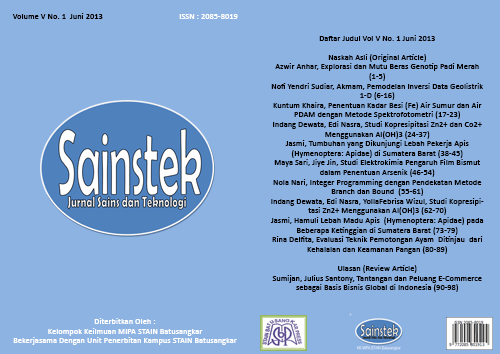
STUDI ELEKTROKIMIA PENGARUH FILM BISMUT DALAM PENENTUAN ARSENIK
DOI:
https://doi.org/10.31958/js.v5i1.81Abstract
The research objective was to determine arsenic by anodic stripping technique of differential pulse voltammetry to see the effect of the arsenic bismuth films with the potential scan direction opposite to the research that has been done by Nagaosa, et al though there are no reports on the mechanism chemical reaction between arsenic clear with movies bismuth until now. The purpose of this research is to study the effect of bismuth films in the determination of arsenic. In this study, the addition of bismuth ions with a concentration of 200 ppb. Voltammograms can be seen from quite a significant difference between the peak current generated by As (III) films coated with a non-bismuth bismuth films. Visible peak current of As (III) is higher if the addition of bismuth films. This proves the statement Nagaosa, et al who stated that there are mixed effects of bismuth in the determination of As (III) although the mechanism remains unclear.
Keyword: film bismuth, arcenic, differential pulse, anodic, stripping voltammetry
References
Anonim. 2001. Profil Ekosistem: Ekosistem hutan Sumatera di dalam “Hotspot” keanekaragaman hayati sundaland Indonesia. (versi terakhir) 11 De-sember, 2001.
Bhuiyan KH, Hossain HM, Bari MN and Khanan MR. 2002. Identification of bee plants and analysis of honey collected from different plant souerces. Pakistan Journal of Biological Sciences 5 (11): 1199-1201.
Free JB and Furson AW. 1983. Foraging be-havior of honey bee on oil seed rape. Beeword. Vol. 64. No. 1. p. 22-24.
Dag,A and Eisikowitch D. 1995. The influ-ence of hive location on honeybee for-aging activity and fruit set in melons grownin plastic greenhouses. Api-dologie. 26: 512-519.
Eltz T, Bruhl CA, van der Kaars S, Cey VK and Linsensmair KE. 2001. Pollen for-aging and resource partitioning of sting-less bees in relation in flowering dynaimics in a Southeast Asian Tro-pical raintforest. Insectes Sociaux. p. 273-289).
Erickson EH and Atmowidjoyo AH. 1997. Bermuda grass (Cynodon dactylon) as a pollen resource for honey bee colonies in the lower Clorado river agro-ecosystem. Apidologie. 28. p 57-52.
Liferdi. 2008. Lebah polinator utama pada ta-naman hortikultura. Balai Penelitian Tanaman Buah Tropika. Iptek hor-tikultura. No. 4 - Agustus 2008.
Klein A-M, Steffan-Dewenter I and Tscharntke T. 2003. Bee pollination and fruit set of Coffea arabica and C. canephora (Rubiaceae). American Jour-nal of Botany. 90 (1): 153-157.
MacKenzie KE. 1994. The foraging behaviour of honey bees (Apis mellifera L) and bumble bees (Bombus spp) on cran-berry (Vaccinium macrocarpon Ait). Apidologie. 25: 375-383.
Mahmood AN and Furgala M. J983. Effect of polination by insects on seed oil perentage of oilseed sunflower. Ameri-can Bee Juornal. Vol. 123. No. 9. p. 663-666.
Manaan A. 1997. The role honeybees on the polination of coconut mixed-croping. Indonesian Agriculture Risearch & De-velopment Jurnal. Volume 19, No. 3.
Mardan M. 1995. Apis dorsata honey hunting/gathering ecotour in tropical Asia. Beenet Online. Vol. 1. No. 3. p. 10-12.
Michener CD. 1974. The social behavior of the bees a comparative study. The Belknap Press of Havard University. Cambridge. Massachusetts.
Muntamah L. 2009. Aktifitas Apis cerana mencari polen dan identifikasi polen diperlebahan tradisional di Bali. Tesis. Sekolah Pascasarjana Institut Pertanian Bogor. Bogor.
Notodirnedjo S. 1990. Pengaruh pengadaan lebah, penyerbukan buatan dan pern-berian GA3 terhadap pertumbuhan pe-neratif tanaman apel (Malus sylvestris Mill) varietas rome beaty. Agrivita. Vol. 3. No.3. p. 65-69.
O Toole C and Raw A. 1991. Bees of the world. Biandford. London.
Ramaldho M, Kleinert-Giovenini A and Imperatriz-Fenzeca VL. 1989. Utili-zation of floral resources by spe-sies of Melipona (Apidae, Melipo-ninae): flo-ral preferences. Apidologie. 20: 185-195.
Salmah S. 1987. Jenis-jenis lebah pengahasil madu dan potensinya di Sumatera Ba-rat. Laporan penelitian. BKS-B dan USAID Pusat Penelitian Universitas Andalas. Padang.
Salmah S. 1989. Tempat dan volume beberapa jenis lebah yang terdapat di Sumatera (Hymenoptera: Apidae). Seminar dan Kongres Biologi Nasional IX di Pa-dang. Padang, 10-11 Juli 1989.
Salmah S. 1990. Jenis lebah sosial (Apidae) dan distribusinya di Taman Nasional Kerinci Seblat. Laporan penelitian. Departemen Pendidikan dan Kebu-dayaan. Pusat Penelitian Universitas Andalas Padang.
Tiwari P, Tiwari JK and Ballabha R. 2010. Studies on sources of bee-forage for rock bee (Apis dorsata F.) from Garh-wal Himalaya, India: a Melisso-paly-nogaical Approach. Natural and Scien-ce. 8 (6).
Tjitrosoepomo G. 2000. Morfologi tumbuhan. Gajah Mada University Press.
Downloads
Published
Issue
Section
License
Copyright (c) 2016 MAYA SARI, Jiye Jin

This work is licensed under a Creative Commons Attribution-NonCommercial-NoDerivatives 4.0 International License.
Authors who publish with this journal agree to the following terms:
- Authors retain copyright and grant the journal right of first publication with the work simultaneously licensed under a Creative Commons Attribution License that allows others to share the work with an acknowledgement of the work's authorship and initial publication in this journal.
- Authors are able to enter into separate, additional contractual arrangements for the non-exclusive distribution of the journal's published version of the work (e.g., post it to an institutional repository or publish it in a book), with an acknowledgement of its initial publication in this journal.
- Authors are permitted and encouraged to post their work online (e.g., in institutional repositories or on their website) prior to and during the submission process, as it can lead to productive exchanges, as well as earlier and greater citation of published work.