
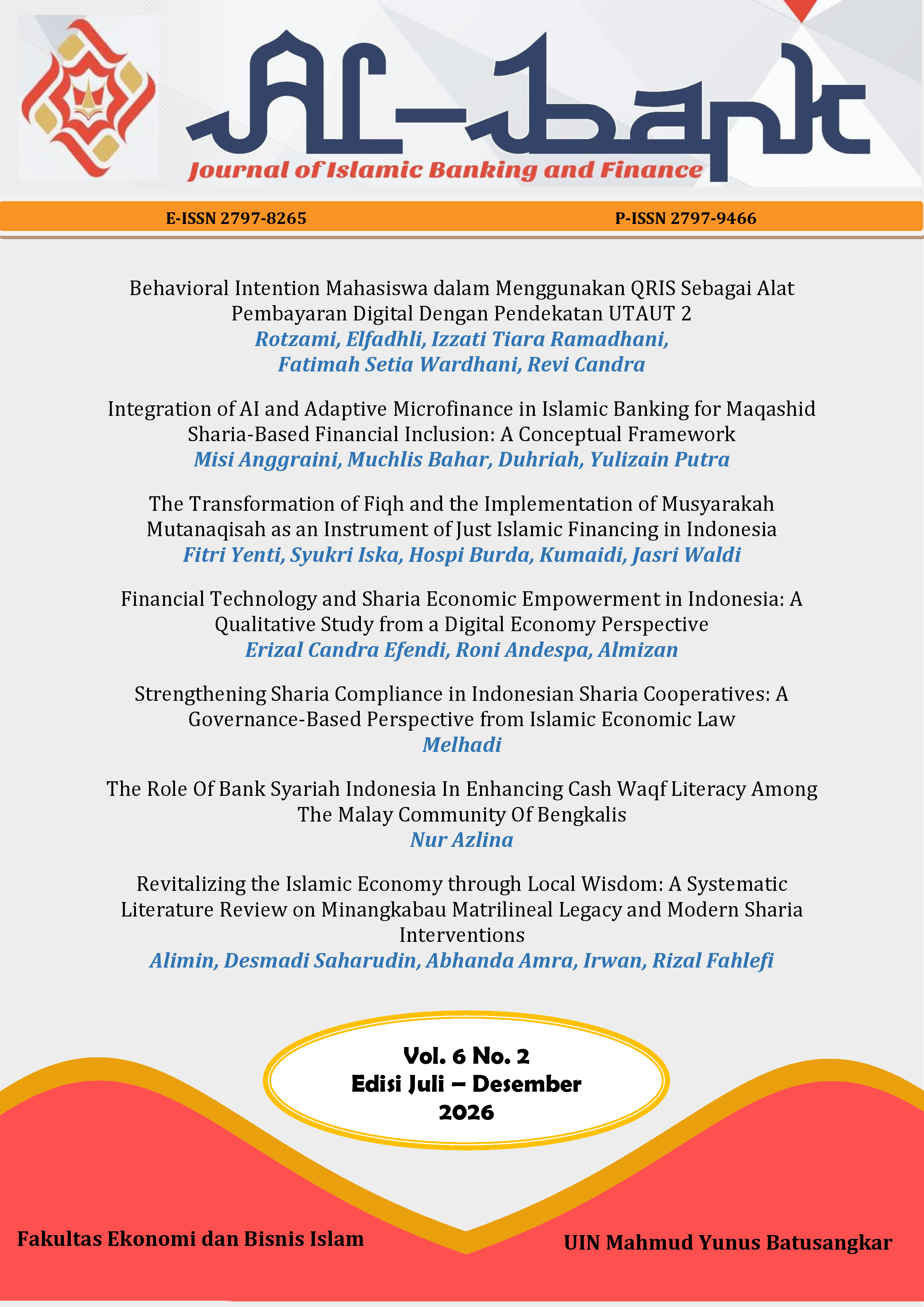
The Transformation of Fiqh and the Implementation of Musyarakah Mutanaqisah as an Instrument of Just Islamic Financing in Indonesia
DOI:
https://doi.org/10.31958/ab.v6i2.17183Keywords:
Musyarakah Mutanaqisah, Maqasid al Shariah, Islamic FinanceAbstract
This study examines the fiqh transformation of Musyarakah Mutanaqisah as a Sharia-based financing model in Indonesia by assessing the alignment between fiqh theory, the DSN–MUI fatwa, and banking practices. Although Musyarakah Mutanaqisah is conceptually grounded in partnership, gradual ownership, and risk sharing, its implementation across Islamic banks demonstrates a persistent tendency to resemble conventional credit structures, particularly through fixed rental margins, limited transparency, and weak risk-sharing mechanisms. This research employs a library-based qualitative approach using a normative–maqasidi framework combined with critical–empirical analysis. The findings indicate that the reconstruction of Musyarakah Mutanaqisah must be oriented towards the substantive realisation of Maqasid al-Shariah, particularly justice, public interest, and the protection of wealth. Reformulation is required in contractual structures, accounting systems, Sharia supervision, and the integration of sustainability values. Accordingly, Musyarakah Mutanaqisah holds the potential to evolve into a more equitable, transparent, and welfare-oriented Sharia financing instrument.
References
Abdul-Matin, I. (2010). Green deen: What Islam teaches about protecting the planet. Berrett-Koehler Publishers.
Afit Kurniawan, & Nur Inayah. (2014). Tinjauan kepemilikan dalam KPR syariah: Antara murabahah, ijarah muntahiyyah bittamlik, dan musyarakah mutanaqisah. Equilibrium: Jurnal Ekonomi Syariah, 1(2), 279–301. https://doi.org/10.21043/equilibrium.v1i2
Ahmed El-Ashker, & Wilson, R. (2006). Islamic economics: A short history. Edinburgh University Press.
Alandejani, M., Kutan, A. M., & Samargandi, N. (2017). Do Islamic banks fail more than conventional banks? Journal of International Financial Markets, Institutions and Money, 50, 135–155. https://doi.org/10.1016/j.intfin.2017.05.007
Alfiyan, R., Pramono, S., & Mardian, S. (2023). Islamic banking stability and digital transformation: Evidence from Indonesian Islamic banks. Journal of Islamic Accounting and Business Research, 14(5), 712–731. https://doi.org/10.1108/JIABR-07-2022-0173
Anggita Isty Intansari, & Fatimah. (2022). Comparative analysis of implementation of murabahah bil wakalah contracts and musyarakah mutanaqisah contracts for sharia financing products. Wealth: Journal of Islamic Banking and Finance, 1(2), 139–150. https://doi.org/10.24090/wealth.v1i2
Annisa, I. P. K., Kusmastuti, A., & Ningsih, A. F. (2024). Analisis standar syariah terhadap penerapan kontrak pembiayaan musyarakah dan musyarakah mutanaqisah di perbankan syariah. Iqtishaduna: Jurnal Ilmiah Mahasiswa Hukum Ekonomi Syariah. https://doi.org/10.24252/iqtishaduna.vi.50553
Ayub, M. (2007). Understanding Islamic finance. John Wiley & Sons.
Chapra, M. U. (1992). Islam and the economic challenge. The Islamic Foundation.
Chapra, M. U. (2000). The future of economics: An Islamic perspective. The Islamic Foundation.
Djamil, F. (2023). Hukum ekonomi Islam: Sejarah, teori, dan konsep. Rajawali Press.
Dusuki, A. W., & Bouheraoua, S. (2011). The framework of maqasid al-shariah and its implication for Islamic finance. Islam and Civilisational Renewal, 2(2), 316–336.
Ela Wilfa Sari, Mursalin, S., & Hartini, K. (2024). Peranan pembiayaan musyarakah mutanaqisah (MMQ) Bank Syariah Indonesia pada pengembangan UMKM di Kota Bengkulu. Jurnal Tabarru': Islamic Banking and Finance. https://doi.org/10.25299/jtb.2024.vol7(1).16857
Fachruddin Majeri Mangunjaya. (2019). Conserving nature in the land of the Quran. Yayasan Obor Indonesia.
Habriyanto, M., Ridho, M. T., & Amida, S. (2024). Pemahaman nasabah tentang konsep pembiayaan akad musyarakah mutanaqisah (MMQ) pada pembiayaan KPR subsidi di Bank 9 Jambi Syariah. Jurnal Publikasi Manajemen Informatika, 2(2). https://doi.org/10.55606/jupumi.v2i2.711
Hafidhuddin, D. (2021). Zakat & wakaf: Institusi ekonomi umat. Gema Insani.
Hakim, M. B. A. (2020). Hukum ekonomi syariah: Membangun ekonomi umat yang berkeadilan. Kencana.
Hakim, M. L. (2020). Implementasi, kendala dan efektifitas kursus pranikah di KUA Kecamatan Pontianak Tenggara. Al-Istinbath: Jurnal Hukum Islam, 5(2), 311–328. https://doi.org/10.29240/jhi.v5i2.1817
Hartanto, S., & Sup, D. F. A. (2022). Konsep hybrid contract di Indonesia dalam perspektif Fatwa DSN-MUI. Journal of Islamic Economics and Finance Studies, 3(1), 43–54. https://doi.org/10.47700/jiefes.v3i1.4295
Hidayat, T., & Nurhasanah, S. (2024). Implementation of DSN-MUI Fatwa No. 146/2021 in sharia-based e-commerce transactions. Al-Iqtishad: Journal of Islamic Economics, 16(1), 77–98. https://doi.org/10.15408/aiq.v16i1.34567
Ibnu Hajar Al-Asqalani. (n.d.). Bulughul Maram.
Islamic Development Bank. (2023). Islamic finance and green economy report.
Islamic Development Bank Institute. (2023). Islamic finance strategic report 2023.
Islamic Financial Services Board. (2023). Islamic financial services industry stability report 2023.
Islamic Financial Services Institutions. Accounting and Auditing Organization for Islamic Financial Institutions. (2021). Sharia standards (Rev. ed.).
Islahi, A. A. (2008). Economic concepts of Ibn Taimiyah. Islamic Research and Training Institute.
Junita, & Alisman. (2024). Pengaruh pembiayaan murabahah dan musyarakah terhadap permintaan nasabah dalam memilih produk KPR di Bank BTN KCPS Meulaboh. Jurnal Ilmiah Ekonomi Terpadu (JIMETERA), 4(2), 138–150.
Kamali, M. H. (2008). Maqasid al-shariah made simple. The International Institute of Islamic Thought.
Kamali, M. H. (2010). Shari'ah law: An introduction. Oneworld Publications.
Khoualed, A. O. O., Almi, H., Rekiba, S., & Saadallah, O. (2025). Artificial intelligence and the objectives of Shariah in Islamic finance: A maqasid-based framework for smart applications in Islamic banking. 21st Century Media and Communications, 9(1), 72–83. https://doi.org/10.54664/ggui5781
Kuran, T. (2011). The long divergence: How Islamic law held back the Middle East. Princeton University Press.
Mankiw, N. G. (2017). Principles of economics. Cengage Learning.
Mannan, M. A. (1998). Pengantar ekonomi Islam. Intermasa.
Moleong, L. J. (2021). Metodologi penelitian kualitatif. PT Remaja Rosdakarya.
Monzer Kahf. (1978). The Islamic economy: Analytical study of the functioning of the Islamic economic system. Muslim Students Association of the United States and Canada.
Muhammad Anwar Zainuddin. (2023). Akad musyarakah mutanaqisah dalam sistem perbankan syariah. Bilancia: Jurnal Studi Ilmu Syariah dan Hukum. https://doi.org/10.24239/blc.v12i2.373
Mushoffa, M. (2015). Konsep Ibnu Khaldun dalam politik ekonomi. UIN Sunan Kalijaga Press.
Naqvi, S. N. H. (1981). Ethics and economics: An Islamic synthesis. The Islamic Foundation.
Nurlaelasari, N. (2022). Analisis hukum Islam dalam penerapan bagi hasil pada Bank Muamalat Sukabumi. Jurnal Akuntansi UMMI, 3(1), 34–41. https://doi.org/10.37150/jammi.v3i1
Rahmawati, A., & Zaki, I. (2019). Analisis faktor preferensi implementasi akad musyarakah mutanaqishah dibandingkan akad ijarah muntahiya bittamlik pada Bank Jatim Syariah Surabaya. Jurnal Ekonomi Syariah Teori dan Terapan, 6(4), 720–731. https://doi.org/10.20473/vol6iss20194pp720-731
Sarwedhie, A. K., & Suprayogi, N. (2014). Perlakuan akuntansi akad musyarakah mutanaqisah (Studi kasus: KPR iB pada Bank Muamalat Cabang Darmo Surabaya). Jurnal Ekonomi Syariah Teori dan Terapan, 1(6), 434–447. https://doi.org/10.20473/vol1iss20146pp434-447
Syarifa Mahila. (2017). Perjanjian pembiayaan hunian syariah dengan akad murabahah dan musyarakah pada PT Bank Muamalat Indonesia, Tbk. Cabang Jambi. Jurnal Ilmiah Universitas Batanghari Jambi, 14(4), 131–140. https://doi.org/10.33087/jiubj.v14i4
Usmani, M. T. (2002). An introduction to Islamic finance. Idaratul Ma'arif.
Vika Mitasari, Ramadhan, A., & Rahmawati. (2024). Penerapan akad musyarakah mutanaqishah dalam pembiayaan KPR syariah di Bank BSI. Journal of Economic, Management, Accounting and Technology. https://doi.org/10.32500/jematech.v6i2.4026
Zubir, Muhazir, & Wahyudani, Z. (2023). Akad al-ijarah al-mausufah fi al-dzimmah in sharia banking in Aceh: A study of homeownership finance. Justicia Islamica, 19(2), 312–330
Downloads
Published
How to Cite
Issue
Section
License
Copyright (c) 2026 Fitri Yenti, Syukri Iska, Hospi Burda, Kumaidi Kumaidi, Jasri Waldi

This work is licensed under a Creative Commons Attribution-NonCommercial 4.0 International License.
Copyright Notice
Authors who publish with this journal agree to the following terms:
- Authors retain copyright and grant the journal the right of first publication with the work simultaneously licensed under?áa Creative Commons Attribution-NonCommercial 4.0 International License that allows others to share the work with an acknowledgment of the work's authorship and initial publication in this journal.
- Authors are able to enter into separate, additional contractual arrangements for the non-exclusive distribution of the journal's published version of the work (e.g., post it to an institutional repository or publish it in a book), with an acknowledgment of its initial publication in this journal.
- Authors are permitted and encouraged to post their work online (e.g., in institutional repositories or on their website) prior to and during the submission process, as it can lead to productive exchanges, as well as earlier and greater citation of published work.