
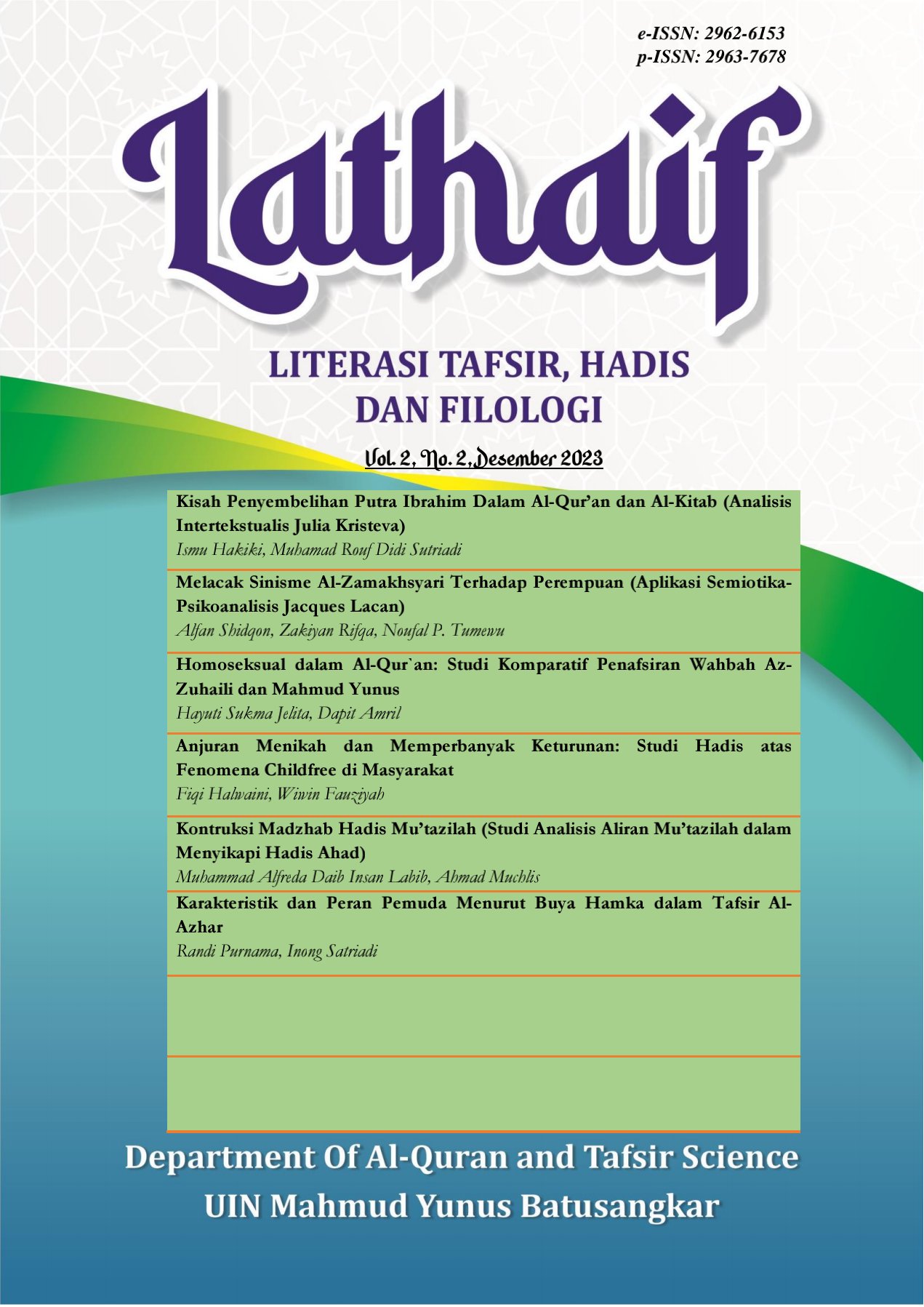
Karakteristik dan Peran Pemuda Menurut Buya Hamka dalam Tafsir Al-Azhar
DOI:
https://doi.org/10.31958/lathaif.v2i2.10916Keywords:
Youth, Buya Hamka, Tafsir Al-AzharAbstract
The main problem in this study is youth according to Buya Hamka in Tafsir Al-Azhar (Studies of thematic interpretations). The purpose of this study is based on the formulation of the problem above, namely to explain the characteristics of youth, the role of youth and solutions to youth challenges according to Buya Hamka in Tafsir Al-Azhar. The type of research used is library research. The data collection technique used is the thematic method(maudhu'i)that is by collecting all the verses Al-Qur`an verses related to youth according to Buya Hamka in Al-Azhar Tafsir. Then the data is processed using descriptive analysis method with content analysis approach(content analysis) to get answers to the problems discussed. The results of research related to youth can be concluded that the characteristics that must be present in a young man are faith in Allah, istiqamah on the straight path, never give up, obey leaders, stand firm, and be smart/smart. Then the role that must be carried out by a young man is to become an enforcer of truth in fighting falsehood and being useful to others under any circumstances, both in happy and difficult situations. The solution to the challenges experienced by youth in the form of promiscuity or known as rampant adultery can be overcome by acting Iffah namely maintaining self-respect by holding back lust and lust.
References
A Simangunsong, G. (2022). Penyelesaian Sengketa Bisnis Ekspor Udang Indonesia Dan Amerika Serikat. Jurnal Rechten : Riset Hukum Dan Hak Asasi Manusia, 4(1), 1–7. https://doi.org/10.52005/rechten.v4i1.71
Baehaqi, A., & Suyanto, S. (2019). Audit Internal Lembaga Keuangan Syariah Dalam Perpektif Al-Hisbah. Jurnal Riset Keuangan Dan Akuntansi, 4(2), 15–24. https://doi.org/10.25134/jrka.v4i2.1694
Dunn, R. M., & Mutti, J. H. (2014). International Economics. Taylor And Francis e-Library.
Liu, C., Yang, S., Hao, T., & Song, R. (2022). Service risk of energy industry international trade supply chain based on artificial intelligence algorithm. Energy Reports, 8, 13211–13219. https://doi.org/10.1016/j.egyr.2022.09.182
Lu, Z., Gozgor, G., Mahalik, M. K., Padhan, H., & Yan, C. (2022). Welfare gains from international trade and renewable energy demand: Evidence from the OECD countries. Energy Economics, 112(March), 106153. https://doi.org/10.1016/j.eneco.2022.106153
Muaidi. (2006). Penyelesaian Sengketa Dalam Hukum Ekonomi Syariah. Jurnal Hukum Ekonomi Syariah Dan Ahawl as Syahsiyah, 3, 5–65.
Oktasari, W. (2017). Islamic Economics for Social Justice and Welfare Excerpt from Seerah of Prophet Muhammad SAW. Seerat Studies, 02, 1–10.
Rakhmawati, A. (2016). Implementasi Lembaga Hisbah Dalam Meningkatkan Bisnis Islami. Malia, 7, 311–334.
Rozalinda. (2014). Ekkonomi Islam: Teori dan Aplikasinya Pada Aktivitas Ekonomi. In Ekonomi Islam.
Wulandari, L., & Zuhri, S. (2019). Pengaruh Perdagangan Internasional Terhadap Pertumbuhan Ekonomi Indonesia Tahun 2007-2017. Jurnal REP (Riset Ekonomi Pembangunan), 4(2), 1–189. https://doi.org/10.31002/rep.v4i2.781
Yuni, R., & Hutabara, D. (2021). Dampak Perdagangan Internasional Terhadap Pertumbuhan Ekonomi Indonesia Pada Tahun 2009-2019. Niagawan, 10(1), 62. https://doi.org/10.24114/niaga.v10i1.19193
Downloads
Published
Issue
Section
License
Copyright (c) 2023 Randi Purnama

This work is licensed under a Creative Commons Attribution-NonCommercial 4.0 International License.
Authors who publish with?áLathaif: Literasi Tafsir, Hadis dan Filologi?áagree to the following terms:
- Authors retain copyright and grant the journal right of first publication with the work simultaneously licensed under a?áCreative Commons Attribution-NonCommercial 4.0 International License?á(CC BY-NC 4.0) that allows others to share the work with an acknowledgment of the work's authorship and initial publication in this journal.
- Authors are able to enter into separate, additional contractual arrangements for the non-exclusive distribution of the journal's published version of the work (e.g., post it to an institutional repository or publish it in a book), with an acknowledgment of its initial publication in this journal.
- Authors are permitted and encouraged to post their work online (e.g., in institutional repositories or on their website) prior to and during the submission process, as it can lead to productive exchanges, as well as earlier and greater citation of published work (See?áThe Effect of Open Access).


