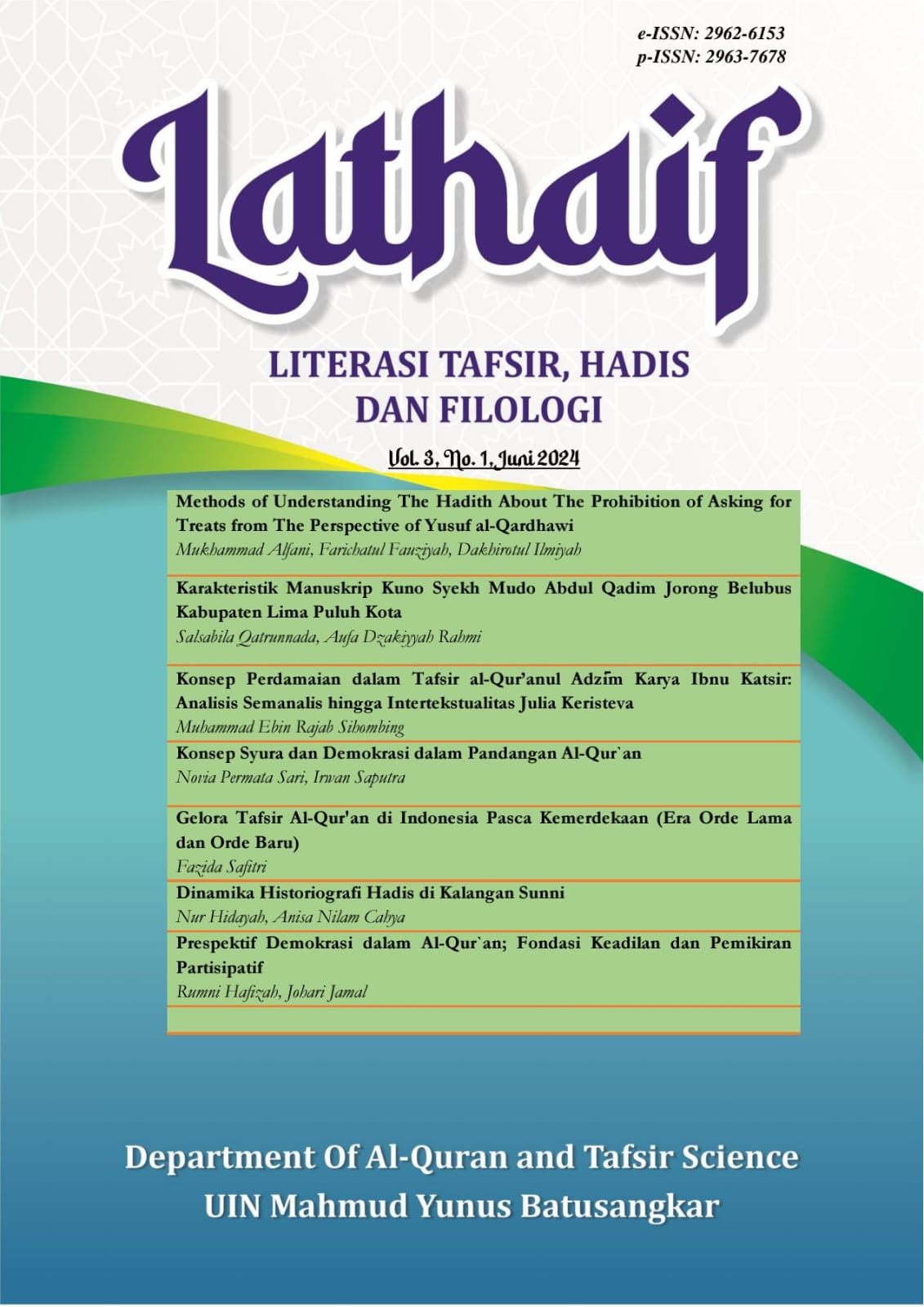
Gelora Tafsir Al-QurÔÇÖan di Indonesia Pasca Kemerdekaan (Era Orde Lama dan Orde Baru)
DOI:
https://doi.org/10.31958/lathaif.v3i1.10933Kata Kunci:
Tafsir, Orde Lama, Orde BaruAbstrak
The era of Orla and Orba became a period where changes regarding the interpretation of the Qur'an occurred quite significantly. In the era of Orla era, Indonesia experienced the process of forming the state and drafting the constitution. The interpretation of the Qur'an became a concern to build a solid religious foundation and religious life in Indonesia. While in the next era Orba, the government gave recognition to the religions that existed in Indonesia, but the implementation of supervision and control. This of course influenced the development of Qur'anic tafsir in Indonesia. This paper will focus on discussing the movement of the development of tafsir in Indonesia in the post-independence era where there were still upheavals in the Indonesian government system marked by several major events that occurred namely the old order era to the new order by using a socio-historical approach. The development of interpretation during the Old Order and New Order is an interesting phenomenon to be studied so that it can be seen and reflect the intellectual diversity of culture in Indonesian society. There are 11 works of Indonesian Qur'anic commentaries published in the Old Order and New Order periods that became part of the wealth of tafsir in Indonesia.The interpretation of the Qur'an involved intellectual actors who were involved in the socio-political life of the time. Intellectual actors who were involved in the socio-political life at that time, based on their intellectual backgrounds and social identities. Movement interpretation of the Qur'─ün in post-independence Indonesia has had a significant impact on religious understanding and Muslim life in Indonesia. Qur'anic interpretation became an integral part of education and proselytization in Indonesia, and Muslim scholars and intellectuals made a significant contribution to the development of Qur'anic exegesis in the country.
Referensi
Datokarama, Malkan STAIN, ‘Tafsir Al-Azhar’, Jurnal Hunafa, 6.3 (2020), 248–53.
Erneste, Pamusuk. “H.B Jassin: Paus Sastra Indonesia. Jakarta: Djambatan, 1987
Federspiel, Howard M., ‘Popular Indonesian Literature of the Quran’, 1994, p. 166 halaman
Fikrul Hanif Sufyan, ‘Penoalkan Abdul Malik Ahmad Terhadap Asas Tunggal Pancasila Di Organisasi Muhammadiyah’, Artikel Studi Sejarah Pasca Sarjana Universitas Andalas, 2011
Ghozali, Mahbub, ‘Dialektika Sains, Tradisi Dan Al-Qur’an: Representasi Modernitas Dalam Tafsir Rahmat Karya Oemar Bakry’, AL QUDS : Jurnal Studi Alquran Dan Hadis, 5.2 (2021), 843 <https://doi.org/10.29240/alquds.v5i2.3394>
Gusmian, Islah. “Tafsir Al-Qur’an di Indonesia: Sejarah dan Dinamika,” Jurnal Nun, Vol. 1, No. (2015)
Gusmian, Islah. Khazanah Tafsir Indonesia dari Hermeneutika hingga Ideologi Jakarta: Teraju, (2003)
Hamka. Tafsir Al-Azhar jilid 1. 1965. Pustaka Nasional PTE LTD Singapura.
Liddle, R William, and R William Liddle, ‘Soeharto ’ s Indonesia : Personal Rule and Political Institutions Soeharto ’ s Indonesia : Personal Rule and Political Institutions *’, Pacific Affairs, 58.1 (2018), 68–90
Maslukhin, M, ‘Kosmologi Budaya Jawa Dalam Tafsîr Al-Ibrîz Karya KH. Bisri Musthofa’, Mutawatir, 5.1 (2015), 74 <https://doi.org/10.15642/mutawatir.2015.5.1.74-94>
Rakhmat, Jalaluddin. Tafsir Bil Ma’tsur: Pesan Moral Alquran, Pendahuluan, Bandung, Rosdakarya, (1999)
Rasyidi, Dakwah Sufistik Kang Jalal lmeneteramkan Jiwa, mencerahkan pikiran, Jakarta, Paramadina, (2004)
Roifa, Rifa, Rosihon Anwar, and Dadang Darmawan, ‘Perkembangan Tafsir Di Indonesia’, Al-Bayan, 2.1 (2017), 21–36
Rokhmad, Abu, ‘Telaah Karakteristik Tafsir Arab Pegon Al-Ibriz’, Analisa, XVIII.01 (2011), 27–38
Rusmana 2, Dadan, Nida Amalia Kamal, and Maulana Yusuf Alamsyah, ‘Karakteristik Tafsir Madrasi Karya H. Oemar Bakri Dan Penggunaannya Pada Kurikulum Kmi Darussalam Gontor Putri’, Al-Bayan: Jurnal Studi Ilmu Al- Qur’an Dan Tafsir, 6.1 (2021) <https://doi.org/10.15575/al-bayan.v6i1.13999>
Sayyida, Sayyida, Kusmana Kusmana, Eva Nugraha, Hamka Hasan, Yudi Setiadi, and Rahman Ahdori, ‘Literature Qur’an in Indonesia: Tafsir Al-Qur’an H. Zainuddin Hamidy And Fachruddin HS (Has Analysis Of The Philological Approach)’, 2021 <https://doi.org/10.4108/eai.20-10-2020.2305183>
Shihab, Quraish. Tafsir Al-Qur’an Al-Karim: Tafsir atas Surat-surat Pendek Berdasarkan Urutan Turunnya Wahyu Bandung: Pustaka Hidayah, (1997)
Suryadinata, Sartika, ‘Penafsiran Kata Syaythan Menurut Dawam Rahardjo Dalam Ensiklopedi Al-Qur’an’, Istinarah: Riset Keagamaan, Sosial Dan Budaya, 2.1 (2020), 30 <https://doi.org/10.31958/istinarah.v2i1.2031>
Syamsu, Nur, ‘Pemikiran Pendidikan Islam H . Abdul Mukti Ali’, Universitas Islam Negeri Sunan Kalijaga Yogyakarta 1, November, 2019, 1–3
Yanuari, Beti, ‘Perkembangan Islam Di Indonesia Pasca Kemerdekaan’, Historia, 3.2 (2015), 75–82
Zia Al-Ayyubi, M., ‘Dinamika Tafsir Al-Qur’an Di Indonesia (Era Pra-Kolonialisme Hingga Kolonialisme)’, Rausyan Fikr: Jurnal Ilmu Studi Ushuluddin Dan Filsafat, 16.1 (2020)
Wirjosukarto, “Pembaharuan Pendidikan dan Pengajaran Islam”, Jember: Muria Offset, (1985)
Diterbitkan
Terbitan
Bagian
Lisensi
Hak Cipta (c) 2024 Fazida Safitri

Artikel ini berlisensi Creative Commons Attribution-NonCommercial 4.0 International License.
Authors who publish with?áLathaif: Literasi Tafsir, Hadis dan Filologi?áagree to the following terms:
- Authors retain copyright and grant the journal right of first publication with the work simultaneously licensed under a?áCreative Commons Attribution-NonCommercial 4.0 International License?á(CC BY-NC 4.0) that allows others to share the work with an acknowledgment of the work's authorship and initial publication in this journal.
- Authors are able to enter into separate, additional contractual arrangements for the non-exclusive distribution of the journal's published version of the work (e.g., post it to an institutional repository or publish it in a book), with an acknowledgment of its initial publication in this journal.
- Authors are permitted and encouraged to post their work online (e.g., in institutional repositories or on their website) prior to and during the submission process, as it can lead to productive exchanges, as well as earlier and greater citation of published work (See?áThe Effect of Open Access).


