
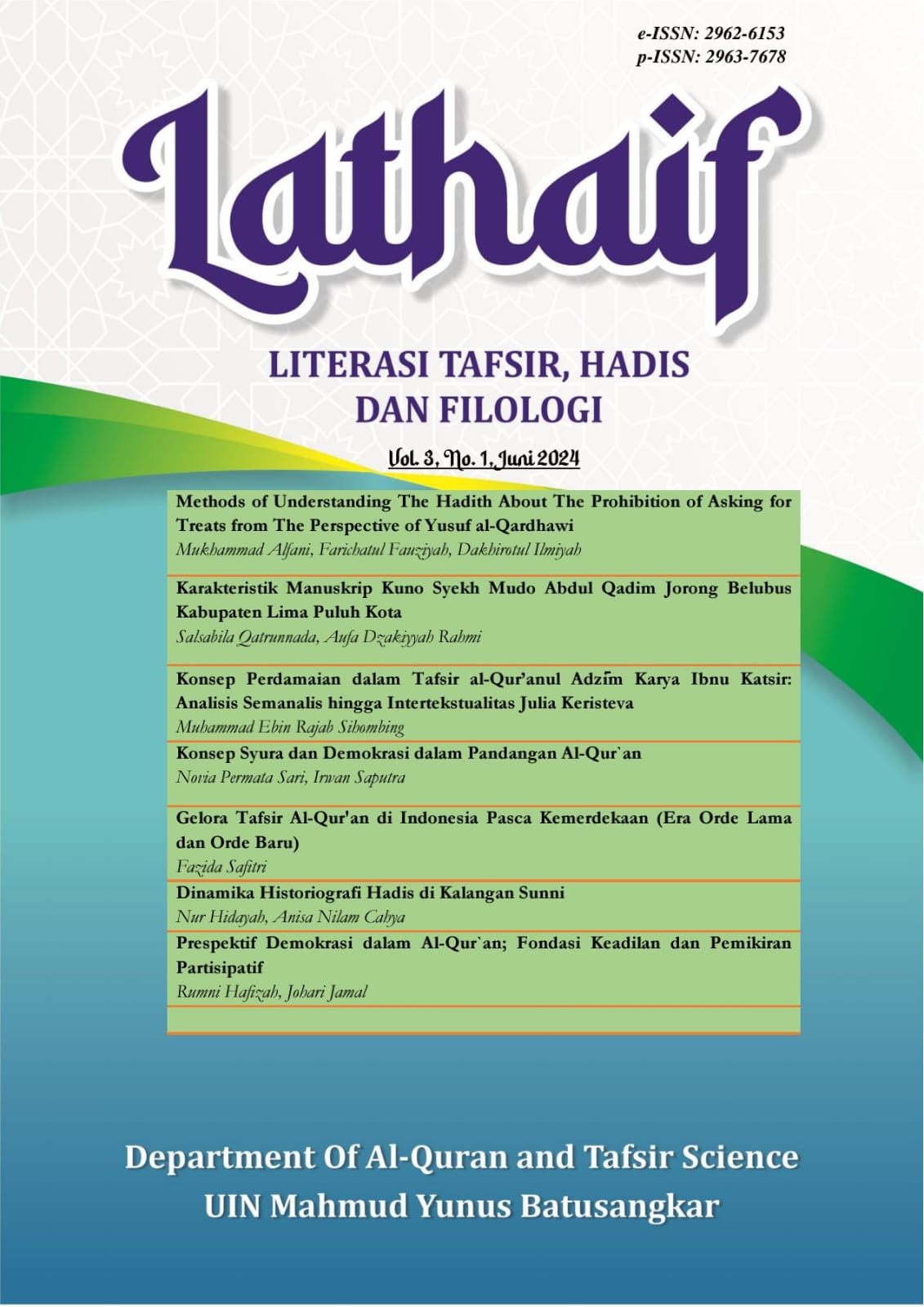
Methods of Understanding The Hadith About The Prohibition of Asking for Treats from The Perspective of Yusuf al-Qardhawi
DOI:
https://doi.org/10.31958/lathaif.v3i1.12439Kata Kunci:
Hadith, asking for a treat, perspective, Yusuf Al-QardhawiAbstrak
This article explores the interpretation of the Hadith concerning the forbiddance of soliciting gifts, as seen through the lens of Egyptian-born Islamic scholar Yusuf al-Qardhawi, born in 1926. Al-Qardhawi's approach to interpreting Hadiths plays a crucial role in comprehending Islamic principles in daily life. A proper understanding of the Hadith should align with the directives of the Qur'an, consolidate similar traditions, and corroborate the Hadith with historical realities. The analysis of the Hadith on the forbiddance of soliciting gifts underscores the significance of harmonizing the Hadith with Qur'anic guidance for a comprehensive and coherent grasp of Islamic doctrines. Al-Qardhawi maintains a balanced perspective of the Sunnah and emphasizes the need to comprehend the Sunnah within the framework of tashri', religious studies, and civilization. The hadith's prohibition against begging reiterates it as forbidden, with exceptions for certain individuals who meet specific criteria. As such, examining the Hadith on the forbiddance of soliciting gifts from Yusuf al-Qardhawi's viewpoint offers valuable perspectives on the application of Islamic teachings in everyday life.
Referensi
Ardiansyah, A., Sarinah, S., Susilawati, S., & Juanda, J. (2022).
KAJIAN PSIKOANALISIS SIGMUND FREUD. Jurnal Kependidikan, 7(1), Article 1.
Asiah, A., Violina, E. I., & Mawaddah, S. (2022). Buku Ajar Konseling Karir. Eureka Media Aksara. https://repository.penerbiteureka.com/pt/publications/560187/
Bertens, K. (2006). Psikoanalisis Sigmund Freud. Gramedia Pustaka Utama.
Choirudin, M. (2016). PENYESUAIAN DIRI: SEBAGAI UPAYA MENCAPAI KESEJAHTERAAN JIWA. Hisbah: Jurnal Bimbingan Konseling dan Dakwah Islam, 12(1), 1–20. https://doi.org/10.14421/hisbah.2015.121-07
Hapsyah, D. R., Jabbar, A. A., & Hidayat, D. R. (2019). IMPLEMENTASI TEORI DONALD E. SUPER PADA PROGRAM LAYANAN BK KARIR DI SMK. Vol ., 64.
Kurniawan, M. F., & Stanislaus, S. (2016). PERILAKU PRO-SOSIAL DITINJAU DARI TIPE KEPRIBADIAN INTROVERT DAN EKSTROVERT (Studi pada Mahasiswa Psikologi UNNES). Intuisi : Jurnal Psikologi Ilmiah, 8(3), Article 3. https://doi.org/10.15294/intuisi.v8i3.8664
M. Enoch Markum. (2014). Psikologi Sosial, cet 5. Tanggerang : Universitas Terbuka, hlm.310.
Pamungkas, A. (2020). Tipe Kepribadian Ektrovert-Introvert dan Kecemasan Mahasiswa pada masa Pandemi Covid-19. Syams: Jurnal Kajian Keislaman, 1(2), Article 2.
Rosida, E. R., & Astuti, T. P. (2015). PERBEDAAN PENERIMAAN TEMAN SEBAYA DITINJAU DARI TIPE KEPRIBADIAN EKSTROVERT DAN INTROVERT. 4.
Sanyata, S. (t.t.). Teori dan Aplikasi Pendekatan Behavioristik dalam Konseling.
S.Pd.,M.Pd, G. L. (2021). Teori dan Pendekatan Konseling. umsu press.
Tikfi, R. K., & Mulyani, M. (2022). Analisis Ketidakmampuan Bersosialisasi pada siswa Introvert : Proceeding Seminar Nasional Bimbingan Dan Konseling (SEMNASBK), 17–20.
Zainal Abidin. (2021). Optimalisasi Konseling Individual. 133.
##submission.downloads##
Diterbitkan
Terbitan
Bagian
Lisensi
Hak Cipta (c) 2024 Mukhammad Alfani, Farichatul Fauziyah, Dakhirotul Ilmiyah

Artikel ini berlisensi Creative Commons Attribution-NonCommercial 4.0 International License.
Authors who publish with?áLathaif: Literasi Tafsir, Hadis dan Filologi?áagree to the following terms:
- Authors retain copyright and grant the journal right of first publication with the work simultaneously licensed under a?áCreative Commons Attribution-NonCommercial 4.0 International License?á(CC BY-NC 4.0) that allows others to share the work with an acknowledgment of the work's authorship and initial publication in this journal.
- Authors are able to enter into separate, additional contractual arrangements for the non-exclusive distribution of the journal's published version of the work (e.g., post it to an institutional repository or publish it in a book), with an acknowledgment of its initial publication in this journal.
- Authors are permitted and encouraged to post their work online (e.g., in institutional repositories or on their website) prior to and during the submission process, as it can lead to productive exchanges, as well as earlier and greater citation of published work (See?áThe Effect of Open Access).


