
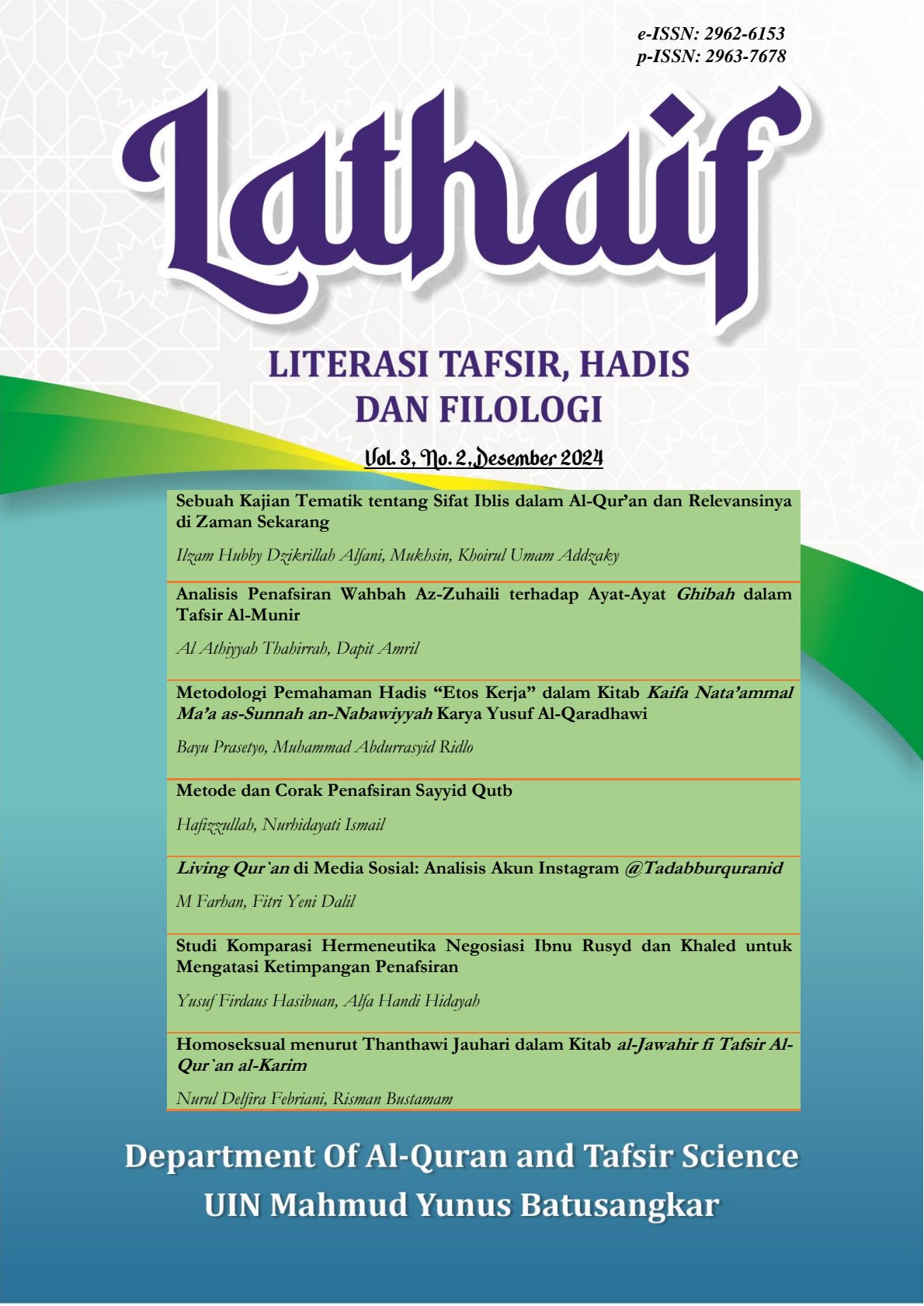
Metodologi Pemahaman Hadis ÔÇ£Etos KerjaÔÇØ dalam Kitab Kaifa NataÔÇÖammal MaÔÇÖa as-Sunnah an-Nabawiyyah Karya Yusuf Al-Qaradhawi
DOI:
https://doi.org/10.31958/lathaif.v3i2.13483Kata Kunci:
Ethos at Work, Understanding Hadith, Yusuf Al-QaradhawiAbstrak
This article aims to determine the understanding of the hadith about work ethic in the book Kaifa Nata'ammal Ma'a as-Sunnah an-Nabawiyyah from the perspective of Yusuf al-Qaradhawi. Hadiths about work ethic are often misunderstood by some communities as legality to avoid shari'a in worldly affairs, even though the prophet SAW did not intend this. This research is a qualitative study through a literature study approach with a content analysis study method sourced from primary and secondary data based on data collection which includes the book Kaifa Nata'ammal Ma'a as-Sunnah an-Nabawiyyah as primary data and the book as-Sunnah Mashdar li Ma'rifah wa al-Hadharah, Shahih Muslim, al-Minhaj fi Syarh Shahih Muslim as secondary data, as well as scientific articles and other supporting literature sources relevant to this research. This article seeks to answer the questions of how Yusuf al-Qaradhawi's contribution in the context of modern Islamic thought, how the hadith understanding methodology developed by Yusuf al-Qaradhawi, and how Yusuf al-Qaradhawi's understanding of the hadith about work ethic can contribute to building an inclusive and relevant Islamic view of the world of work in the contemporary era. the results of this study indicate that the hadith about ÔÇÿWork ethicÔÇÖ in general is the prophet's instructions on how the order and behaviour of Muslims in the completion of a job, and in a specific sense speaks of professionalism in the world of work, namely respect for professional expertise or other fields of expertise that are universal.
Referensi
Alim Syahirul. (2020). Potensi dan Strategi Pengembangan Wisata Syariah di Banyuwangi. Skripsi Universitas Ahmad Dahlan.
Antariksa Basuki. (2016). Kebijakan Pembangunan Kepariwisataan, Malang: Intrans Publishing.
Arsyad, Azhar. (2014). Pokok-Pokok Manajemen. Yogyakarta: Pustaka Pelajar
Badarab Fitriah. 2017. Strategi Pengembangan Destinasi Pariwisata di Kepulauan Togean Provinsi Sulawesi Tengah.Jurnal Tourism and Hospitality Essentials.Vol 7.7, No. 2.
Bawazir Tohir, (2013). Panduan Praktis Wisata Syariah, Jakarta Timur: PUSTAKA AL-KAUTSAR. 4
Dr. Rusyaida D., M.Ag, (2022). Pariwisata Halal Bercirikan Kearifan Lokal Di Sumatera Barat Perpektif Maqashid al-Syariah. Edisi Pertama. Jakarta: KENCANA.
Dr. Drs. H. Rifa’I Abubakar, MA. (2021). Pengantar Metodologi Penelitian, Cetakan Pertama. Yogyakarta: SUKA-Press UIN Sunan Kalijaga.
Dr. Unggul Priyadi M.Sii. (2016). Pariwisata Syariah Prospek dan Perkembangan. Cetakan Pertama. Yogyakarta: SEKOLAH TINGGI ILMU MANAJEMEN YKPN.
Fandely, Chafid. Dasar-Dasar Manajemen Kepariwisataan, n.d.
Hartawan, F.-, & Afrilian, P. (2022). Strategi Pengembangan Taman Marga Satwa dan Budaya Kinantan (TMSBK) studi kasus Benteng Fort de Kock Dinas Pariwisata, Pemuda dan Olahraga kota Bukittinggi. I-Tourism: Jurnal Pariwisata Syariah, 1(2), 55. https://doi.org/10.31958/i-tourism.v1i2.534
Isdarmanto, (2016).Dasar-Dasar Kepariwisataan dan Pengelolaan Destinasi Pariwisata. Yogyakarta: Gerbang Media Aksara dan StiprAmhttps://doi.org/10.1108/10867371011060018
Marshesa, N. A., & Yulianda, H. (2021). Strategi Pengembangan Desa Wisata Kubu Gadang Sebagai Salah Satu Desa Wisata Terbaik Di Sumatera Barat. I-Tourism: Jurnal Pariwisata Syariah, 1(1), 43–53.
##submission.downloads##
Diterbitkan
Terbitan
Bagian
Lisensi
Hak Cipta (c) 2024 Bayu Prasetyo, Muhammad Abdurrasyid Ridlo

Artikel ini berlisensi Creative Commons Attribution-NonCommercial 4.0 International License.
Authors who publish with?áLathaif: Literasi Tafsir, Hadis dan Filologi?áagree to the following terms:
- Authors retain copyright and grant the journal right of first publication with the work simultaneously licensed under a?áCreative Commons Attribution-NonCommercial 4.0 International License?á(CC BY-NC 4.0) that allows others to share the work with an acknowledgment of the work's authorship and initial publication in this journal.
- Authors are able to enter into separate, additional contractual arrangements for the non-exclusive distribution of the journal's published version of the work (e.g., post it to an institutional repository or publish it in a book), with an acknowledgment of its initial publication in this journal.
- Authors are permitted and encouraged to post their work online (e.g., in institutional repositories or on their website) prior to and during the submission process, as it can lead to productive exchanges, as well as earlier and greater citation of published work (See?áThe Effect of Open Access).


