
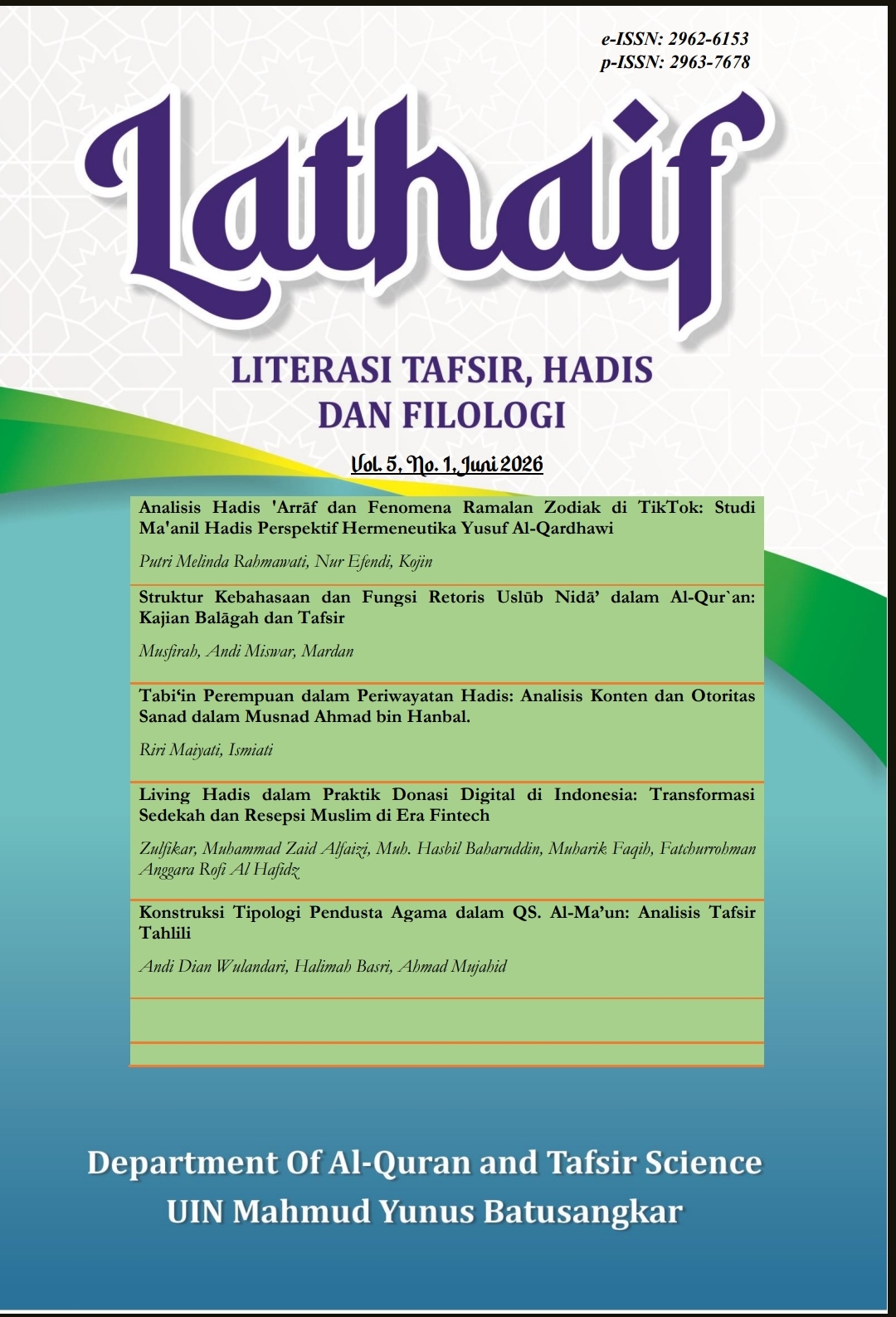
Konstruksi Tipologi Pendusta Agama dalam QS. Al-Ma’un: Analisis Tafsir Tahlili
DOI:
https://doi.org/10.31958/lathaif.v5i1.16945Kata Kunci:
Islamic Morals, Religious Hypocrite, Surah Al-Mā‘ūn, Tafsir TahliliAbstrak
The phenomenon of denying religion in surah Al-Mā‘ūn is generally understood as a form of deviant socio-religious behavior; however, it has not been systematically examined from an exegetical perspective. Therefore, this research aims to analyze the meaning of surah Al-Mā‘ūn/107:1–7 using a tahlili interpretation approach and to formulate a typology of religious hypocrites based on the indicators present in the verse. The study focuses on interpreting surah Al-Mā‘ūn/107:1–7 through an analytical lens to identify indicators of religious hypocrisy, which will then serve as the foundation for developing a typology. This research is conducted as library research using qualitative methods. Data analysis involved verse inventory, vocabulary analysis, and synthesis of interpretations from various commentators. The findings indicate that the concept of religious hypocrite in surah Al-Mā‘ūn is not solely tied to belief but also illustrates a disconnect between ritual piety and social responsibility. Consequently, three primary typologies of religious hypocrites were formulated: social, ritual, and moral typologies. The novelty of this research lies in constructing a typology of religious deceivers that is systematically organized through an analytical interpretation approach based on behavioral indicators found in surah Al-Mā‘ūn. This study contributes to the advancement of Quranic exegesis and is pertinent for enhancing moral education and socio-religious awareness.
Referensi
Al-Jauziyyah, I. Q. (2011). Cita Rasa Sholat. Nakhlah Pustaka.
Al-Razi, F. al-D. (n.d.). Tafsir Al-Kabir (31st ed.). Dar al-Kutub al-‘Ilmiyyah.
Al-Shawkani, M. ibn A. (n.d.). Fath al-Qadir al-Jami’ bayna Fannay al-Riwayah wa al-Dirayah min ‘Ilm al-Tafsir (5th ed.). Dar al-Fikr.
Al-Syekh, A. bin M. bin A. bin I. (2005). Lubaabut Tafsir min Ibnu Katsir, Terj. M. Abdul Ghoffar dan Abu Ihsan Al-Atsari (8th ed.). Pustaka Imam as-Syafi’i.
Al-Ṭabarī, A. J. M. ibn J. (2007). Jāmi‘ al-Bayān fī Ta’wīl al-Qur’ān (A. ‘Abd al-R. al-B. M. ‘Ādil M. M. ‘Abd al-L. K. M. M. ‘Abd Al-Ḥamīd, Ed.). Pustaka Azzam.
Al-Tabari, M. ibn J. (1972). Jami’ al-Bayan fi Tafsir al-Qur’an (28th ed.). Dar al-Ma’rifah.
Al-Zamakhshari, M. ibn U. (n.d.). Al-Kashshaf ‘an Haqa’iq al-Tanzil wa ‘Uyun al-Aqawil fi Wujuh al-Ta’wil (IV). Mustafa al-Babi al-Halabi.
Al Qurthubi, S. I. (2008). Tafsir Al-Qurthubi Juz ’Amma (20th ed.). Pustaka Azzam.
As-Suyūṭī, J. al-D. (2000). Lubāb al-Nuqūl fī Asbāb al-Nuzūl (1st ed.). Dār al-Taqwā.
Ash-Shabuni, M. A. (1339). Shafwah At-Tafasir. Dar Ash-Shabuni.
Astuti, R. W. (2009). Pendusta Agama Dalam Al-Qur’an (Studi atas Surat Al-Ma‘un). Universitas Islam Negeri Sunan Kalijaga.
Aṭ-Ṭabarī, A. J. M. ibn J. (2007). Tafsir Ath-Thabari Juz ’Amma. Pustaka Azzam.
Azizan, Z., Zein, A., & Budianti, Y. (2023). The Value of Spiritual and Social Education in Surah Al-Maun and Its Relevance to Learning the History of Islamic Culture. Yupa: Historical Studies Journal, 7(1), 1–16.
Faisal, G., & Ikaputra. (2022). Tipologi Permukiman di Indonesia: Penjejangan, Dikotomi, Konteks Sosial, dan Spasial. Langkau Betang: Jurnal Arsitektur, 9(2), 141–155. https://doi.org/10.26418/lantang.v9i2.51813
Jamaluddin, R., Rokim, S., & Bafadhol, I. (2023). Pendusta Agama Perspektif Mufassir Kajian Tafsir Tahlili Surat Al-Ma’un. Cendika Muda Islam Jurnal Ilmiah, 3(02). https://doi.org/https://doi.org/10.30868/cendikia.v3i02.4734
Katsir, I. I. (2019). Tafsir Juz ’Amma Ibnu Katsir (1st ed.). Insan Kamil.
Machmud, S. (2005). Mutiara Juz „Amma. Mizan.
Maisaroh, T., Mujrimin, B., & Supriadi. (2025). Menumbuhkan Jiwa Sosial Siswa Melalui Pemahaman Surah Al-Ma’un di Lembaga Pendidikan Islam. 5, 43–51.
Moneo, R. (1979). Oppositions Summer on Typology. Journal for Ideas and Criticism in Architecture, 13, 23–45.
Muhammad Abduh. (1999). Tafsir Juz ’Amma, terj. Muhammad Bagir. Mizan.
Munawwir, A. W. (1984). Kamus Al-Munawwir Arab-Indonesia. Pustaka Progresif.
Munir, M., Ayzzahro, A. L., Octaviani, L., & Anjarwati, M. (2026). Penguatan Karakter Peduli Sosial Berbasis Nilai-Nilai Islam Melalui Aktivitas Kepramukaan di Mi Fathul Huda Kalipakis. Al-Athfal STAI Muhammadiyah Probolinggo, 07(01).
Ritonga, M. T. (2022). Tafsir Surah Al-Ma ’ un. Al-Kaffah, 10(1), 55–68.
Sartika, D., Abubakar, A., & Irham, M. (2023). Pendusta Agama dalam QS. Al-Ma’un (Sebuah Kajian Tematik Surah). Pappasang: Jurnal Studi Al-Qur’an-Hadist Dan Pemikiran, 5(2).
Shihab, Q. (2005). Tafsir al-Mishbah; Pesan, Kesan dan Keserasian Al-Quran (15, Ed.). Lentera Hati.
Zuhaili, W. (n.d.). Tafsir Al-Munir: Akidah, Syariah dan Manhaj (15th ed.). Gema Insani.
##submission.downloads##
Diterbitkan
Terbitan
Bagian
Lisensi
Hak Cipta (c) 2026 Andi Dian Wulandari, Halimah Basri, Ahmad Mujahid

Artikel ini berlisensi Creative Commons Attribution-NonCommercial 4.0 International License.
Authors who publish with?áLathaif: Literasi Tafsir, Hadis dan Filologi?áagree to the following terms:
- Authors retain copyright and grant the journal right of first publication with the work simultaneously licensed under a?áCreative Commons Attribution-NonCommercial 4.0 International License?á(CC BY-NC 4.0) that allows others to share the work with an acknowledgment of the work's authorship and initial publication in this journal.
- Authors are able to enter into separate, additional contractual arrangements for the non-exclusive distribution of the journal's published version of the work (e.g., post it to an institutional repository or publish it in a book), with an acknowledgment of its initial publication in this journal.
- Authors are permitted and encouraged to post their work online (e.g., in institutional repositories or on their website) prior to and during the submission process, as it can lead to productive exchanges, as well as earlier and greater citation of published work (See?áThe Effect of Open Access).


