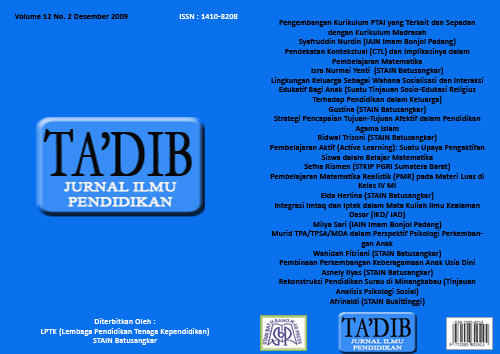
PEMBINAAN PERKEMBANGAN KEBERAGAMAAN ANAK USIA DINI
DOI:
https://doi.org/10.31958/jt.v12i2.168Abstract
Among potentials that children have as they were born, religious potential is one that needs to be developed in line with other potentials by means of education. Pre-school aged children refer to those who are between 0 and 6 years old. They are in their ultimate growing and developing period in intelligence, emotion, social, and language. Specifically, characteristics of religious awareness among children is reflected in the form of unreflective, egocentrical, antropomorphical, vebal, ritual and imitative. Introducing and familiarizing religious among children can be done by making use of their initial growth and developing through good model, stories, field trip to behold the great and glory of Allah, to get used to worship, good moral, help each other, and so on. It is believed that introducing religion in early ages will provide children with guidance and foundation in their life.
Kata Kunci: anak usia dini, pertumbuhan, perkembangan, keberagamaanReferences
Sujanto Agus. 1988. Psikologi Per-kembangan. Jakarta : Rineka Cipta
Desmita. 2005. Psikologi Perkembang-an. Bandung: Remaja Rosda Karya.
Elizabeth B. Hurlock, 1978. Per-kembangan Anak. Terjemahan oleh Meitasari Tjandrasa dan Muslichah Zarkasih. 2000. Jakarta: Erlangga
Elizabeth B. Hurlock, 1980. Psikologi Perkembangan; Suatu Pendekatan Sepanjang Rentang Kehidupan. Terjemahan oleh Istiwidayanti dan Soejarwo. 2003. Jakarta: Erlangga
F.J. Monks & A.M.P Knoers. 2004. Psikologi Perkembangan; Peng-antar dalam berbagai Bagiannya. Yogyakarta: Gajah Mada Univer-sity Press.
Rumini Sri, dan Siti Sundari. 2004. Perkembangan Anak dan Remaja. Jakarta: Rineka Cipta
Yusuf Syamsu. L.N. 2005. Psikologi Perkembangan Anak dan Remaja. Bandung: Remaja Rosda Karya
Downloads
Published
How to Cite
Issue
Section
License
Copyright (c) 2009 ASNELLY ILYAS

This work is licensed under a Creative Commons Attribution-NonCommercial-NoDerivatives 4.0 International License.
Authors who publish with this journal agree to the following terms:
- Authors retain copyright and grant the journal right of first publication with the work simultaneously licensed under a?áCreative Commons Attribution License?á(CC-BY-NC)?áthat allows others to share the work with an acknowledgement of the work's authorship and initial publication in this journal.
- Authors are able to enter into separate, additional contractual arrangements for the non-exclusive distribution of the journal's published version of the work (e.g., post it to an institutional repository or publish it in a book), with an acknowledgement of its initial publication in this journal.
- Authors are permitted and encouraged to post their work online (e.g., in institutional repositories or on their website) prior to and during the submission process, as it can lead to productive exchanges, as well as earlier and greater citation of published work.