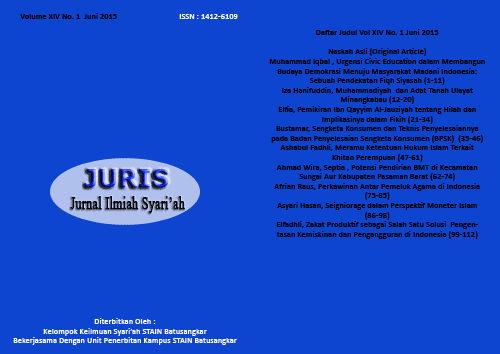
MERAMU KETENTUAN HUKUM ISLAM TERKAIT KHITAN PEREMPUAN
DOI:
https://doi.org/10.31958/juris.v14i1.296Abstract
Observing several academic documents that enrich the historical value, the discourse about circumcision apparently still presents interesting questions and ideas according to the conditions and social culture surrounding them. Cutting a small portion of the genitals on the implementation of circumcision is commonly done throughout the community on the child's age. The social values that legitimize female circumcision should be criticized because it may cause bad impact. Meanwhile, according to religious dogma, female circumcision is not a significant issue. Therefore, the practice of circumcision continues to be executed, but some of them lead to contradictory disagreement.
 
Kata kunci: khitan, perempuan, hukum IslamReferences
Al-Bukhari, Muhammad bin Ismail. t.th. Shahih al-Bukhari, Beirut: Dar al-Shu’ub.
Daud, Abu, t.th. Sunan Abu Daud, Indonesia: Maktabah Dahlan.
Donohue, John dan Esposito, John. t.th. Islam dan Pembaharuan Ensiklopedi Masalah-Masalah, judul asli Islam in Transition Muslim Perspektif, Jakarta: PT. Raja Grafindo Persada.
Majah, Ibn. t.th. Sunan Ibn Majah, Kairo: dar al-Hadis.
Iqbal, M. 1981. The Reconstruction of Religious Thought in Islam, New Delhi: Kitab Bhaven.
An-Naisaburi, Imam Abi al-Husen Muslim bin Hijaz. t.th. Shahih al-Muslim, Beirut: Dar al-Kutub al-Ilmiyah
Qal‘ahji, Muhammad Rawas. 1999. Mausu’ah Fiqhi Umar Ibn al-Khattab, terj. Muhammad Abdul Mujieb, Jakarta: PT. Raja Grafindo Persada,
Al-Jauziyyyah, Ibnu Qayyim, 1997. I’lām al-Muwaqqi’īn ‘an Rabb al-‘Ālamīn, Beirut: Dar al-Fikr, cet ke-2, juz 1
Downloads
Published
How to Cite
Issue
Section
License
Copyright (c) 2016 Juris

This work is licensed under a Creative Commons Attribution-NonCommercial-NoDerivatives 4.0 International License.
Authors who publish with this journal agree to the following terms:- Authors retain copyright and grant the journal right of first publication with the work simultaneously licensed under a Creative Commons Attribution License that allows others to share the work with an acknowledgement of the work's authorship and initial publication in this journal.
- Authors are able to enter into separate, additional contractual arrangements for the non-exclusive distribution of the journal's published version of the work (e.g., post it to an institutional repository or publish it in a book), with an acknowledgement of its initial publication in this journal.
- Authors are permitted and encouraged to post their work online (e.g., in institutional repositories or on their website) prior to and during the submission process, as it can lead to productive exchanges, as well as earlier and greater citation of published work (See The Effect of Open Access).