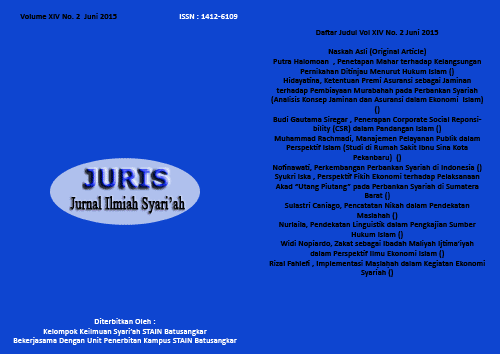
PENERAPAN CORPORATE SOCIAL RESPONSIBILITY (CSR) DALAMPANDANGAN ISLAM
DOI:
https://doi.org/10.31958/juris.v14i2.303Abstract
Corporate Social Responsibility (CSR) is basically the moral responsibility of companies and enterprises toward societies. The responsibility itself can be initiated by the company itself, employees, other companies, social environments, and even the State where the business is established. The concept of CSR can be seen from two different perspectives. First, it concerns with the companyÔÇÖs goal is for profit. Therefore, CSR is believed to be parts of business. Second, it deals with the purpose of a company is for profit while ensuring peopleÔÇÖs welfare and environmental sustainability become prior concerns. Islam strongly supports CSR since it cannot be denied that the businesses create a lot of unexpected social problems. Consequently, it is the companies and enterprisesÔÇÖ responsibility to fix those problems. This is reasonable since they need to explore a variety of natural resources for business sustainability, therefore, they should be responsible for the people and environment in return.
Kata kunci: implementasi, tanggung jawab sosial perusahaan, pandangan Islam
References
Abdul Karim Amrullah, Abdul Malik., 2003. ( HAMKA ),Tafsil Al-azhar Jilid 2, Singapura : Pustaka Nasional PTE LTD, Cet. Ke-5.
Agama Republik Indonesia, Departemen. t.t. Al Qur an dan Tafsirnya Jilid II, Semarang : Effhar Offset.
_____, 1989. al-Qur’an dan Terjemahnya, Semarang : CV Toha Putra, ,Cet. ke-4
Abdurrahman, Abdullah, bin, al Bassam, 2006. Syarah Bulughul Marom, Jakarta : Pustaka Azzam, Cet. ke-1, jilid 5.
Bakry, Hasbullah, 1985. Kumpulan Lengkap Undang-Undang dan Peraturan Perkawinan di Indonesia, Jakarta : Djambatan, Cet. ke-3.
Dalimunte, Marwan,Adat Dalihan Natolu, di unduh dari http:// sirajasonang. wordpress.com.
Dedi Rohayana, Ade, 2008. Ilmu Qowa’id Fiqhiyyah Kaidah-kaidah Hukum Islam, Jakarta : Gaya Media Pratama, cet. Ke-1.
Farid Muhammad Washil, Nashr, Abdul Aziz Muhammad Azzam, 2009. Qowa’id Fiqhiyyah, Jakarta : Amzah, Cet. Ke-2.
Ghazaly, Abd. Rahman, 2006. Fiqh Munakahat, Jakarta: Kencana, ed. 1, cet. Ke-1
Hajar, Ibnu, al’Asqolani, tt` Bulughul Marom min adallatil Ahkam, Jeddah : Alharomaini Liththoba’ati Wannasyri Wattauzi’i.
Ibnu Taimiyah, Taqiyuddin, Imam al’ Alamah, Penerjemah Rusnan Yahya, 1997. Hukum-hukum Perkawinan, Jakarta : Pustaka Al-Kautsar, Cet. Ke-1
Jawad Mughniyah, Muhammad, 2001. Fiqih Lima Mazhab, Jakarta : PT. Lentara.
Mas’ud, Ibnu, 2000. Fiqih Madzhab Syafi’i, Bandung : CV. Pustaka Setia, Cet. ke-1, jilid 2.
Mubarok, Jaih, 2002. Kaidah Fiqh Sejarah dan Kaidah Asasi, Jakarta : Raja Grafindi Persada, ed. 1, Cet. Ke-1.
Mu’in, A, dkk, 1986. Ushul Fiqh Qaidah-qaidah Istinbath dan Ijtihad ( Jakarta : Dirjen. Pembinaan Kelembagaan Agama Islam Departemen Agama.
Nasib ar-Rifa’i, 1999. Muhammad, Ringkasan Tafsir Ibnu Katsir, Jakarta : Gema Insani, Cet ke-1, Jilid 1.
Nelli Jumni, M. Ag, 2008. Fiqh Munakahat, Pekanbaru : Suska Press.
Sayyid Quthb, Syahid, Penerjemah : As’ad Yasin, Abdul Aziz Salim Basyarahil dan Muchotob Hasan, 2001. Tafsir Fi Zhilalil Qur an,( Jakarta : Gema Insani Press, Cet.Ke- 1
Downloads
Published
How to Cite
Issue
Section
License
Copyright (c) 2016 Budi Gautama Siregar

This work is licensed under a Creative Commons Attribution-NonCommercial-NoDerivatives 4.0 International License.
Authors who publish with this journal agree to the following terms:- Authors retain copyright and grant the journal right of first publication with the work simultaneously licensed under a Creative Commons Attribution License that allows others to share the work with an acknowledgement of the work's authorship and initial publication in this journal.
- Authors are able to enter into separate, additional contractual arrangements for the non-exclusive distribution of the journal's published version of the work (e.g., post it to an institutional repository or publish it in a book), with an acknowledgement of its initial publication in this journal.
- Authors are permitted and encouraged to post their work online (e.g., in institutional repositories or on their website) prior to and during the submission process, as it can lead to productive exchanges, as well as earlier and greater citation of published work (See The Effect of Open Access).