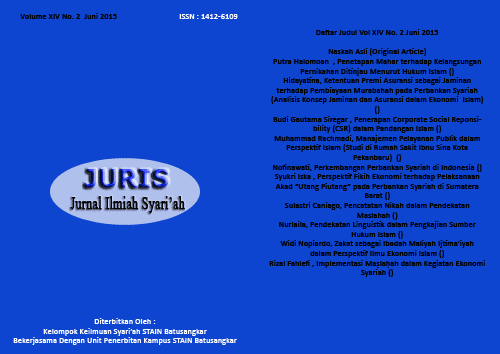
PERKEMBANGAN PERBANKAN SYARIAH DI INDONESIA
DOI:
https://doi.org/10.31958/juris.v14i2.305Abstract
Sharia banking in Indonesia has approached 24 years of age. This age implies that it such sharia banking has shifted to maturity phase. It has developed significantly compared to that of previous years. It can be observed from its average growth of its assets, DPK, PYD which is 45% higher than the years of 2000 up to 2014. However, it is expected that it must able to make use of opportunities which are presently available to encounter challenges in the future, Consequently, it should be able to take advantage of supports and contributions of other such related parties as government, ulama, society, academicians, and students majoring in sharia banking as well.
Kata kunci: development, sharia banking, Indonesia
References
Dwijayanti, Erny, 2013, Pengaruh Pengungkapan Tanggung Jawab Sosial terhadap Earning Response Coefficient (ERC), Malang
Widagya dan Triani, 2014, Peranan PSAK No. 33 Pada Perusahaan di Indonesia
Pradipta, D.H. dan Purwaningsih, A. 2012. Pengaruh Luas Pengungkapan Tanggung Jawab Sosial dan Lingkungan Perusahaan Terhadap Earning Response Coefficient (ERC), dengan Ukuran Perusahaan Dan Leverage Sebagai Variabel Kontrol. Simposium Nasional Akuntansi XV. Banjarmasin
Siswoyo, B.B. et. al. 2009. Penyusunan Strategi Kebijakan Efektivitas Pemanfaatan Corporate Social Responsibility (CSR).Kerjasama Bappeda Provinsi Jawa Timur dan Lembaga Penelitian Universitas Negeri Malang
Kalangit, KM. 2009. Konsep Corporate Social Responsibility, Pengaturan dan Pelaksanaannya di Indonesia
K. Bertens, Pengantar Etika Bisnis, Bandung: PT Refika Aditama
Ismail Sholihin, Pengantar Bisnis : Pengenalan Praktis dan Studi Kasus, Jakarta Kencana, 2006
Burhanudin Salam, Etika Sosial (Asas Moral dalam Kehidupan Manusia), Jakarta, Rineka Cipta, 2002
Rafik Isa, Etika Bisnis Islami,Yogyakarta:Pustaka Pelajar,2004
Downloads
Published
How to Cite
Issue
Section
License
Copyright (c) 2016 Nofinawati Nofinawati

This work is licensed under a Creative Commons Attribution-NonCommercial-NoDerivatives 4.0 International License.
Authors who publish with this journal agree to the following terms:- Authors retain copyright and grant the journal right of first publication with the work simultaneously licensed under a Creative Commons Attribution License that allows others to share the work with an acknowledgement of the work's authorship and initial publication in this journal.
- Authors are able to enter into separate, additional contractual arrangements for the non-exclusive distribution of the journal's published version of the work (e.g., post it to an institutional repository or publish it in a book), with an acknowledgement of its initial publication in this journal.
- Authors are permitted and encouraged to post their work online (e.g., in institutional repositories or on their website) prior to and during the submission process, as it can lead to productive exchanges, as well as earlier and greater citation of published work (See The Effect of Open Access).