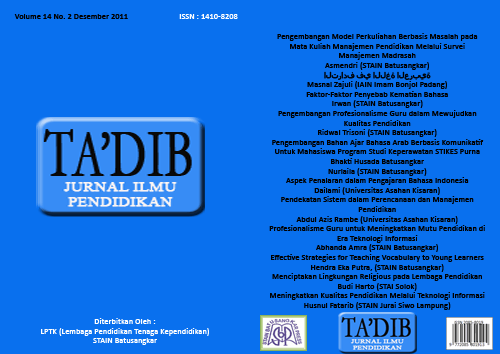
PENGEMBANGAN PROFESIONALISME GURU DALAM MEWUJUDKAN KUALITAS PENDIDIKAN
DOI:
https://doi.org/10.31958/jt.v14i2.205Abstract
Teacher plays strategic roles in realizing qualified human resources. Any attempts made in improving human resources quality without involving teacher will end in difficulties since the teacher is the key persons in determining the quality of education. Consequently, teachers are expected to have professionalism by mastering such competencies as pedagogic, professional, social and personal. To ensure the mastery of those competencies, various programs need to carry out. Among the programs are: teacherÔÇÖs professional improvement must be started from teacherÔÇÖs training institution (LPTK), by sending teachers higher level, in-service training, and educational supervision.
Kata kunci: profesionalisme, guru, kualitasReferences
Baepler, Paul. (2003). "White slaves, African masters". The ANNALS of the American Academy of Political and Social Science. Cambridge: Cambridge University Press.
Barzilai, Gad. (2003). Communities and Law: Politics and Cultures of Legahkjkjl Identities. University of Michigan Press.
Bloomfield, Leonard (1974). revised edition. An introduction to the study of language. New York: Henry Holt and Company.
British Library. (1999). Endanger: Save the World. Birmingham. Christian Church Company.
Crystal, David (1997). The Cambridge Encyclopedia of Language. Cambridge: Cambridge University Press.
Crystal, David (2001). The Cambridge Encyclopedia of the English Language. Cambridge: Cambridge University Press.
Deddy Mulyana dan Jalaluddin Rakhmat. Komunikasi Antar budaya: Panduan Berkomunikasi dengan Orang-Orang Berbeda Budaya. 2006. Bandung: Remaja Rosdakarya.
Departemen Pendidikan dan Kebu-dayaan. (1999). Kamus Besar Bahasa Indonesia. Jakarta, Balai Pustaka.
Eugene, Joan. C. (2008). Language Dissappear. Journal of Language. Hongkong.
Freedman. A. (2003). Language Death. Language Research Project. Ontario: Ride Publishing.
Gleitman, Lila (1993) "A human universal: the capacity to learn a language." Modern Philology. New York: Longman.
Harimurti Kridalaksana (2008). Kamus Linguistik (edisi keempat). Jakarta: Gramedia Pustaka Utama.
Haroold. K.J. 1978. World War. Madison. Scotland F.A
Hasyim. A.B. 1998. Bahasa-Bahasa Nusantara. Solo. Dana Mitra
Katzner, K (1999). The Languages of the World. New York: Routledge.
Niedzielski, Nancy & Dennis Preston (2000). Folk Linguistics. Berlin: Mouton de Gruyter.
Poedjosoedarmo, S. (2001). Filsafat Bahasa. Muhammadiyah University Press. Surakarta.
Rogers. T.S. (1990). Who Can Live? Essex. Roulede Printing.
UNESCO. http/www.unesco.org. retrived on march 2011.
Wardaugh, Ronald. (1983). An Introduction to Sociolinguistics. New York. McGrawHill Company.
Downloads
Published
How to Cite
Issue
Section
License
Copyright (c) 2016 RIDWAL TRISONI

This work is licensed under a Creative Commons Attribution-NonCommercial-NoDerivatives 4.0 International License.
Authors who publish with this journal agree to the following terms:
- Authors retain copyright and grant the journal right of first publication with the work simultaneously licensed under a?áCreative Commons Attribution License?á(CC-BY-NC)?áthat allows others to share the work with an acknowledgement of the work's authorship and initial publication in this journal.
- Authors are able to enter into separate, additional contractual arrangements for the non-exclusive distribution of the journal's published version of the work (e.g., post it to an institutional repository or publish it in a book), with an acknowledgement of its initial publication in this journal.
- Authors are permitted and encouraged to post their work online (e.g., in institutional repositories or on their website) prior to and during the submission process, as it can lead to productive exchanges, as well as earlier and greater citation of published work.