
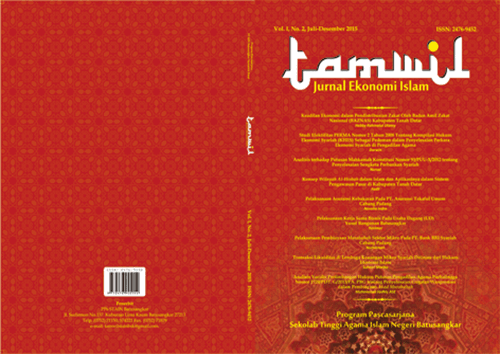
STUDI EFEKTIFITAS PERMA NOMOR 2 TAHUN 2008 TENTANG KOMPILASI HUKUM EKONOMI SYARIAH (KHES) SEBAGAI PEDOMAN DALAM PENYELESAIAN PERKARA EKONOMI SYARIAH DI PENGADILAN AGAMA
DOI:
https://doi.org/10.31958/jtm.v1i2.325Abstract
This study was focused on the Rules of Supreme Courts (PERMA) Number 2/2008 about the Compilation of Islamic Economy Laws (KHES). The sudy was classified into qualitative approach. The finding revealed that PERMA Number 2/2008 about KHES was run effectively in religious court since September 10th, 2008.
Keywords: PERMA Number 2/2008, KHES, Religious Justice Court, Syariah EconomyReferences
Abdur Rahman an-Nahlawi, Ushulut Tarbiyah Al-Islamiyah fil Baiti Wal Madrasah Wal Mujtama, Terj: Shihabuddin (Jakarta : Gema Insani, 1995
A. Mukti ali, Beberapa Persoalan Agama Dewasa Ini, (Jakarta: Rajawali Press, 1987)
Al-Gazali, al-Munkiz min al-Dahal, Beirut: Dar al-Andalus, 1967
Anaroga, Pandji, dan Sri Suyati . Psikologi kerja. Jakarta: Rineka cipta,1998
Bukhori Mokhtar, Pendidikan Dalam Pembangunan, (Yogya Karta: Tiara
Wacana, 1994)
Imran, Ali . Pembinaan guru di Indonesia, hal. 215
Nurcholis Majid, Islam Agama Kemanusiaan, ( Jakarta: Pramadina, 1995)
Downloads
Published
How to Cite
Issue
Section
License
Copyright (c) 2016 Darwin Darwin

This work is licensed under a Creative Commons Attribution-NonCommercial-NoDerivatives 4.0 International License.
- Authors retain copyright and grant the journal right of first publication, with the work [SPECIFY PERIOD OF TIME] after publication simultaneously licensed under a Creative Commons Attribution License that allows others to share the work with an acknowledgement of the work's authorship and initial publication in this journal.
- Authors are able to enter into separate, additional contractual arrangements for the non-exclusive distribution of the journal's published version of the work (e.g., post it to an institutional repository or publish it in a book), with an acknowledgement of its initial publication in this journal.
- Authors are permitted and encouraged to post their work online (e.g., in institutional repositories or on their website) prior to and during the submission process, as it can lead to productive exchanges, as well as earlier and greater citation of published work (See The Effect of Open Access).

This work is licensed under a Creative Commons Attribution-NoDerivatives 4.0 International License.


