- CERTIFICATE AND ACCREDITATION
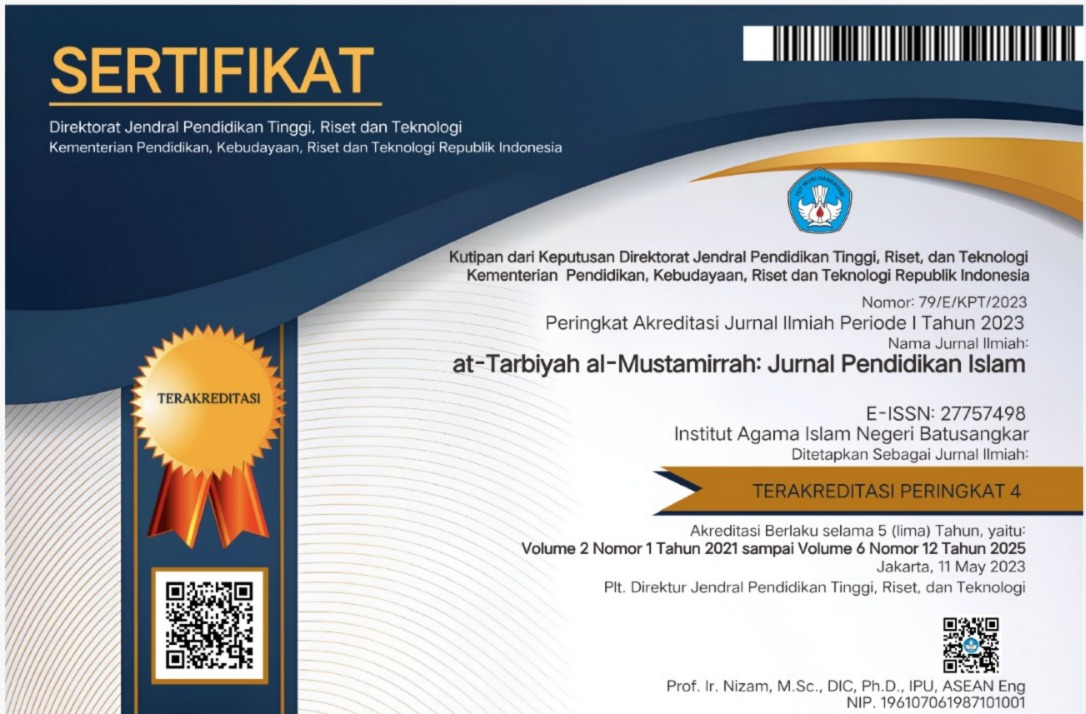

At-Tarbiyah al-Mustamirrah: Jurnal Pendidikan Islam invites scholars and experts working in all disciplines related to Islamic education.
Submitted articles must be original, research-based, unpublished, and not under review for publication in other journals.
Manuscripts should be prepared in MS Word format using Times New Roman, font size 12 pt, 1.5 spacing, A4 paper size, with a length of approximately 4,000–6,000 words. All manuscripts must be submitted through the journal website:
http://ecampus.iainbatusangkar.ac.id/ojs/index.php/at-tarbiyah
Articles may be written in Indonesian, English, or Arabic. The title of the article should not exceed 16 words. The title, author(s) name(s), email address, and institutional affiliation must appear at the top of the manuscript.
All submissions must include an abstract of 150–250 words and 3–5 keywords. The abstract of a research article should clearly state the title, purpose, method, and main findings.
Quotations, passages, and terms written in local or foreign languages must be translated into English.
Full research papers should have broad relevance and contribute new insights to the field of education. The manuscript should consist of the following sections:
Journal Article:
Khojir, K. (2020). Moderasi Pendidikan Pesantren di Kalimantan Timur. Ta’dib, 23(1), 95–106.
Book (Single Author):
Azra, A. (2004). The Origins of Islamic Reformism in Southeast Asia: Networks of Malay-Indonesian and Middle Eastern ‘Ulamā in the Seventeenth and Eighteenth Centuries. Crows’ Nest, NSW: Allen & Unwin.
Book (Two Authors):
Djamarah, S. B., & Zain, A. (2003). Strategi Belajar Mengajar. Jakarta: Rineka Cipta.
Book (Three Authors):
Springer, D. R., Regens, J. L., & Edger, D. N. (2009). Islamic Radicalism and Global Jihad. Washington, D.C.: Georgetown University Press.
Book (Edition):
Pohan, R. (2014). Toleransi Inklusif: Menapak Jejak Sejarah Kebebasan Beragama dalam Piagam Madinah (1st ed.). Yogyakarta: Kaukaba.
Chapter in Edited Book:
Madan, T. N. (2005). Religions of India: Plurality and Pluralism. In J. Malik & H. Reifeld (Eds.), Religious Pluralism in South Asia and Europe. New Delhi: Oxford University Press.
Translated Book:
Daniel, W. W. (1980). Statistika Nonparametrik Terapan (Translated by Tri Kuntjoro). Jakarta: Gramedia.
Online Sources:
Kumar, N., & Rose, R. C. (2010). Examining the link between Islamic work ethic and innovation capability. Journal of Management Development, 29(1), 79–93. https://doi.org/10.1108/02621711011009081
Rafiki, A., & Wahab, K. A. (2014). Islamic values and principles in the organization: A review of literature. Asian Social Science, 10(9), 1–7. Retrieved from http://www.ccsenet.org/journal/index.php/ass/article/view/35858
Tapscott, D. (2009). Grown Up Digital: How the Net Generation Is Changing Your World. New York: McGraw-Hill. Retrieved from http://www.books24x7.com/marc.asp?bookid=14311
Conference Paper:
Albantani, A. M., & Madkur, A. (2016, October). Integrating character education values in language teaching. Paper presented at the 4th ELITE International Conference, Faculty of Education, UIN Syarif Hidayatullah Jakarta.
Proceedings:
Marazi, H. (2015). Empowering education with values and integration of religion and science: Madrasah al-Zahra Model. Proceedings of the International Conference on Empowering Islamic Civilization in the 21st Century, 51–77.
Unpublished Thesis/Dissertation:
Rahmat, M. (2010). Implikasi Konsep Insan Kamil dalam Pendidikan Umum di Pondok Sufi Pomosda. Unpublished doctoral dissertation, Universitas Pendidikan Indonesia.
Note: Authors are encouraged to use reference management software, such as Mendeley.





