
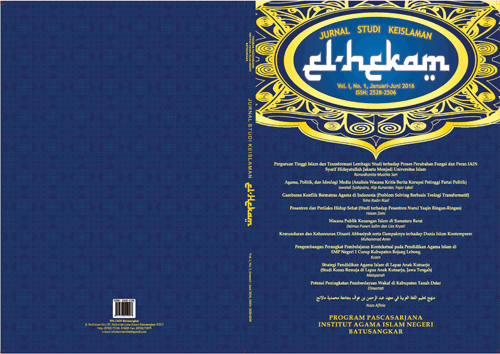
POTENSI PENINGKATAN PEMBERDAYAAN WAKAF DI KABUPATEN TANAH DATAR
DOI:
https://doi.org/10.31958/jeh.v1i1.343Abstract
The study analyzes the potential, opportunities, human resources and challenges in improving wakaf empowerment in Tanah Datar. The method that used in this research is a field research. To collect data that needed in this study is by interviews and documentation. Data was analyzed by descriptive qualitative. Result of this study is expected to produce guidelines or rule for the conduct of wakaf and can be used as a foothold in making policies. Base on data, potential of wakaf in in Tanah Datar about 639 locations already have wakaf certificate (AIW). A religious community of Tanah Datar people could be more efective to improve wakaf empowerment by using the rule that stated by government to manage of wakaf in Tanah Datar. And this rule also To avoid any mistake or human error in mangement to empower of wakaf.
Keywords: Wakaf, Potential, Empowerment.
References
Abdullah, Taufik. 1971. Schools and politics: The Kaum Muda movement in West Sumatra, (1927–1933). Ithaca, NY: Cornell Modern Indonesia Project, Cornell University.
_______. 1972. Modernisation in the Minangkabau World: West Sumatra in the early decades of the twentieth century. InCulture and politics in Indonesia, ed. Claire Holt, 179–243. Ithaca: Cornell University Press.
Antonio, M. S. (2008) ‘Islamic Microfinance Initiatives to Enhance Small and Medium Sized Enterprises’, in Fealy, G. and White, S. (eds) Expressing Islam Religious Life and Politics in Indonesia, Singapore: ISEAS.
Ariff, M. (1988) ‘Resource Mobilization Through the Islamic Voluntary Sector in Southeast Asia’, in Ariff, M. (ed.) The Islamic Voluntary Sector in Southeast Asia, Singapore: ISEAS.
Billah, M.M. (2007) ‘Islamic Banking and the Growth of Takaful’, in Lewis, M.K. and Hassan, M.K. (eds) Handbook of Islamic Banking, Massachusetts: Edward Elgar Publishing Limited.
Dobbin, Christine. 1983.Islamic revivalism in a changing peasant economy: Central Sumatra, 1784–1847. London: Curzon Press.
Fairclough, N. (1989) Language and Power, London: Longman.
—— (1995). Critical Discourse Analysis: the Critical Study of Language. London; New York: Longman.
Hefner, Robert W. 1996. Islamizing capitalism: on the founding of Indonesia’s first islamic banking. In Toward a new paradigm: recent development in Indonesian islamic thought, ed. Wooodward. Arizona: Arizona State University.
Juoro, U. (2008) ‘The Development of Islamic Banking in the Post-crisis Indonesian Economy’, in Fealy, G. and White, S. (eds) Expressing Islam Religious Life and Politics in Indonesia, Singapore: ISEAS.
Kuran, T. (1995) ‘Islamic Economics and the Islamic Subeconomy’, The Journal of Economic Perspectives 9 (4): 155-173. __(1997) ‘The Genesis of Islamic Economics: A Chapter in the Politics of Muslim Identity’, Social Research 64 (2): 301-339.
Lubis, N.A.F. (2004) ‘Financial Activism among Indonesian Muslims’, in
Hooker, V. and Saikal, A. (eds) Islamic
Perspectives on the New Millenium, Singapore: ISEAS.
Saeed, A. (1999) ‘Indonesian Islamic Banking in Historical and Legal Context’, in Lindsey, T. (ed.) Indonesia Law and Society, Leichhardt, NSW: Federation Press.
Verdasco, A.M. (2006) Islamic Banking and Finance in South-East Asia: Its Development and Future, Singapore:
World Scientific Publishing.
Downloads
Published
How to Cite
Issue
Section
License
Copyright (c) 2016 ELIMARTATI ELIMARTATI

This work is licensed under a Creative Commons Attribution-NonCommercial-NoDerivatives 4.0 International License.
Authors who publish with this journal agree to the following terms:?á
- Authors retain copyright and grant the journal right of first publication with the work simultaneously licensed under a Creative Commons Attribution License that allows others to share the work with an acknowledgement of the work's authorship and initial publication in this journal.
- Authors are able to enter into separate, additional contractual arrangements for the non-exclusive distribution of the journal's published version of the work (e.g., post it to an institutional repository or publish it in a book), with an acknowledgement of its initial publication in this journal.
- Authors are permitted and encouraged to post their work online (e.g., in institutional repositories or on their website) prior to and during the submission process, as it can lead to productive exchanges, as well as earlier and greater citation of published work.